.svg)
.svg)
.svg)
Two-Layer Subsidiary Rule Under FEMA — What Indian Companies Must Report in APR for Step-Down Structures
APR for step-down subsidiaries under FEMA ODI: know the two-layer rule, reporting duties, APR filing, and common compliance gaps.

Accorp Compliance Team
Our team of compliance experts specializes in PCI DSS, SOC 2, and other security frameworks to help businesses achieve and maintain compliance.
An Indian company sets up a wholly owned subsidiary in Singapore. That subsidiary later incorporated its own subsidiary in the UAE. That UAE entity then wants to set up one more layer underneath it. Somewhere in that chain, FEMA's overseas investment rules start asking harder questions — and most Indian companies only discover where the line sits after they've already crossed it.
Step-down subsidiaries — a foreign entity's own subsidiaries, sitting one or more levels beneath the Indian party's direct overseas investment — are common in genuinely global business structures, and entirely legitimate for the vast majority of them. But India's Overseas Investment (OI) Rules, 2022 impose a structural constraint on how many layers deep this can go under the automatic route, and separately, impose a reporting obligation that catches a surprising number of otherwise compliant companies off guard: every step-down subsidiary in the chain has to show up correctly in the Annual Performance Report, not just the first-level foreign entity the Indian company directly invested in.
This article works through both halves of that problem — the layering restriction itself, and the APR audit mechanics that follow from it.
Why FEMA Cares About How Many Layers Deep a Structure Goes
The layering restriction exists for a specific reason: round-tripping. Historically, before this was addressed more directly, some Indian entities used multi-layer overseas structures — a foreign entity that itself held a step-down subsidiary, which held another step-down subsidiary, and so on — partly to create distance between the original Indian investment and eventual returns flowing back into India in ways that were harder to trace and regulate. The RBI's foreign investment reporting framework has tightened around this over successive rounds of regulation, precisely because the more layers a structure has, the harder it becomes for regulators — and often for the Indian company's own compliance team — to maintain a clear line of sight into what's actually happening at the bottom of the chain.
Under the current OI Rules, 2022, Indian entities are restricted from structuring outbound investment in a way that results in more than two layers of foreign subsidiaries. This is a meaningful tightening compared to the pre-2022 framework, and it's the piece of FEMA compliance that trips up companies expanding through multiple markets without realising each additional layer of foreign incorporation is being counted against a specific structural limit, not just tracked for informational purposes.
How Step-Down Subsidiary Levels Are Actually Counted
This is where a lot of the confusion in practice comes from, and it's worth being precise about it. Under the reporting framework — specifically the level classification used in Form FC and carried through into APR reporting — the level of a step-down subsidiary (SDS) is calculated by treating the foreign entity (FE), the entity the Indian party directly invested in, as the parent for counting purposes. A subsidiary sitting directly beneath that foreign entity is classified as the first-level SDS. A subsidiary beneath that first-level SDS is the second-level SDS, and so on down the chain.
This layered counting matters because ODI compliance obligations attach separately to each level. A step-down subsidiary doesn't require a fresh act of RBI approval simply to exist under the automatic route in most ordinary cases — but it absolutely must be disclosed as part of the Indian party's ongoing FEMA compliance, and treating a step-down subsidiary as somehow outside the reporting perimeter because "the Indian company never directly invested in it" is one of the more common and consequential misunderstandings in this area.
Where APR Reporting for Step-Down Structures Actually Goes Wrong
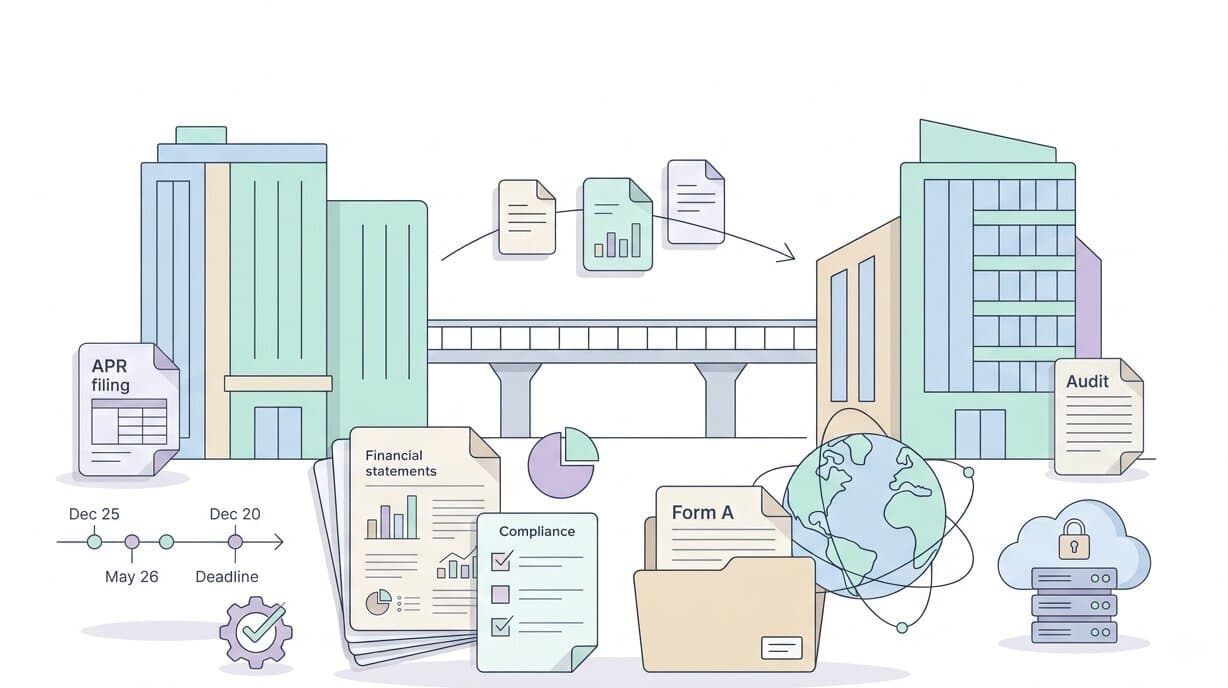
The single most frequent compliance gap here isn't the layering restriction itself — it's the APR filing India obligation that follows once a structure includes step-down subsidiaries. Every step-down subsidiary within an Indian party's overseas structure needs to be captured and disclosed within the APR, alongside the first-level foreign entity. An APR that reports the Indian company's direct foreign entity in full detail, but is silent on a step-down subsidiary sitting beneath it, is generally treated by the RBI and the reporting AD bank as an incomplete filing — not a partial one that simply needs a supplementary note, but a filing that hasn't actually satisfied the underlying ODI compliance obligation for that reporting year.
This creates a genuinely practical problem, because getting complete financial information on a step-down subsidiary is often harder than getting it on the first-level foreign entity. The Indian party has direct visibility into the entity it invested in; a step-down subsidiary two levels removed is often managed entirely by local finance teams in a jurisdiction the Indian company has no direct presence in, using an accounting cycle and audit timeline set by local requirements rather than India's own.
A Realistic Example
Consider an Indian software company that set up a wholly owned subsidiary in the UK three years ago. Last year, that UK entity — pursuing its own regional strategy — incorporated a small first-level step-down subsidiary in the US to handle North American sales. This year, the Indian parent is preparing its APR audit and correctly reports the UK entity's financials, sourced through the UK entity's own auditor. But the US step-down subsidiary's financials, which sit with a separate US CPA engaged directly by the UK entity rather than the Indian parent, don't make it into the same reporting cycle, simply because nobody on the Indian side thought to specifically request them as part of the APR preparation process.
This is precisely the kind of gap that later surfaces as an incomplete APR filing — not because the Indian company was careless about its FEMA compliance generally, but because the reporting obligation for a step-down subsidiary is easy to overlook when the entity in question was never something the Indian company directly set up or funded.
Coordinating With Advisors Across the Structure
For Indian companies with multi-jurisdiction step-down structures, the practical fix is establishing a direct information channel to whichever local advisor manages each entity in the chain, not just the top-level foreign entity. Where a step-down subsidiary sits in the UK, this means the Indian company's compliance team, or its own FEMA advisor, needs a working relationship with the UK auditor for APR filing purposes specifically — not to redo the UK entity's own local statutory audit, but to obtain the specific certified figures the APR needs for that layer of the structure. Where the step-down subsidiary sits in the US, the equivalent relationship needs to exist with the US CPA for APR filing purposes, again requesting the relevant financial summary on a timeline that aligns with India's December 31 deadline rather than the US entity's own separate reporting cycle.
Without this coordination built in deliberately, the default outcome is that step-down subsidiary data simply doesn't make it into the APR on time, because no single party in the structure has an inherent incentive to prioritise India's specific reporting calendar over their own.
Common Mistakes With Layered Structures
Assuming a step-down subsidiary doesn't need separate ODI compliance attention because the Indian party never directly invested in it. The obligation flows from the overall structure, not from direct investment alone.
Losing track of which level a subsidiary sits at as a structure grows. A structure that starts simple — one foreign entity, one step-down subsidiary — can drift toward a third layer over time as the foreign entity or its step-down subsidiary independently pursues further expansion, without the Indian parent explicitly deciding to cross the two-layer threshold.
Treating the APR as complete once the top-level foreign entity's financials are filed. As covered above, this is the most common and most consequential gap, and one that often isn't caught until a subsequent RBI query or a future ODI transaction is blocked pending resolution of the earlier incomplete filing.
Not establishing local advisor relationships at each level of the structure early. Waiting until the APR deadline approaches to figure out who has the financial data for a step-down subsidiary consistently produces late or incomplete filings.
The Bottom Line
The two-layer restriction under India's overseas investment framework, and the APR reporting obligation that follows for every layer of a structure, are two sides of the same underlying regulatory concern: keeping outbound investment structures traceable and transparent, rather than allowing complexity to accumulate faster than compliance can keep pace with it. For Indian companies with genuinely global operations, the practical answer isn't necessarily to avoid step-down structures altogether — they're often a legitimate and sometimes necessary way to organise multi-market operations — but to treat every additional layer as a compliance commitment in its own right, with its own advisor relationship, its own data-collection timeline, and its own place in the APR, well before the December deadline arrives.
Learn more- https://accorppartners.com/services/cpa-services/apr