.svg)
.svg)
.svg)
AD Bank Rejected Your APR Audit? Common Reasons and How to Fix Them
Avoid APR audit rejection in India. Learn common audit issues, foreign subsidiary audit compliance errors, and how expert support ensures smooth ODI compliance.

Accorp Compliance Team
Our team of compliance experts specializes in PCI DSS, SOC 2, and other security frameworks to help businesses achieve and maintain compliance.
You’ve completed your overseas financial reporting, coordinated with your auditors, and submitted your compliance documents — only to find that your APR audit has been rejected by the AD Bank. This is a common issue faced by Indian companies managing overseas investments.
Authorised Dealer (AD) Banks carefully review the APR audit documents before accepting them in accordance with RBI and FEMA regulations. If there are inconsistencies, missing documents, or audit-related concerns, the submission may be returned for correction.
The good news is that most APR audit rejections are preventable. By understanding the common mistakes and strengthening your overseas subsidiary audit process, you can significantly improve compliance accuracy and reduce delays.
In this guide, we explain why APR audit submissions get rejected and how businesses can fix these issues effectively.
Why AD Banks Closely Review APR Audit Documents
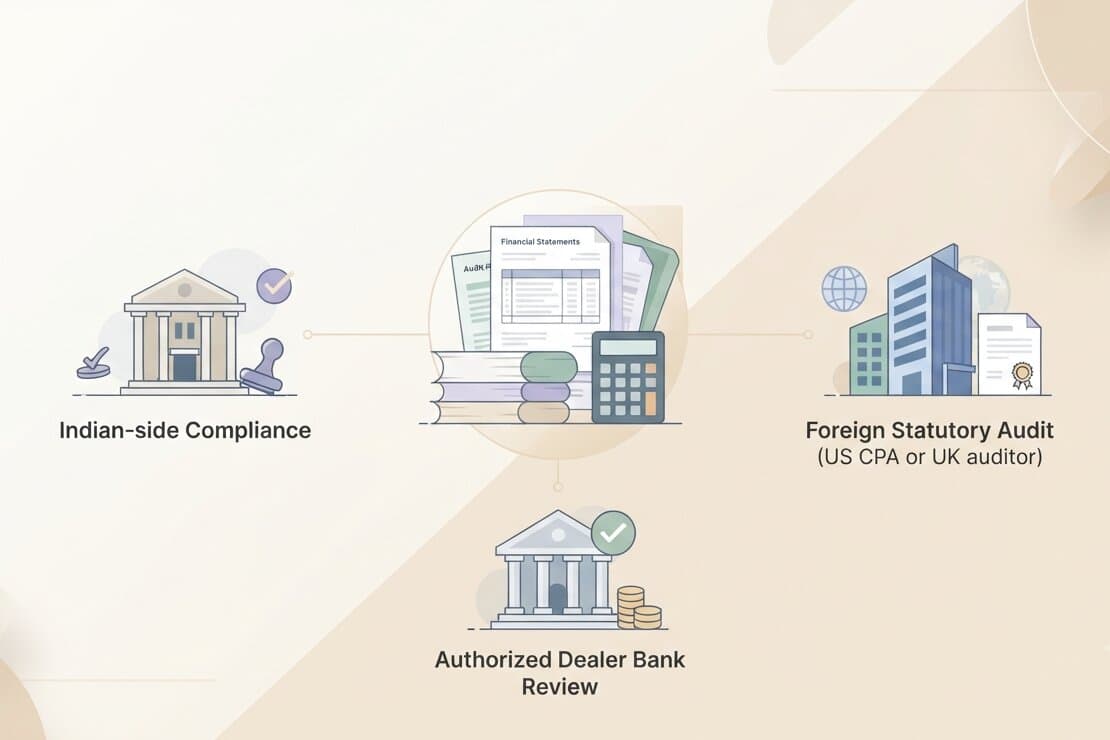
AD Banks act as the first compliance checkpoint for overseas investment reporting.
What AD Banks Typically Review
Accuracy of overseas financial statements
Consistency with ODI compliance records
Auditor certification validity
Completeness of supporting documents
Alignment with RBI reporting requirements
Their objective is to ensure strong foreign subsidiary audit compliance before forwarding records for regulatory review.
Common Reasons Why APR Audit Gets Rejected
1. Incorrect or Incomplete Financial Information
One of the biggest reasons for APR audit rejection is inaccurate financial reporting.
Common Problems
Mismatch between audited statements and compliance records
Missing balance sheet or profit & loss statements
Incorrect investment or net worth reporting
Inconsistent financial disclosures
How to Fix It
Conduct a proper overseas subsidiary audit before submission and carefully verify all financial information.
2. Missing or Invalid Auditor Certification
APR audit heavily depends on valid audit certification.
Common Mistakes
Missing foreign auditor certification
No Indian CA verification
Using an unqualified overseas auditor
Incomplete audit signatures or credentials
Correct Approach
Work with properly recognized professionals such as:
A US CPA for APR filing for US-based entities
A UK auditor for APR filing for UK subsidiaries
Certified local auditors for other jurisdictions
This strengthens foreign subsidiary audit compliance and improves acceptance by AD Banks.
3. ODI Compliance Mismatches
APR audit details must perfectly align with ODI compliance records.
Frequent Errors
Wrong ODI registration number
Incorrect shareholding percentages
Mismatch in investment amounts
Missing updates on capital restructuring
Solution
Cross-check all ODI-related records before finalizing the APR audit.
4. Incomplete Supporting Documentation
Missing documents can immediately trigger rejection.
Commonly Missing Documents
Audited financial statements
Auditor certificates
Investment proof
Remittance records
ODI approval details
How to Avoid This
Use a structured compliance checklist before submitting your APR audit package.
5. Delayed Submission and Last-Minute Preparation
Late submissions often receive stricter scrutiny from banks.
Key Deadline
December 31 every year
Risks of Delay
Higher chances of rejection
Increased compliance queries
FEMA penalties
Delays in future overseas approvals
Early preparation improves APR audit quality and reduces compliance pressure.
6. Failure to Meet Local Audit Requirements
Every country has its own audit standards and certification expectations.
Examples
US entities generally require a US CPA for APR filing
UK entities require a UK auditor for APR filing
Other countries require locally licensed audit professionals
Ignoring local audit requirements weakens overseas subsidiary audit credibility.
7. Errors in APR Audit Forms and Reporting
Even small reporting mistakes can result in rejection.
Common Issues
Incorrect entity information
Missing mandatory fields
Inconsistent reporting formats
Incorrect currency conversions
Solution
Perform detailed reviews before submission to ensure consistency and accuracy.
8. Weak Coordination Between Stakeholders
APR audit involves multiple teams across countries.
Parties Usually Involved
Internal finance team
Overseas auditor
Indian Chartered Accountant
Compliance consultants
AD Bank officials
Common Coordination Problems
Delayed communication
Conflicting financial data
Last-minute changes
Lack of responsibility ownership
Strong communication is essential for smooth foreign subsidiary audit compliance.
Step-by-Step Process to Fix a Rejected APR Audit
Step 1: Understand the Bank’s Feedback
Carefully review all observations and identify the exact reasons for rejection.
Step 2: Correct Financial and ODI Information
Fix inconsistencies in:
Financial statements
Investment reporting
Shareholding records
ODI compliance data
Step 3: Update Auditor Certification
If required, obtain revised certification from:
A US CPA for APR filing
A UK auditor for APR filing
Another qualified local auditor
Step 4: Complete Missing Documentation
Prepare and attach all pending documents requested by the bank.
Step 5: Re-Review the Entire APR Audit
Perform a complete compliance review before resubmission.
Step 6: Resubmit Through the AD Bank
Submit the corrected APR audit package with proper supporting records.
How to Avoid APR Audit Rejection in Future
Start Preparation Early
Avoid last-minute audit coordination and document collection.
Work with Experienced Professionals
Choose experts familiar with:
APR audit
FEMA compliance
ODI compliance
Overseas subsidiary audit standards
Maintain Accurate Records
Keep overseas financial data and investment records updated throughout the year.
Use a Structured Checklist
Track every required document, certification, and reporting detail.
Conduct Final Quality Reviews
A detailed final review significantly reduces rejection risk.
Why Professional Support Improves APR Audit Accuracy
Managing APR audit internally can become difficult, especially for companies with multiple overseas subsidiaries.
Benefits of Professional Assistance
Better coordination with global auditors
Improved foreign subsidiary audit compliance
Accurate ODI compliance reporting
Reduced rejection risk
Faster resolution of bank queries
Stronger regulatory confidence
Professional support simplifies the entire audit and reporting process.
Conclusion
APR audit rejection may seem like a setback, but it also highlights areas where your compliance process can improve. Most rejections happen due to avoidable mistakes such as inaccurate financial reporting, incomplete audit certification, weak documentation, or ODI mismatches.
By strengthening your overseas subsidiary audit process, working with qualified experts like a US CPA for APR filing or UK auditor for APR filing, and maintaining accurate records, businesses can significantly improve compliance outcomes.
A well-managed APR audit not only helps avoid rejection but also strengthens your overall overseas investment compliance framework for long-term international growth.