.svg)
.svg)
.svg)
APR Audit for US Subsidiaries: Why Your US CPA Must Meet GAAP Standards
US CPA for APR filing with GAAP, FEMA compliance, ODI compliance, RBI reporting requirements, and APR audit support for foreign subsidiaries.

Accorp Compliance Team
Our team of compliance experts specializes in PCI DSS, SOC 2, and other security frameworks to help businesses achieve and maintain compliance.
When an Indian company establishes a subsidiary in the United States, compliance responsibilities extend far beyond incorporation and taxation. Businesses must comply with both US accounting regulations and India’s RBI reporting requirements under FEMA compliance and ODI compliance frameworks.
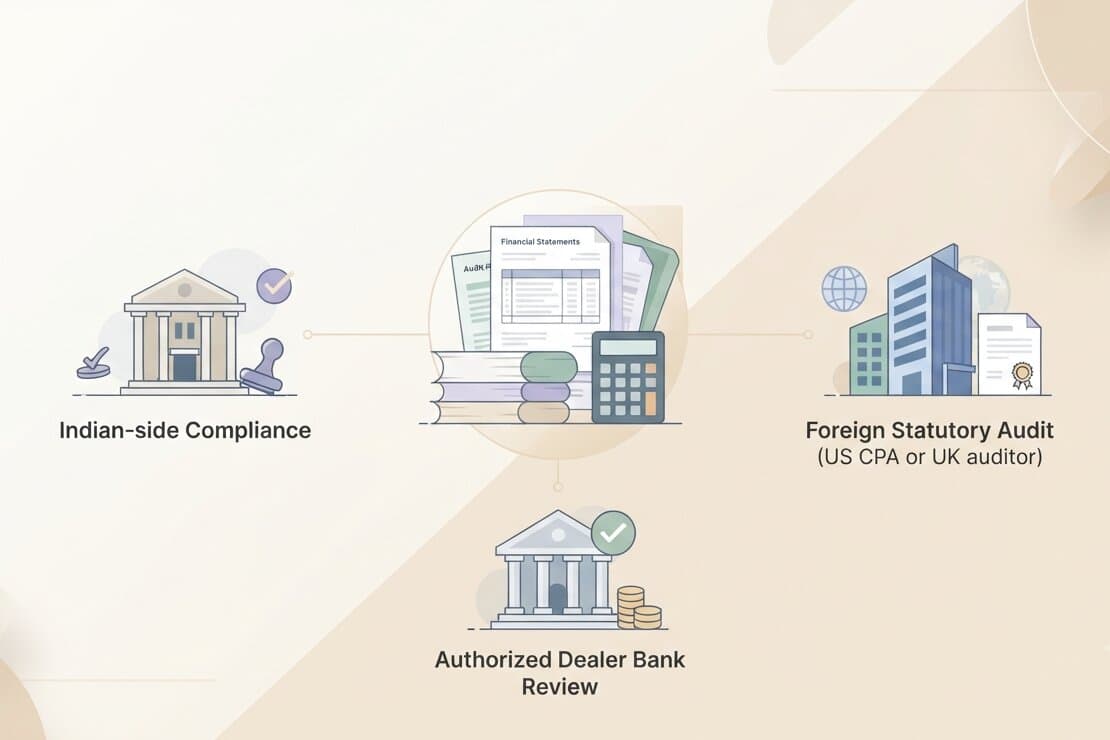
At the center of this process is the APR audit — a mandatory compliance requirement for Indian entities with overseas investments. Before submitting APR documentation to the Reserve Bank of India (RBI), the US subsidiary’s financial statements must be audited by a qualified US CPA who understands both GAAP standards and RBI expectations.
A successful APR audit ensures strong overseas subsidiary audit compliance and smooth foreign investment reporting.
The Role of a Qualified US CPA in APR Audit Compliance
Why a Specialized US CPA Matters
A US CPA for APR audit is not just responsible for preparing financial statements. The auditor must understand:
US GAAP standards
FEMA compliance requirements
RBI reporting requirements
ODI compliance rules
Foreign subsidiary audit compliance procedures
Many CPAs are experienced in standard US audits, but APR audit requirements demand additional expertise in cross-border reporting and overseas investment compliance.
Key Responsibilities of a US CPA in APR Audit
GAAP-Compliant Financial Reporting
The US CPA ensures the subsidiary’s financial statements comply with:
Financial Accounting Standards Board (FASB) guidelines
US GAAP accounting principles
Revenue recognition standards
Disclosure requirements
RBI-Focused Compliance Support
The auditor should also assist with:
Related-party transaction reporting
FEMA-compliant documentation
Exchange rate treatment
Capital movement disclosures
APR audit supplementary schedules
Without this expertise, businesses may face RBI queries or filing complications.
Understanding GAAP Standards for APR Audit
What GAAP Compliance Includes
A proper overseas subsidiary audit in the United States requires full GAAP compliance.
Core GAAP Requirements
Accrual-Based Accounting
Financial statements must follow accrual accounting instead of cash accounting.
Revenue Recognition
Revenue must comply with ASC 606 standards and reflect proper performance obligations.
Inventory Valuation
Inventory must be recorded at:
Lower of cost or market value
Fixed Asset Depreciation
Assets should be depreciated using systematic and documented methods.
Detailed Financial Disclosures
Financial statements must include:
Accounting policies
Significant estimates
Contingent liabilities
Related-party transactions
Key Areas RBI Reviews During APR Audit
Operating and Non-Operating Income
RBI expects clear separation between:
Operating Income
Revenue generated from core business activities.
Non-Operating Income
Income from:
Interest
Dividends
Asset sales
Other non-core activities
Related-Party Transactions
Related-party transactions receive special scrutiny under foreign subsidiary audit compliance.
RBI Focus Areas
Parent-company transactions
Service charges
Intercompany sales
Transfer pricing justification
Businesses must demonstrate arm’s length pricing for all intercompany dealings.
Contingent Liabilities
The APR audit must disclose:
Pending litigation
Loan guarantees
Credit exposures
Financial commitments
This supports transparent overseas investment compliance.
Step-by-Step APR Audit Process for US Subsidiaries
Step 1: Financial Statement Preparation
Timeline: October–November
The US CPA prepares and audits:
Balance sheet
Profit and loss statement
Cash flow statement
Notes to accounts
All reports must comply with GAAP standards.
Step 2: Audit Report and Certification
Timeline: November–December
The CPA issues:
Audit opinion
Auditor’s certificate
Supporting disclosures
This forms the foundation of the APR audit documentation.
Step 3: APR Audit Documentation Preparation
Timeline: December
Financial statements are converted into RBI-compliant reporting formats.
Required Documentation
APR Form ODI Part II
Audit certificate
Related-party transaction schedules
Capital movement records
Exchange rate reconciliation
This stage is critical for subsidiary compliance reporting.
Step 4: Indian Auditor Review
Timeline: December
The Indian Chartered Accountant reviews:
US audit reports
FEMA compliance alignment
Ind-AS consistency
APR audit schedules
The Indian auditor then issues the required certification.
Step 5: AD Bank Verification and RBI Submission
The Authorized Dealer (AD) Bank verifies the complete APR audit package before submission through the RBI FIRMS portal.
Common APR Audit Challenges for US Subsidiaries
Exchange Rate Fluctuations
RBI requires specific exchange rate treatment for:
Currency conversions
Forex gains and losses
INR reporting consistency
Improper handling can create reporting discrepancies.
Intercompany Transactions
RBI closely reviews:
Service agreements
Parent-company billing
Pricing methodology
Transfer pricing support
Incomplete documentation weakens foreign subsidiary audit compliance.
Retained Earnings Analysis
RBI expects clarity on how profits are utilized:
Reinvestment into business
Dividend distributions
Bank balances retained overseas
Loan Documentation
If the Indian parent company has provided loans to the US subsidiary, documentation must include:
Loan agreement
Interest terms
Repayment schedules
FEMA compliance support
Why FEMA Compliance Matters in APR Audit
FEMA Compliance Covers All Capital Movement
Every financial transaction between India and the US must comply with FEMA regulations.
RBI Focus Areas Include
Equity investments
Dividend repatriation
Foreign loans
Capital infusions
Overseas remittances
Risks of Non-Compliance
Improper APR audit reporting may lead to:
RBI notices
Delayed approvals
Compliance investigations
Financial penalties under FEMA
Strong overseas investment compliance minimizes these risks.
Recommended APR Audit Timeline for US Subsidiaries
September–October
Prepare financial data
Finalize trial balance
October–November
Conduct audit procedures
Verify financial statements
November–December
Finalize audit report
Prepare APR audit documentation
December 1–20
Indian auditor review
Compliance verification
December 21–31
AD Bank review
RBI FIRMS portal submission
Delays can impact annual compliance for foreign subsidiaries.
Best Practices for Smooth APR Audit Compliance
Maintain Organized Financial Records
Track:
Investments
Loans
Intercompany transactions
Dividend payments
throughout the year.
Coordinate Auditors Early
Ensure communication between:
US CPA
Indian Chartered Accountant
Internal finance team
well before the filing deadline.
Review Related-Party Transactions Carefully
Maintain proper transfer pricing support and agreements for all intercompany dealings.
Monitor FEMA Compliance Continuously
Do not wait until year-end to review ODI compliance and overseas investment reporting.
Strategic Benefits of a Strong APR Audit Process
Faster RBI Processing
Well-documented APR audits reduce the likelihood of RBI queries.
Better Compliance Protection
Strong documentation supports FEMA and ODI compliance during inspections or audits.
Easier Profit Repatriation
Properly documented earnings simplify dividend remittance to India.
Improved Global Compliance Structure
Consistent reporting strengthens long-term international business compliance.
Conclusion
A standard US statutory audit alone is not enough for successful APR audit compliance. Indian businesses with US subsidiaries need auditors who understand the intersection of:
FEMA compliance
US GAAP standards
RBI reporting requirements
ODI compliance
Foreign subsidiary audit compliance
An experienced US CPA for APR audit ensures your reporting satisfies both US regulatory standards and Indian overseas investment regulations.
By combining GAAP expertise with RBI-focused compliance knowledge, businesses can reduce risk, improve reporting accuracy, and maintain smooth overseas investment compliance year after year.
Also Read: Annual Performance Report (APR) Filing for ODI – Full Guide