.svg)
.svg)
.svg)
First-Time ODI? What APR Audit Looks Like in Year One
New to ODI? Learn how APR audit works in year one, including audit requirements, timelines, foreign auditor rules, and ODI compliance essentials.

Accorp Compliance Team
Our team of compliance experts specializes in PCI DSS, SOC 2, and other security frameworks to help businesses achieve and maintain compliance.
Expanding your business internationally is an exciting milestone, but overseas growth also brings regulatory responsibilities. For Indian companies making their first overseas investment, understanding APR audit requirements is critical from day one.
Many businesses mistakenly believe that compliance begins only after the overseas entity becomes operational or starts generating revenue. In reality, the APR audit process starts much earlier. Even in the first year, Indian companies must comply with overseas investment compliance rules under FEMA regulations.
This guide explains what APR audit looks like in year one, what documentation is required, and how businesses can maintain strong foreign subsidiary audit compliance from the start.
Why APR Audit Matters in the First Year of ODI
ODI compliance is regulated by the Reserve Bank of India (RBI) under FEMA guidelines. Once an Indian company invests in a foreign entity, annual compliance obligations begin — including APR audit requirements.
Why the First-Year APR Audit is Important
Establishes your long-term ODI compliance track record
Builds credibility with banks and regulators
Supports transparent foreign investment reporting
Reduces future compliance risks
Prevents penalties and reporting delays
Even if the overseas entity is newly incorporated or inactive, APR audit obligations may still apply.
Is APR Audit Required in Year One?
This is one of the most common concerns among first-time overseas investors.
The Short Answer: Yes
APR audit is generally required if:
The overseas entity has completed a financial year
Financial statements exist, even with minimal activity
The Indian company holds an active overseas investment
Important Clarification
Even if your overseas company:
Has not started operations
Has no revenue
Has zero turnover
You may still need to complete APR audit and compliance reporting under ODI compliance regulations.
What APR Audit Looks Like in Year One
The first-year APR audit is slightly different because many overseas entities are still in the setup phase.
1. Basic Financial Verification
The APR audit focuses on validating:
Initial investment amount
Setup and incorporation expenses
Capital utilization
Bank transactions
Shareholding structure
Even minimal financial activity must be properly documented.
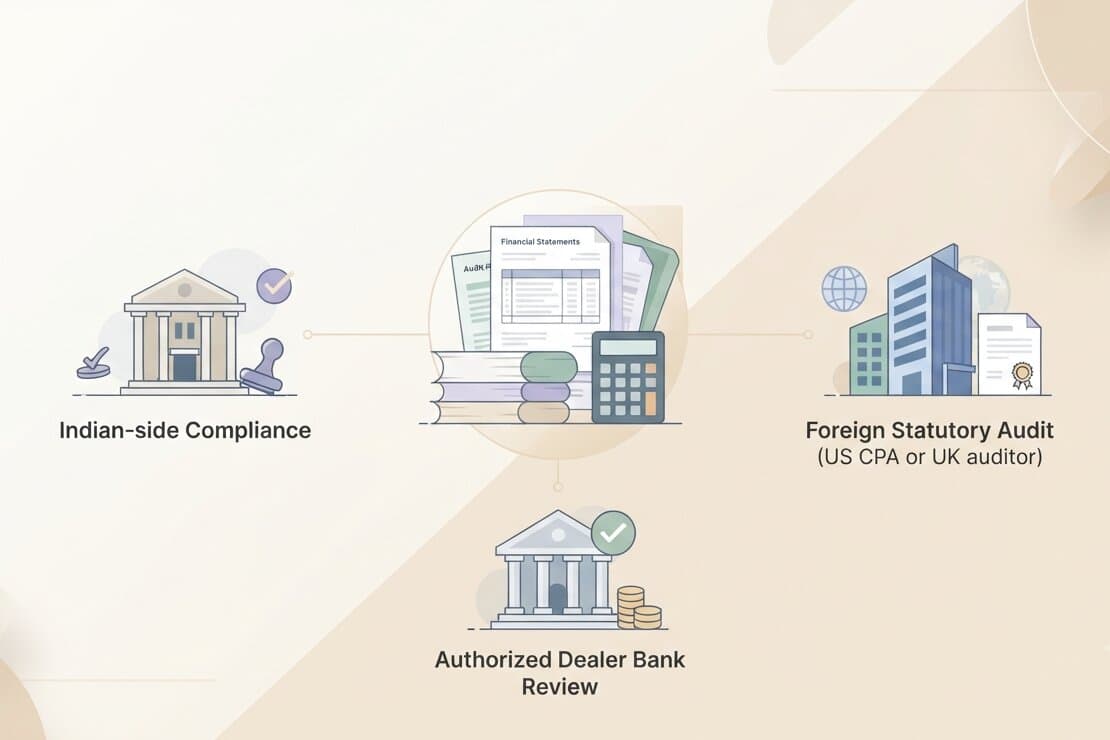
2. Overseas Auditor Certification
For strong foreign subsidiary audit compliance, financial statements often need certification by a locally recognized auditor.
Examples
US entities usually require a US CPA for APR filing
UK entities typically require a UK auditor for APR filing
Other jurisdictions require certified local auditors
This overseas subsidiary audit confirms that financial records comply with local accounting standards.
3. Indian CA Review
An Indian Chartered Accountant generally reviews the APR audit before submission through the Authorized Dealer (AD) Bank.
The Indian CA helps ensure:
ODI details are correctly reported
Investment figures match RBI records
Audit documents are properly structured
4. Supporting Documentation
A complete APR audit package may include:
Audited financial statements
ODI registration details
Investment proof
Shareholding records
Bank remittance details
Auditor certificate and license details
Accurate documentation is essential for smooth overseas investment compliance.
Step-by-Step APR Audit Process in Year One
Step 1: Gather Financial Records
Collect all available financial information related to the overseas entity.
This may include:
Incorporation costs
Initial investments
Operational expenses
Bank statements
Step 2: Conduct Overseas Subsidiary Audit
A basic overseas subsidiary audit validates the financial information before reporting.
Even in year one, this audit process helps strengthen compliance accuracy.
Step 3: Appoint the Correct Foreign Auditor
Depending on the jurisdiction, engage:
A US CPA for APR filing
A UK auditor for APR filing
A certified local auditor for other countries
Choosing the right auditor is critical for foreign subsidiary audit compliance.
Step 4: Prepare APR Audit Documentation
The APR audit should clearly report:
Investment details
Financial position of the entity
Operational status
Capital structure
Step 5: Review ODI Compliance Details
Cross-check all ODI information carefully.
Common review points include:
Investment amount
Shareholding percentage
Remittance details
Loan or guarantee information
Step 6: Submit Through the AD Bank
The completed APR audit documentation is submitted through the Authorized Dealer bank as part of RBI reporting requirements.
APR Audit Timeline for First-Time ODI Investors
Important Dates
Financial Year End: March 31
APR submission deadline: December 31
Although businesses receive several months for compliance, early preparation is strongly recommended.
Common First-Year APR Audit Challenges
1. Uncertainty About Audit Requirements
Many businesses are unsure whether APR audit applies in the first year.
2. Incomplete Financial Records
New overseas entities often lack structured accounting systems.
3. Difficulty Finding Qualified Foreign Auditors
Finding a reliable US CPA for APR filing or UK auditor for APR filing can take time.
4. ODI Reporting Errors
Incorrect reporting of investment details may create compliance issues later.
5. Delayed Audit Preparation
Late preparation often results in rushed submissions and avoidable mistakes.
Best Practices for Smooth First-Year APR Audit
Start Early
Begin collecting records and coordinating with auditors well before the deadline.
Maintain Organized Documentation
Track all overseas transactions and investment records from the start.
Work with Experienced Professionals
Engage experts familiar with:
APR audit
ODI compliance
FEMA compliance
Overseas subsidiary audit requirements
Coordinate with Global Auditors
Ensure timely communication with your foreign auditor throughout the audit process.
Perform Final Reviews
Double-check all audit records and ODI details before submission.
Why Professional Support Matters for APR Audit
First-year APR audit can become complicated, especially for businesses operating across multiple jurisdictions.
Benefits of Professional Assistance
Better coordination with overseas auditors
Accurate compliance reporting
Strong foreign subsidiary audit compliance
Reduced compliance risk
Faster audit completion
Improved documentation quality
Professional support helps companies avoid errors and maintain smooth international business compliance.
Conclusion
Your first year of overseas investment compliance is not just about reporting — it sets the foundation for your future global operations. Understanding APR audit requirements early helps businesses stay compliant, avoid delays, and reduce regulatory risks.
Even if the overseas entity is inactive or newly incorporated, maintaining proper overseas subsidiary audit standards remains essential. By working with experienced professionals, maintaining accurate records, and coordinating with qualified experts like a US CPA for APR filing or UK auditor for APR filing, businesses can simplify the entire process.
A well-managed APR audit strengthens your ODI compliance framework and ensures long-term regulatory confidence as your international business grows.
Read Also: APR Audit for Australian Subsidiaries: ASIC Compliance and RBI Reporting Alignment