.svg)
.svg)
.svg)
How RBI Verifies Capital Infusion Into US Subsidiaries
Learn how RBI verifies capital infusion during overseas subsidiary audit, APR filing India, FEMA reporting, and ODI compliance.

Accorp Compliance Team
Our team of compliance experts specializes in PCI DSS, SOC 2, and other security frameworks to help businesses achieve and maintain compliance.
Sending capital to a US subsidiary may appear straightforward from a business perspective, but from a regulatory standpoint, every overseas investment is closely monitored under India’s FEMA and ODI framework. The Reserve Bank of India (RBI) expects Indian companies to maintain complete transparency regarding how funds are transferred, utilised, and reported in overseas entities.
During APR filing India, capital infusion becomes one of the most important areas reviewed by regulators. RBI does not only verify whether money was remitted abroad, but it also checks whether the investment was properly disclosed, accurately reflected in audited financial statements, and supported with valid documentation.
For businesses managing international operations, a properly conducted overseas subsidiary audit plays a major role in demonstrating financial transparency and maintaining foreign subsidiary audit compliance. Understanding how RBI verifies capital infusion can help companies avoid reporting gaps, FEMA violations, and future ODI compliance complications.
Why Capital Infusion Reporting Matters Under FEMA
Under FEMA regulations, Indian companies investing abroad must comply with ODI rules governing:
Equity investment
Financial commitments
Overseas remittances
Loans and guarantees
Reporting obligations
Whenever funds are infused into a US subsidiary, the transaction becomes part of RBI’s compliance monitoring system.
APR filing India requires businesses to disclose:
Total overseas investment
Shareholding percentage
Financial performance of the subsidiary
Additional capital contributions
Outstanding loans and guarantees
The RBI reviews these disclosures to ensure overseas investments remain within permitted ODI compliance limits.
What Qualifies as Capital Infusion Into a US Subsidiary
Capital infusion refers to financial support provided by the Indian parent company to the overseas subsidiary.
Common examples include:
Equity share subscription
Additional capital contribution
Inter-company loans
Preference share investment
Compulsory convertible instruments
Parent-funded operational support
These transactions must be accurately reflected during the overseas subsidiary audit process.
How RBI Tracks Overseas Investments
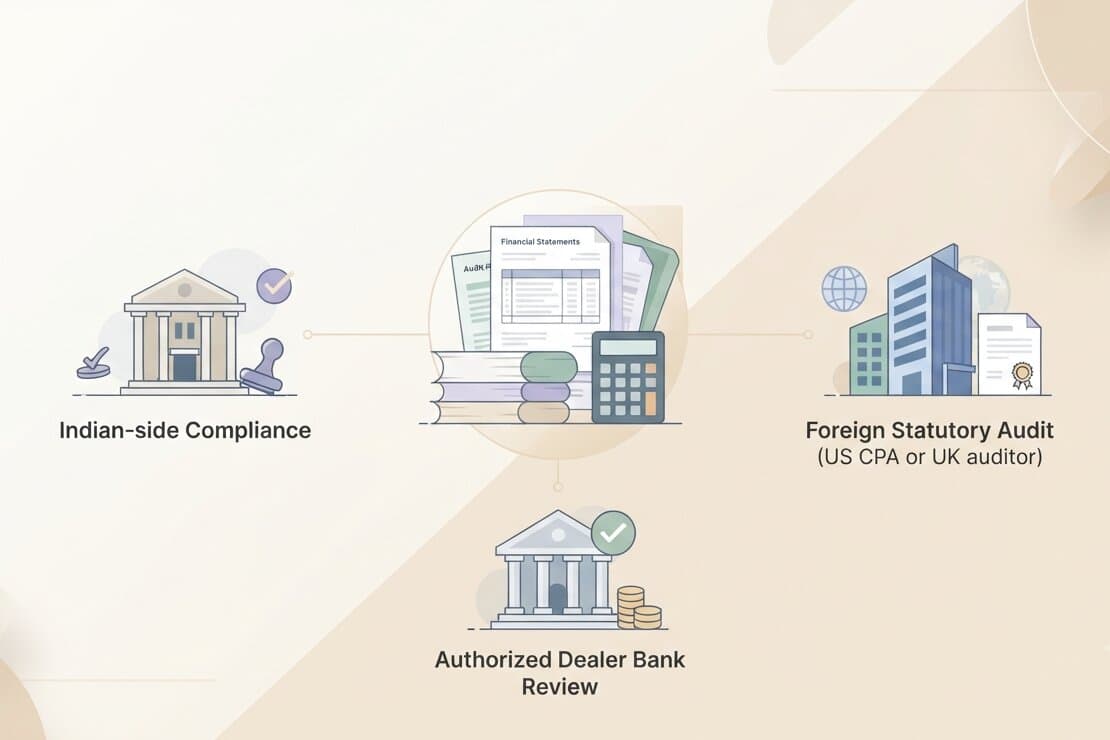
1. Monitoring Through Authorized Dealer Banks
Indian companies usually route overseas remittances through authorised dealer (AD) banks.
Banks maintain records relating to:
Remittance purpose
ODI filing references
Investment amount
Beneficiary entity details
This information becomes part of RBI’s compliance tracking system.
2. Review During APR Filing India
During APR filing for foreign subsidiaries, RBI reviews:
Audited financial statements
Shareholding changes
Capital additions
Outstanding loans
Financial commitment calculations
Any mismatch between reported investment and actual remittances may trigger clarification requests.
3. Verification Through Overseas Subsidiary Audit
An overseas subsidiary audit helps validate whether capital infusion has been:
Properly recorded
Correctly classified
Supported by documentation
Reflected in financial statements
Auditors also examine whether inter-company transactions align with accounting standards and RBI reporting obligations.
Key Documents RBI Reviews for Capital Infusion Verification
1. Bank Remittance Records
RBI may verify:
SWIFT confirmations
Foreign outward remittance certificates
AD bank documentation
Payment advice records
These records establish the actual movement of funds overseas.
2. Share Allotment and Investment Proof
Businesses should maintain:
Share certificates
Subscription agreements
Board resolutions
Capital allotment records
Missing investment documents are a common foreign subsidiary audit compliance issue.
3. Audited Financial Statements
The overseas subsidiary’s financial statements should accurately reflect:
Equity contributions
Outstanding loans
Parent company funding
Share capital balances
For US entities, a US CPA for APR filing generally reviews these disclosures under US accounting standards.
Similarly, UK entities may require a UK auditor for APR filing for local statutory reporting.
Common RBI Concerns During Capital Infusion Review
1. Mismatch Between ODI Reporting and Financial Statements
One of the most common problems occurs when:
ODI filings show one investment amount
Overseas financial statements show another
This often results from:
Delayed accounting entries
Currency conversion issues
Incorrect classification of funds
2. Improper Classification of Funding
Businesses sometimes incorrectly classify:
Loans as equity
Operational funding as capital contribution
Temporary advances as investments
Such classification errors can affect ODI compliance calculations.
3. Lack of Supporting Agreements
RBI may question transactions if businesses cannot provide:
Loan agreements
Investment approvals
Share subscription documents
Funding resolutions
Documentation gaps increase compliance risk significantly.
Currency Conversion Challenges in APR Filing
US subsidiaries maintain accounts in USD, while APR filing India often requires INR-based reporting.
Companies must ensure:
Consistent exchange rate application
Proper reconciliation of capital balances
Accurate reporting of investment values
Currency conversion errors frequently create discrepancies during overseas subsidiary audit reviews.
Best Practices for Managing Capital Infusion Compliance
1. Maintain a Centralized Investment Record
Businesses should maintain organized records for:
ODI filings
Overseas remittances
Shareholding changes
Funding approvals
Loan documentation
Strong documentation simplifies APR filing for foreign subsidiaries.
2. Coordinate Between Finance and Compliance Teams
Cross-border reporting requires coordination between:
Indian finance departments
Overseas accounting teams
Auditors
FEMA consultants
This improves reporting consistency and reduces reconciliation issues.
3. Conduct Periodic FEMA Compliance Reviews
Businesses should regularly review:
ODI exposure limits
Outstanding overseas commitments
Inter-company funding structures
APR disclosure accuracy
This helps identify risks before RBI reporting deadlines.
4. Start APR Preparation Early
Early preparation allows sufficient time for:
Financial reconciliation
Currency conversion
Audit completion
Documentation review
Late preparation often increases reporting errors.
Conclusion
Capital infusion into overseas subsidiaries is one of the most closely monitored aspects of RBI compliance under FEMA and ODI regulations. During an overseas subsidiary audit, regulators review whether overseas investments are properly documented, accurately reported, and fully supported by financial records.
While a US CPA for APR filing may certify overseas financial statements under local accounting standards, Indian businesses must also ensure compliance with RBI reporting expectations.
Companies that maintain strong documentation, accurate reconciliation, and proactive APR filing India processes can significantly improve foreign subsidiary audit compliance and reduce long-term regulatory risks.
Also Read: Repatriation of Overseas Profits to India – FEMA Rules and Bank Requirements
FAQS
Q1. Does the RBI actually check every rupee I send to my US subsidiary?
Yes. Every overseas remittance goes through your AD bank, which maintains records of the amount, purpose, and entity details. RBI cross-checks these records against your APR filing — any mismatch triggers a clarification request.
Q2. What documents do I need to prove capital infusion into my US subsidiary?
Keep your SWIFT confirmations, share certificates, subscription agreements, and board resolutions handy. If you can't prove the investment with documents, RBI will question it during APR review.
Q3. I sent money to my US subsidiary as a loan, not equity. Does that still need to be reported?
Yes. Loans, guarantees, and any financial support to an overseas subsidiary are all part of ODI reporting. Many companies get flagged for incorrectly classifying loans as equity or vice versa — always report the correct category.
Q4. My US CPA already certified the financials. Will RBI still have questions about capital infusion
Possibly. A US CPA audits under US accounting standards — they don't specifically check RBI or FEMA compliance. RBI may still ask questions if your ODI filings don't match the financial statements or if documentation is missing.
Q5. How do I avoid mismatches between my ODI filing and my US subsidiary's financial statements?
Start reconciling early. Compare your remittance records, ODI filings, and subsidiary financials before the December deadline. Currency conversion errors are the biggest cause of mismatches — always use consistent exchange rates across all documents.