.svg)
.svg)
.svg)
How to Calculate Tax Liability Before Exercising Your ESOPs
Calculate ESOP tax liability before exercise in India. Understand employee stock option plan taxation, ESOP valuation, perquisite and capital gains tax rules.

Accorp Compliance Team
Our team of compliance experts specializes in PCI DSS, SOC 2, and other security frameworks to help businesses achieve and maintain compliance.
For many professionals working in startups and high-growth firms, ESOPs (Employee Stock Option Plans) represent a significant part of compensation. While they offer strong wealth-building potential, taxation is often misunderstood—especially at the time of exercising options.
Before you convert your stock options for employees into actual shares, it’s essential to calculate your tax liability. A wrong move can lead to unexpected financial stress, particularly if liquidity is limited.
This guide will help you understand how to estimate taxes on your ESOPs clearly and practically.
Understanding ESOP Taxation Basics
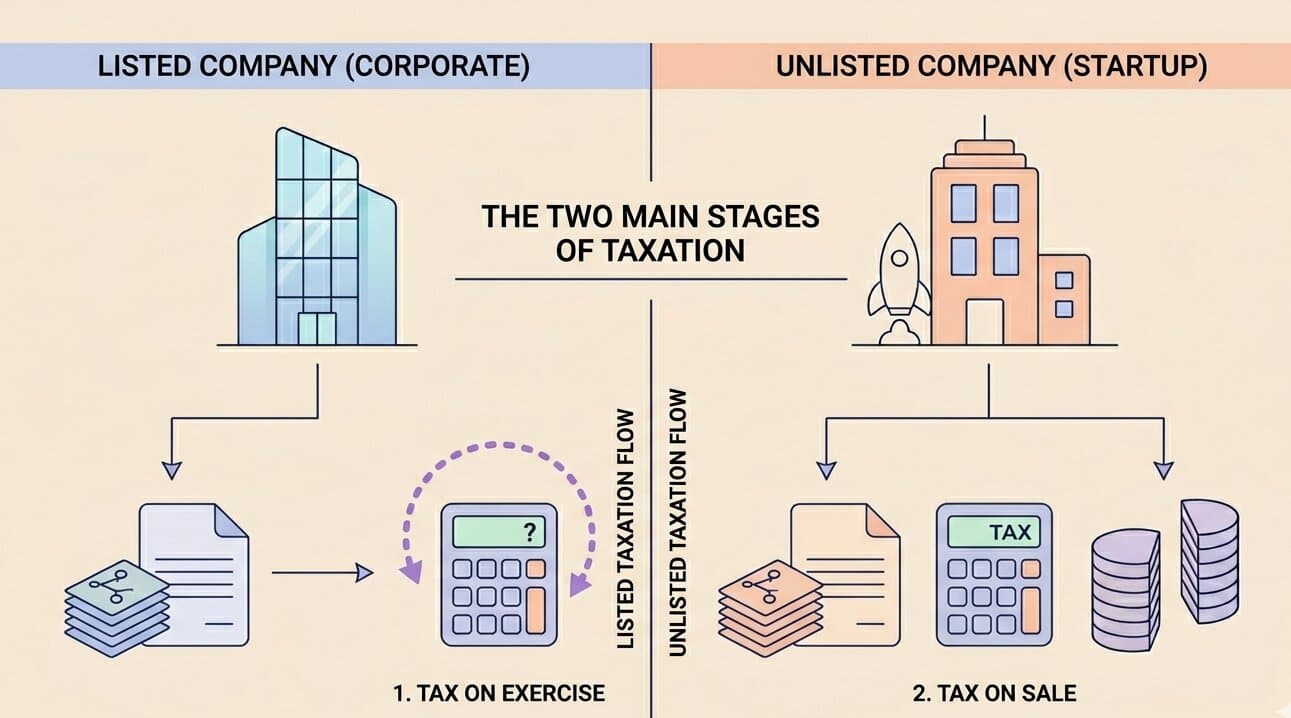
Under a typical employee stock option plan, taxation occurs in two stages:
At Exercise (Perquisite Tax)
At Sale (Capital Gains Tax)
When you exercise your share options for employees, the difference between the fair market value (FMV) and the exercise price is treated as income. This is taxed under the “salary” head.
Later, when you sell the shares, any additional gain is taxed as capital gains.
Step-by-Step: How to Calculate Tax on Exercise
Let’s break the process into simple steps.
Step 1: Identify the Exercise Price
This is the price you pay to convert your options into shares under your ESOP plan.
Step 2: Determine Fair Market Value (FMV)
FMV depends on whether the company is listed or unlisted:
Listed companies: Market price on the exercise date
Unlisted companies: Determined through a valuation process (known as ESOP valuation)
Step 3: Calculate Perquisite Value
Use this formula:
Perquisite Value = FMV – Exercise Price
This value represents your taxable income from the employee stock option scheme.
Step 4: Apply Your Income Tax Slab
The perquisite value is added to your salary and taxed according to your income tax slab.
What About Capital Gains Tax?
After exercising your ESOP stock, the next tax event happens when you sell the shares.
Short-Term Capital Gains (STCG): If sold within 12 months (for listed shares)
Long-Term Capital Gains (LTCG): If held longer
The cost of acquisition becomes the FMV considered at the time of exercise.
This means proper planning under your stock option plan is essential to minimise total tax liability.
Special Case: DPIIT Startup ESOPs
If you work for an eligible startup, tax payment on ESOPs may be deferred. This applies to certain ESOP companies recognised by DPIIT.
In such cases, tax is payable at a later date (sale, exit, or after a specified period). However, the calculation method remains the same—you’re only delaying payment, not avoiding it.
Key Factors That Affect Your ESOP Tax
Before exercising your options, consider these critical factors:
1. ESOP Valuation
A higher ESOP valuation increases your taxable income. Exercising too late may mean paying more tax.
2. Liquidity
If your company is unlisted, selling shares may not be easy. You could face tax without an immediate cash flow.
3. Income Tax Slab
Your total income determines how much tax you’ll pay on your employee stock ownership benefits.
4. Company Policies
Different employee stock ownership plans have varying rules around exercise windows and exit options.
Common Mistakes to Avoid
Many employees make costly errors while handling their ESOP schemes:
Exercising without tax planning
Ignoring valuation trends
Assuming tax applies only after selling shares
Not setting aside funds for tax liability
A careful approach can help you maximize gains from your employee ownership plan.
Why Tax Planning is Crucial for ESOP Employees
An ESOP employee owned structure can be highly rewarding, but only if managed wisely. Since taxes can arise before actual profits are realized, planning becomes essential.
Employees should treat ESOPs not just as compensation, but as an investment decision. Understanding the tax impact ensures you don’t lose a significant portion of your gains.
Final Thoughts
Calculating tax liability before exercising your ESOPs is a crucial step that should never be overlooked. Whether you’re part of a startup or a listed company offering stock options for employees, understanding the numbers helps you make informed decisions.
A well-structured employee share ownership plan can create long-term wealth, but poor tax planning can reduce its benefits. Always evaluate the ESOP stock, your financial position, and timing before taking action.
In the end, ESOPs are a powerful tool for employee ownership—but like any financial opportunity, they reward those who plan.
Consult Accorp Partners to structure transparent, compliant, and high-impact ESOP plans that benefit both companies and employees.