.svg)
.svg)
.svg)
TDS on ESOPs: Employer Obligations and Employee Responsibilities
Understand TDS on ESOP in India, employee stock option plan taxation, ESOP valuation, employer compliance, and employee stock ownership responsibilities.

Accorp Compliance Team
Our team of compliance experts specializes in PCI DSS, SOC 2, and other security frameworks to help businesses achieve and maintain compliance.
For Indian startups and private limited companies, offering an ESOP (Employee Stock Option Plan) is a great way to build employee ownership. However, many founders and employees overlook one critical aspect—TDS (Tax Deducted at Source) on ESOPs.
Understanding TDS is essential because it directly impacts both employer compliance and employee tax liability. Mistakes in TDS deduction can lead to penalties, interest, and compliance issues.
This blog explains TDS on ESOP in India, including employer obligations, employee responsibilities, taxation, and compliance requirements in a simple and practical manner.
What is ESOP in India?
An Employee Stock Option Plan (ESOP) allows employees to buy shares of the company at a predetermined price after a vesting period.
Legal Framework:
Governed by Companies Act, 2013
Covered under Rule 12 of Companies (Share Capital and Debentures) Rules, 2014
Key Highlights:
Applicable to private limited companies in India
Promotes long-term employee stock ownership
Widely used by startups and growing esop companies
Other names include:
Employee share option plan
Employee stock ownership plan
Stock option plan
Employee share ownership plan
Step-by-Step ESOP Issuance Process
Before understanding TDS, companies must follow the correct ESOP for private limited company in India process:
1. Draft ESOP Scheme
Define:
Eligibility
Vesting schedule
Exercise price
Number of stock options for employees
2. Board Resolution
Approve the employee stock option scheme
3. Shareholder Approval (Special Resolution)
Mandatory under Companies Act
4. Filing of MGT-14
File within 30 days with ROC
5. Grant of ESOPs
Issue share options for employees
6. Vesting & Exercise
Employees earn and exercise options
7. Filing of PAS-3
Required after share allotment
8. Maintain Statutory Registers
Maintain records of:
ESOP grants
Employee details
Share allotments
ESOP Valuation in India
ESOP valuation is crucial for calculating TDS.
Key Points:
Fair Market Value (FMV) must be determined
Conducted by a registered valuer or merchant banker
Why It Matters:
FMV is used to calculate taxable perquisite
Directly impacts ESOP taxation in India and TDS amount
Example:
If FMV is ₹300 and exercise price is ₹100, the difference (₹200) becomes taxable income.
Taxation of ESOPs in India
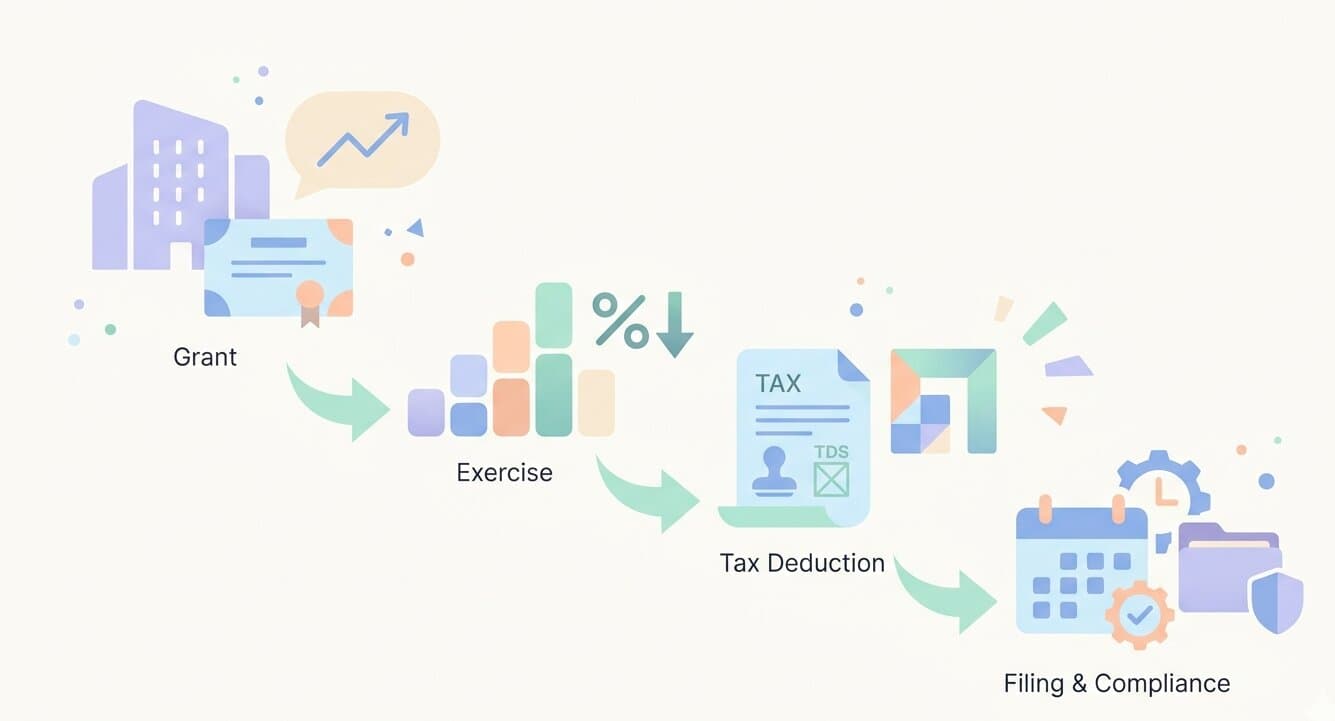
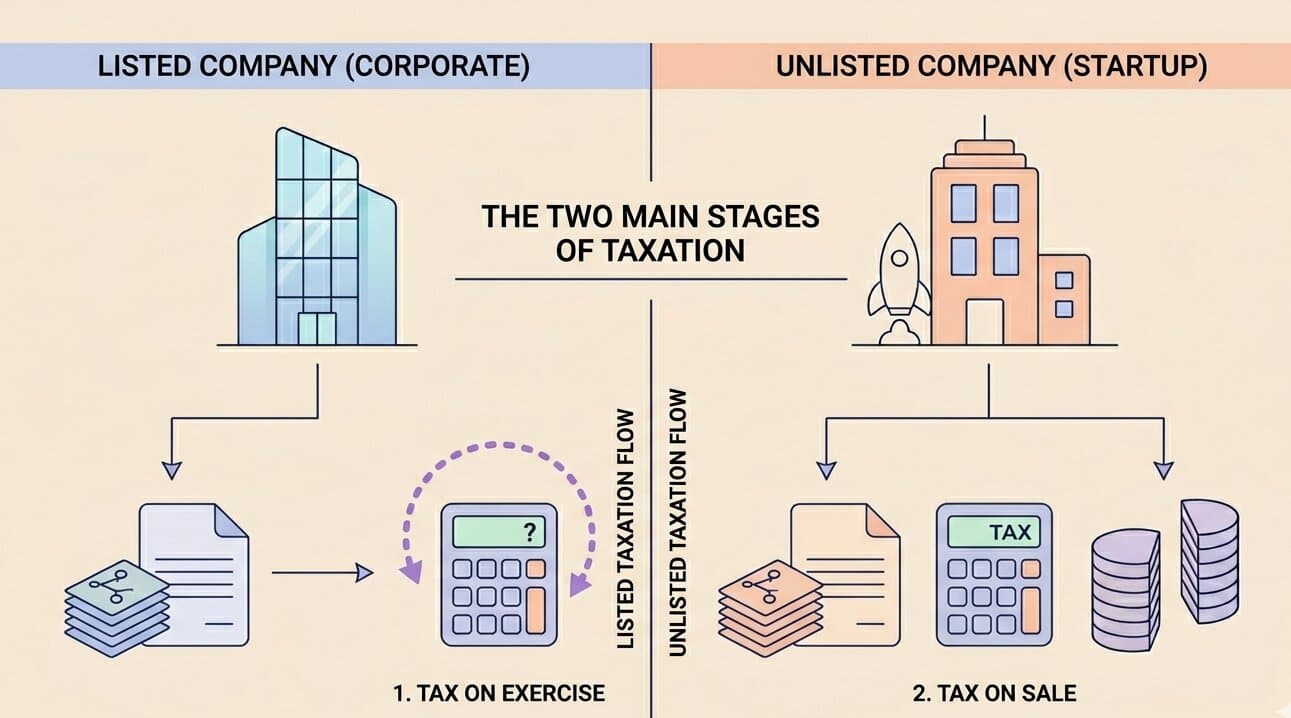
1. Tax at Exercise Stage (Perquisite Tax)
This is where TDS applies.
FMV – Exercise Price = Taxable income (salary)
Taxed under “Income from Salary”
Example:
Exercise Price: ₹100
FMV: ₹300
Taxable Income: ₹200
2. Tax at Sale Stage (Capital Gains Tax)
Applies when shares are sold
Types:
Short-Term Capital Gains (STCG)
Long-Term Capital Gains (LTCG)
3. Income Tax Implications
Employees must report ESOP income in ITR
Tax arises even if shares are not sold
TDS on ESOPs: Employer Obligations
Employers play a critical role in ESOP taxation in India, especially in TDS compliance.
When is TDS Applicable?
At the exercise stage of ESOP
Key Employer Responsibilities:
1. Deduct TDS on Perquisite Value
Calculate: FMV – Exercise Price
Deduct tax as part of salary
2. Deposit TDS with Government
Must be deposited within prescribed timelines
3. Report in Form 16
Include ESOP income in employee salary details
4. Handle Liquidity Issues
Many employees do not have cash to pay tax.
Employers may:
Recover TDS from salary
Arrange sell-to-cover mechanisms
Provide deferred tax options (for eligible startups under Income Tax provisions)
Special Case: Eligible Startups
Recognized startups may defer TDS payment on ESOPs:
TDS payable within 14 days from:
Sale of shares
Leaving the company
5 years from exercise
This is a major relief for esop employee owned startups.
Employee Responsibilities for ESOP Tax
Employees also have key responsibilities in managing their employee stock ownership.
1. Understand Tax Liability
Tax is payable at exercise stage even without selling shares
2. Plan Cash Flow
Ensure funds are available for tax payment
3. Report in Income Tax Return
Include ESOP income under salary
Report capital gains on sale
4. Track Holding Period
Determines capital gains tax (STCG or LTCG)
Practical Example
An employee in a Bengaluru startup exercises ESOP stock:
FMV: ₹500
Exercise Price: ₹100
Taxable Income: ₹400
Employer deducts TDS on ₹400. Later, when shares are sold, capital gains tax applies.
Key Compliance Requirements
To ensure proper employee ownership plan compliance:
Legal Compliance
Follow Companies Act, 2013
Adhere to Rule 12
Mandatory Filings
MGT-14 (special resolution)
PAS-3 (share allotment)
Documentation
Maintain:
ESOP scheme
Grant letters
Exercise records
Accounting Compliance
Record ESOP costs properly
Ensure accurate tax reporting
Conclusion
TDS on ESOPs is one of the most important aspects of managing an ESOP plan in India. While ESOPs help build employee share ownership, they also create tax obligations that both employers and employees must handle carefully.For employers, timely TDS deduction, reporting, and compliance are essential. For employees, understanding tax liability and planning finances is equally important.By following the correct legal process, ensuring proper ESOP valuation, and understanding ESOP taxation in India, companies can create a smooth and compliant employee stock option scheme.A well-managed ESOP structure not only rewards employees but also strengthens trust, transparency, and long-term growth in India’s startup ecosystem.
Managing TDS on ESOPs requires careful planning, accurate valuation, and strict compliance with tax regulations. Both employers and employees need clarity to avoid penalties and optimize tax outcomes.Partner with Accorp Partners to handle ESOP taxation, TDS compliance, and end-to-end structuring with complete accuracy and confidence.