.svg)
.svg)
.svg)
Indian Parent, US Subsidiary — or US Parent, Indian Subsidiary? All the Cases, All the Consequences
Compare US parent vs Indian parent structures for cross-border businesses. Understand FEMA, FDI, ODI, tax, compliance, and holding company setup.

Accorp Compliance Team
Our team of compliance experts specializes in PCI DSS, SOC 2, and other security frameworks to help businesses achieve and maintain compliance.
It sounds like an administrative question. Which company sits on top, which one sits below. In practice, it is one of the most consequential structural decisions an India-US business makes — and getting it wrong costs far more to reverse than it did to avoid in the first place.
Whether you are an Indian founder building something with a US commercial face, a US company expanding into India for talent or market access, or a founder straddling both countries and trying to figure out which way the structure should point — the answer is not the same for every situation.
This article covers every material case. What drives the structure, what each version looks like in practice, what each one costs in tax and compliance, and where each one breaks down.
THE FUNDAMENTAL CHOICE — WHAT CONTROLS IT
Before the cases, one principle: the structure should follow the money. Specifically, where do the revenues primarily come from, and where does the primary capital raise happen?
A company generating revenue primarily from US customers and raising capital from US investors should have its parent entity in the US. A company generating revenue from Indian customers and growing within the Indian market should have its parent in India. Most of the structural mistakes happen when founders build the holding stack in the direction of where they want to be, rather than where the business actually is.
The second driver: which regulatory framework can you live with? An Indian parent holding a US subsidiary creates ODI obligations under FEMA. A US parent holding an Indian subsidiary creates FDI obligations under FEMA and Form 5471 obligations under US tax law. Neither is avoidable — the question is which set you are better positioned to manage.
CASE 1: US PARENT — INDIAN SUBSIDIARY
(The most common structure for foreign companies expanding into India)
A US C-Corporation or Delaware entity holds 100% of an Indian Private Limited Company.
When it makes sense: A US company that has built a product, has US customers, and is setting up an India team for engineering, operations, or GCC purposes. The revenue lives in the US. The talent lives in India. The legal entity in India exists to hire, operate, and invoice the US parent for services.
What the Indian subsidiary does: It signs employment contracts with Indian employees, leases office space in India, invoices the US parent under a services agreement at arm's length transfer pricing, and receives the service fee as its operating revenue in India. Indian corporate tax applies to the Indian subsidiary's profit — at approximately 25.17% under the standard concessional regime under Section 115BAA.
How the US parent is taxed: The US C-Corporation pays US corporate tax at 21% on its profits. The Indian subsidiary's profits do not automatically flow to the US parent as taxable income — but they do create a CFC position under US tax law. The US parent must file Form 5471 annually, disclosing the Indian subsidiary's financial position. Under the NCTI rules effective from January 1, 2026, a portion of the Indian subsidiary's tested income may be attributed back to the US parent and taxed, though the Indian tax credit offset typically reduces the net US exposure materially.
Transfer pricing: Every rupee the Indian subsidiary bills the US parent for services is a related-party international transaction. It must be priced at arm's length under Indian transfer pricing rules. Form 48 (formerly Form 3CEB under the Income Tax Act, 1961) must be filed by October 31 of each year. Safe harbour margins for IT services were rationalised in the March 2026 amendments — a single category now applies to most IT service transactions with a margin range that covers most GCC billing structures.
FEMA compliance: The US parent's FDI into the Indian subsidiary must be reported through Form FC-GPR within 30 days of share allotment. An FLA return is due from the Indian subsidiary to the RBI by July 15 every year. There is no APR obligation in this structure — APR applies only to Indian entities holding overseas investments, not to foreign entities holding Indian subsidiaries.
The weakness: Dividends from the Indian subsidiary to the US parent attract Indian withholding tax — reduced from the domestic 20% to 15% under the India-US DTAA where the beneficial ownership threshold is met. US parent receives the dividend net of Indian withholding and claims a foreign tax credit in the US. The total tax cost of moving profits from India to the US is manageable but real.
CASE 2: INDIAN PARENT — US SUBSIDIARY
(The structure for Indian companies expanding commercially into the US)
An Indian Private Limited Company holds shares in a US entity — typically a Delaware C-Corporation or LLC.
When it makes sense: An Indian company that has built a product or service and now wants a US commercial presence — a US legal entity that can sign contracts with US enterprise customers, hold US bank accounts, employ US-based sales staff, or raise from US venture capital. The product is built in India. The market is in the US.
FEMA — the ODI framework: The Indian parent's investment into the US entity is Overseas Direct Investment under FEMA. Form ODI Part I must be filed with the AD bank before the remittance leaves India. The investment is counted against the 400% net worth limit for ODI under the automatic route. Annual Performance Report must be filed by December 31 each year, based on audited financial statements of the US subsidiary. The US entity's accounts must be audited — by a licensed US CPA — before the APR is accepted by the AD bank.
Two-layer subsidiary limit: Rule 19(3) of the Overseas Investment Rules, 2022 limits the structure to two layers of subsidiaries. Indian Parent → US C-Corp → US Operating LLC is a two-layer structure and is permitted. Adding a third entity below — Indian Parent → US Holdco → US Sub → US Operating Sub — requires prior RBI approval and is not available under the automatic route.
US tax considerations: The US subsidiary is a US domestic corporation for IRS purposes. It files its own US tax return (Form 1120) and pays US corporate tax at 21% on its US-sourced income. Dividends paid to the Indian parent attract US withholding tax — reduced under the India-US DTAA to 15% where the Indian company holds at least 10% of the US entity.
Round-tripping prohibition: One critical FEMA rule in this structure. The US subsidiary cannot invest back into an Indian entity controlled by the same Indian parent — that is round-tripping under FEMA and is prohibited. If the US entity takes US venture capital and wants to deploy capital into the Indian parent or a related Indian entity, the structure of the flow must be reviewed carefully. Round-tripping triggers severe FEMA penalties — up to three times the amount involved — and is one of the areas where FEMA enforcement has become visibly more active.
The weakness: The Indian parent is subject to Indian tax at 25.17% before it can invest into the US entity. Dividends coming back from the US subsidiary to the Indian parent are taxed in India at the Indian corporate rate, with a foreign tax credit for the US withholding. The Section 80M deduction — which allows an Indian holding company to deduct dividends received from overseas subsidiaries up to the amount it distributes to its own shareholders — provides meaningful relief but requires careful planning on distribution timing.
CASE 3: INDIVIDUAL INDIAN FOUNDER — US ENTITY DIRECTLY
(Common in early-stage situations, often the wrong structure)
An individual Indian resident — a founder still living and working in India — holds shares in a US C-Corporation or LLC directly in their personal capacity.
This structure looks clean on paper and is how many early-stage founders proceed when they are building before a proper holding company is established. In practice, it creates compounding FEMA complications.
The FEMA problem: An individual resident in India cannot hold shares in a foreign entity as an individual under the ODI automatic route beyond the Liberalised Remittance Scheme (LRS) limit of USD 250,000 per year per person. If the total investment into the US entity exceeds this — through multiple tranches, employee stock, or capital appreciation — the LRS route is inadequate. The individual needs to route the investment through an Indian LLP or Private Limited Company acting as the ODI vehicle.
Where it breaks completely: When the US entity has an Indian subsidiary. If the individual Indian founder holds the US C-Corp, and the US C-Corp incorporates an Indian subsidiary, the structure now has a foreign entity (the US C-Corp) owned by an Indian resident holding an Indian entity (the Indian sub). This is a step-down structure that requires additional regulatory clearance under FEMA and creates the conditions for PE risk — the Indian resident's control of the US entity and that entity's Indian subsidiary may be seen as creating a permanent establishment in India for the US entity.
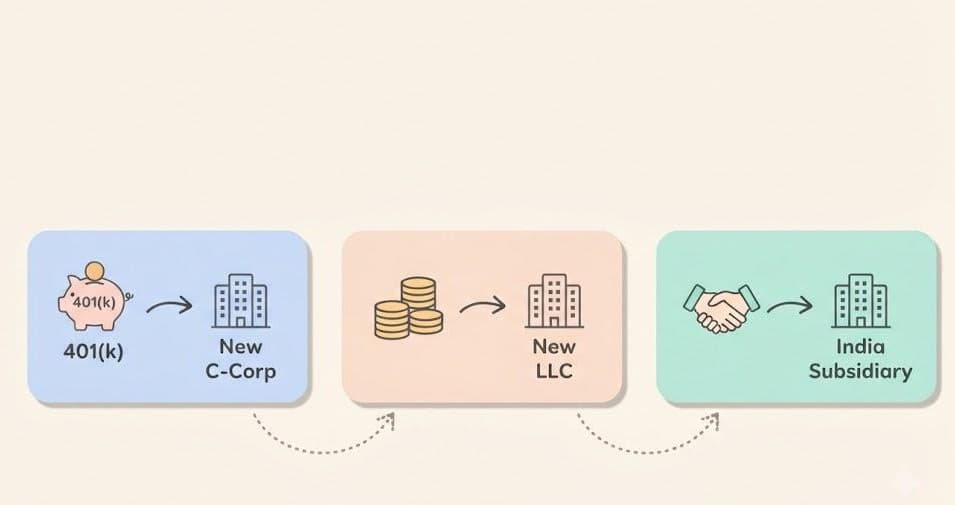
The fix: The individual sets up an Indian LLP or Private Limited Company, which then makes the ODI into the US entity. The Indian LLP holds the US shares and is the entity that handles all FEMA compliance — ODI reporting, APR filings, UIN maintenance. The individual's economic interest is preserved through the LLP structure, but the FEMA compliance is at the entity level.
CASE 4: INDIAN STARTUP SEEKING US VC — THE FLIP STRUCTURE AND ITS COMPLICATIONS
An Indian startup that wants to raise institutional venture capital from US investors often faces pressure to "flip" — to convert the structure so that a Delaware C-Corp sits at the top and the Indian entity becomes a subsidiary of the US parent.
This is Case 1 in structural terms but arrives through a different path, and the FEMA implications of the conversion matter.
When an Indian founder transfers their shares in an Indian company to a US C-Corp in exchange for shares in the US C-Corp — a share swap — this is a disposal of Indian company shares by Indian residents. It requires a specific FEMA approval process. The share swap must be reported. The valuation used for the swap must be certified. The shares received in the US C-Corp must be within the LRS limit for individual founders, or routed through an Indian LLP.
Post-flip: Once the structure is a US C-Corp parent with an Indian subsidiary, the ongoing compliance is Case 1 — FC-GPR for fresh FDI from the US parent, FLA return for the Indian subsidiary, transfer pricing on intercompany service flows, and Form 5471 for the US C-Corp's annual US filing.
The POEM risk: Place of Effective Management is the principle under which India taxes a foreign company whose effective management is in India. A US C-Corp with Indian founders who continue to be based in India, attending board meetings from India, making all business decisions from India, is at risk of being treated as an Indian company for Indian tax purposes — taxed at Indian corporate rates on its worldwide income. For a SaaS company with most of its revenue and customers in the US, POEM risk is manageable with proper governance. For a company whose US entity is primarily a fundraising vehicle with all actual operations in India, POEM risk is real.
WHICH STRUCTURE IS RIGHT FOR YOUR SITUATION
The honest answer is that no single structure is universally correct. But the decision tree is actually fairly clean.
If your primary revenue is from US customers and your primary capital is from US investors, a US parent with an Indian subsidiary is correct. The Indian entity is an operating entity — it generates no external revenue, it simply provides services to the US parent.
If your primary revenue is from Indian customers and you want a US commercial presence to close US enterprise deals, an Indian parent with a US subsidiary is correct. The US entity is a commercial entity — it faces customers, signs contracts, and bills them. The product and most of the team are in India.
If you are an Indian resident founder at an early stage before you have a holding entity, do not hold US company shares in your personal capacity beyond LRS limits. Set up the LLP or holding company first, make the investment from that entity, and treat the structure as the starting position rather than something to fix later.
If you are flipping for US VC, the share swap mechanics need careful FEMA handling, the POEM question needs to be addressed through proper US governance, and the post-flip compliance — specifically the annual APR on the Indian subsidiary and Form 5471 for the US parent — needs to be in your compliance calendar from year one.
HOW ACCORP PARTNERS HELPS
Accorp Partners advises on India-US holding structures from the initial structuring stage through post-incorporation compliance. For Indian companies with US subsidiaries, this includes ODI reporting, APR audit through in-house licensed US CPAs, and transfer pricing documentation. For US companies with Indian subsidiaries, this includes India incorporation through SPICe+, FDI reporting, FLA returns, and ongoing India compliance.
For founders navigating flip structures, share swaps, and POEM exposure, Accorp provides cross-border coordination across both the Indian and US sides of the structure.
Learn more about Accorp Partners' India incorporation and compliance services here:
https://accorppartners.com/services/incorporation/india-incorporation
Frequently Asked Questions
Q: Can an Indian Private Limited Company own 100% of a US C-Corporation?
A: Yes. An Indian company can invest in a US entity through the ODI framework under FEMA. The investment must be within 400% of the Indian company's net worth at the time of investment under the automatic route, made through an AD Category I bank, and reported through Form ODI Part I before the remittance is made. Annual Performance Reports must be filed by December 31 each year covering the US subsidiary's audited financial position.
Q: What is the two-layer subsidiary limit under FEMA ODI rules?
A: Rule 19(3) of the Foreign Exchange Management (Overseas Investment) Rules, 2022 limits overseas subsidiary structures to two layers under the automatic route. An Indian company can have an overseas subsidiary, which can have one further subsidiary — two layers in total. A third layer requires prior RBI approval and is not available on the automatic route.