Documents a US Company Needs to Incorporate in India: Apostille, Board Resolution and KYC
Company registration in India from the US? See documents required for foreign parents: apostille steps, board resolution contents and director KYC.

Accorp Compliance Team
Our team of compliance experts specializes in PCI DSS, SOC 2, and other security frameworks to help businesses achieve and maintain compliance.
A US company can complete company registration in India without setting foot in the country, but only if the paperwork is right. The delays rarely come from the Indian filing itself. They come from foreign documents that were not notarised, not apostilled, not signed by the right person, or not consistent with each other.
This guide lists the documents required for foreign shareholders and directors, explains how apostille works from the US, shows what the board resolution must say, and covers the KYC every director has to clear. Treat it as a checklist you can hand to your legal team before you start.
What Reviewers Are Actually Checking
When the Ministry of Corporate Affairs (MCA) reviews an incorporation filing, and later when your bank opens the account, they are asking three simple questions. Is this person or company real? Did the right people authorise this? And do the names, addresses and signatures match across every document? Most queries come from the third question. A parent name written one way on the resolution and another way on the certificate of incorporation is enough to cause a round of resubmission.
Pack 1: Documents From the US Parent Company
If a US company is the shareholder, it is a corporate subscriber. Expect to provide:
Certificate of incorporation of the US company, plus its charter documents such as the articles and bylaws. Some banks also ask for a certificate of good standing.
A board resolution authorising the investment and the incorporation of the Indian company. This is the most important document in the pack, and the next section covers it.
Authorisation or power of attorney for the person who will sign for the parent and, where needed, an authorised representative in India who can complete filings.
Details of directors and ultimate owners. The Indian company has to disclose who ultimately owns or controls it, so have the ownership chart ready.
Registered address and tax identification of the parent. Banks may also ask for it during KYC.
Everything in this pack should be in English or accompanied by a certified translation, and signed by someone who actually holds the authority the document claims.
Pack 2: Documents for Every Director and Signatory
Every proposed director and every person who signs on behalf of the parent needs an identity file. For foreign nationals, this usually means:
Passport. It is the mandatory identity proof.
Address proof. A recent bank statement or utility bill is commonly accepted. Our note on address proof for foreign nationals explains why this one catches many founders out.
Passport-size photograph.
Email address and phone number.
Specimen signature and the consent and declaration forms that the incorporation form requires, including consent to act as director.
The Indian resident director supplies Indian identity documents, usually a PAN card and Aadhaar. Our guide on whether a foreigner can be a director in an Indian company covers the eligibility rules. If you are an NRI with an Indian passport, the requirements differ, and our NRI documents checklist walks through them.
Pack 3: Documents for the Indian Company Itself
The company needs its own set of papers:
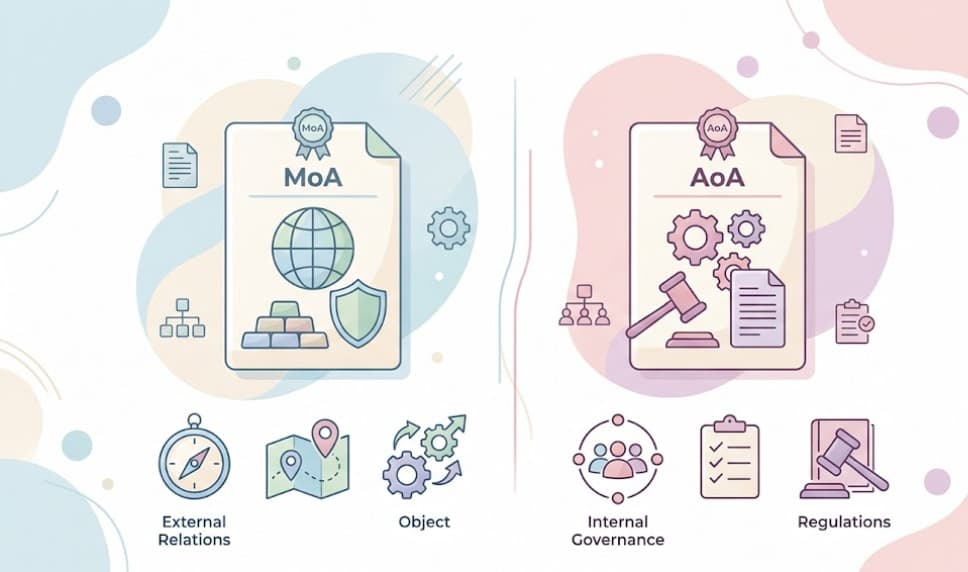
Memorandum and Articles of Association. These set out the objects, share structure and governance. Draft them to reflect the parent's approval rights and reporting needs.
Registered office proof. An address in India is mandatory. You will typically need proof of ownership or a rent agreement, a no-objection certificate from the owner, and a recent utility bill. See our guide on whether a foreign company can register with a virtual office.
Name approval and the subscriber details for each shareholder.
A nominee shareholder arrangement if the structure is wholly owned. A private limited company needs at least two shareholders, so a nominee holds one share on behalf of the parent.
The Board Resolution for an Indian Subsidiary: What It Must Say
The board resolution for Indian subsidiary incorporation is the document the whole filing rests on. It proves that the US company's board approved the investment and named the people who can act. A good resolution is specific. It should cover:
Approval to incorporate a wholly owned subsidiary in India, with the proposed name and purpose.
The amount of the investment and the number of shares the parent will subscribe to.
Authority for named individuals to sign the Memorandum, Articles and incorporation forms.
Approval of the nominee shareholder arrangement, if used.
Authority to appoint the first directors of the Indian company.
Authority to open the bank account, remit capital and complete the FEMA filings after allotment.
Authority for an Indian representative to act under a power of attorney.
Here is the kind of operative wording you would adapt. It is illustrative only, so have counsel certify the resolution as a true copy by a director or the corporate secretary, then notarise and apostille it. Our checklist for the incorporation of a wholly owned subsidiary in India shows where this document fits in the sequence.
Apostille: How It Works From the US
An apostille is an international certificate that authenticates the signature and capacity of the person who signed a document, so India will accept it. Both the US and India are members of the Hague Apostille Convention. This is the standard route for apostille documents for India company registration when documents originate in the US.
The usual chain looks like this:
Sign before a US notary. Documents signed outside India are generally notarised first. For corporate documents, the notary certifies the officer's signature.
Get the apostille. For notarised and state-level documents, the Secretary of State of the relevant state issues the apostille. Federal documents go through the US Department of State.
Keep the originals safe. Your adviser will tell you whether scanned copies suffice for the online filing and whether originals must be sent to India.
Allow time. The process commonly takes one to two weeks, depending on the state, and it is often the longest step in the timeline, so start it before everything else. Our guide on who needs an apostille for India incorporation explains when it applies and when it does not.
There are exceptions worth knowing. An NRI who holds an Indian passport and signs using Indian identity documents generally does not need the apostille route. A foreign director who is physically present in India may be able to complete some verification locally, as our note on skipping apostille when you travel to India explains. Even then, identity and address documents may still need authentication, so confirm before assuming.
KYC: DIN, DSC and the Annual Filing
KYC for a company is mostly a story about its directors.
DIN. Every director needs a Director Identification Number. For a new company, foreign directors obtain it through the incorporation form itself.
DSC. Directors sign the incorporation forms electronically with a Digital Signature Certificate. Foreign directors can usually obtain it remotely through video verification with an Indian certifying authority.
Annual director KYC. Every director holding a DIN must complete DIR-3 KYC each year by 30 September.
Our remote setup guide for NRIs and foreign founders describes how the process works without travel.
After Incorporation: Documents for the Bank and the RBI
Incorporation is not the end of the paperwork. Banks and the RBI ask for a second round. To open the company account, expect to provide the certificate of incorporation, the charter documents, PAN, a board resolution authorising the account and naming signatories, registered office proof and KYC of the directors and the foreign shareholder. Foreign shareholders may be asked for apostilled passport copies and overseas address proof. Our company bank account guide lists what banks typically request.
When the US parent remits capital, keep the bank's evidence of the inward remittance, the share allotment records and the valuation certificate. You need them for Form FC-GPR, which is filed within 30 days of allotment. Our RBI reporting guide explains the form, and our FEMA compliance page covers the wider obligations.
Mistakes That Cause Rejections and Delays
The same errors come up again and again. The parent's name differs between the resolution and the certificate of incorporation. The resolution does not name the signatory or mention the investment amount. Documents are notarised but never apostilled, or apostilled in the wrong order. Address proof is outdated or does not match the passport details. The resolution is signed by someone with no authority to act for the company. And teams start the apostille late, then wait weeks for it while everything else is ready.
A Sensible Order of Work
Week 1: confirm the structure, the director line-up and the resident director. Draft the board resolution and gather identity and address documents.
Weeks 1 to 2: get documents notarised and start the apostille. Begin DSC and DIN steps in parallel.
Weeks 2 to 3: line up registered office proof, finalise the Memorandum and Articles, and reserve the company name.
After approval: open the bank account, remit capital, allot shares and file FC-GPR.
Timings vary by state and by how quickly documents move, so treat these as planning guides.
The Takeaway
Company registration in India from the US is largely a document exercise. Get the board resolution specific, make every name match across every paper, start the apostille first, and keep a clean KYC file for each director. Do that, and the filing itself is routine.
Gathering documents for an Indian subsidiary? Talk to Accorp Partners about pre-checking your documents, coordinating the apostille and completing the incorporation and FEMA filings for your US-owned company.
Frequently Asked Questions
1. Do all documents from the US need an apostille?
Generally, the foreign documents that prove identity, address and corporate authority do. This includes the board resolution, the parent's charter documents and the directors' passports and address proof. Documents prepared in India, such as the company's own Memorandum, do not. Your adviser should map each document before you send anything for authentication.
2. Can the same person sign for the parent and act as a director?
Yes. It is common for a US officer to sign the resolution and also be appointed a director of the Indian company. Just make sure the resolution names that person and gives clear authority, and that the same name appears on every document.
3. Certifies the board resolution?
A director or the corporate secretary certifies it as a true copy. The certified copy is then notarised and apostilled. If your bylaws require a specific approval process, follow it, because a reviewer may ask how the board approved the resolution.
4. How long should documents be valid when we file them?
Identity and address proofs should be current. Utility bills and bank statements are commonly accepted only if recent, often within the last two months, and the MCA and banks can differ. Check the current requirement before you order the apostille so you do not need to redo it.
5. Can our founder sign documents while visiting India?
Sometimes. A foreign national who is in India and signs before a practising Chartered Accountant or Company Secretary may avoid part of the notarisation and apostille chain, but identity and address documents can still need authentication. Confirm with your adviser before you plan around it.
6. Do we need a resident director before we file?
Yes. A private limited company must have at least one director who has stayed in India for the prescribed period in the previous year. Line this person up early, because their documents form part of the filing.