.svg)
.svg)
.svg)
Selling SaaS to French Enterprises: Why a SOC 2 Report Alone Won't Close the Deal
Discover French SaaS compliance requirements, including SOC 2, GDPR, CNIL, SecNumCloud, HDS, data residency, and sovereignty for enterprise sales.

Accorp Compliance Team
Our team of compliance experts specializes in PCI DSS, SOC 2, and other security frameworks to help businesses achieve and maintain compliance.
A SaaS company lands a promising enterprise opportunity in France, sends over its SOC 2 Type 2 report the moment security review comes up, and then watches the deal quietly stall for six weeks — not on price, not on product, but on a set of questions the sales team has never been asked before. Where exactly does the data reside? Is the platform SecNumCloud-qualified? Is there a French-language DPA aligned to CNIL's reference clauses? Nobody on the vendor's side saw this coming, because in the US and UK markets, a clean SOC 2 auditor certification is usually the whole conversation.
This is a genuinely common pattern for companies expanding into France for the first time, and it's worth understanding precisely why a SOC 2 report — even an excellent one — doesn't carry the same weight there that it does elsewhere.
Why a SOC 2 Report Doesn't Travel the Same Way in France
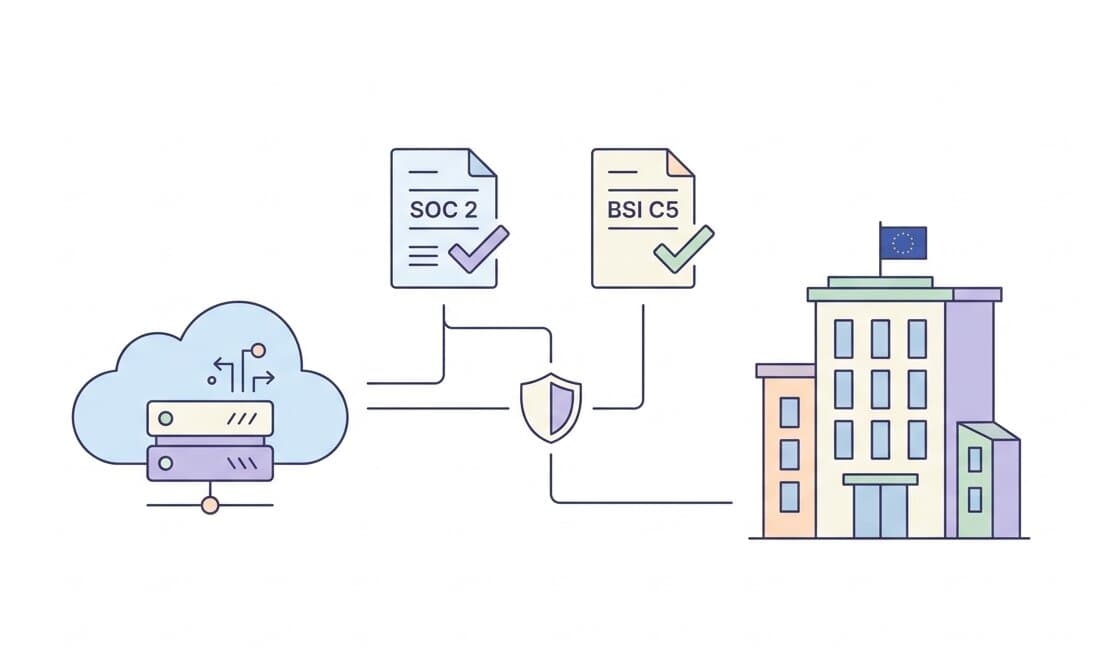
SOC 2 is an AICPA framework, built around US auditing standards, and a SOC 2 audit report — particularly a SOC 2 Type 2 report covering operating effectiveness over an extended period — is genuinely strong evidence of a mature security program. French enterprise buyers, particularly in regulated sectors like financial services, insurance, and healthcare, don't dismiss it. They just don't treat it as sufficient on its own, because French procurement evaluates SaaS vendors through a distinctly different regulatory lens: data sovereignty, not just data security.
This distinction matters more than it sounds. A SOC 2 report tells a buyer that a vendor's controls around confidentiality, availability, and processing integrity are sound and independently verified. It says nothing about where the data physically resides, which country's laws can compel access to it, or whether the vendor's contractual documentation is even usable by a French legal or procurement team in the language they actually operate in. Those three questions are exactly where French enterprise deals stall.
GDPR Compliance Isn't the Same as CNIL-Ready Documentation
Most SaaS companies selling into Europe already treat GDPR compliance as table stakes, and that's correct as far as it goes. What catches vendors off guard in France specifically is the gap between being "GDPR compliant" in a general European sense and having documentation that actually satisfies a French Data Protection Officer's expectations.
France's data protection authority, the CNIL, publishes reference clauses for standard Data Processing Agreement terms, and French DPO offices expect to see those reflected accurately — not paraphrased, not approximated. A French-language SLA and DPA are expected as native French-language documents, not a translated version of the English original with a French cover page stapled on. Vendors that show up with English-only legal documentation, assuming their SOC 2 compliance narrative will cover the gap, routinely find their deal stuck in legal review for weeks over exactly this issue, entirely separate from any actual security concern.
Under Article 32 of GDPR, security obligations sit at the center of CNIL's enforcement posture, with fines reaching up to €20 million or 4% of an organization's global turnover for breaches — which is precisely why French legal and DPO teams scrutinize the underlying documentation as closely as the security certification itself.
Data Residency: Where "EU Region" Stops Being Good Enough
For companies used to selling across the broader EU market, hosting data in Dublin or Frankfurt and calling it "EU-based" is usually sufficient. In France, particularly for financial institutions and public-sector-adjacent buyers, this default frequently fails procurement review outright. French enterprise buyers increasingly distinguish between data merely being stored within EU borders and data being genuinely protected from extraterritorial legal reach — a distinction most non-French vendors haven't had to think about before entering this specific market.
This is the sovereignty question, and it's a separate axis from GDPR compliance entirely. A vendor can be fully GDPR-compliant while still being subject to US extraterritorial laws like the CLOUD Act, simply because of its corporate structure or its underlying cloud infrastructure provider — and French procurement teams, especially in banking, insurance, and government-adjacent sectors, are now actively screening for exactly this exposure.
SecNumCloud: The Qualification Most Non-French Vendors Have Never Heard Of
SecNumCloud is a security and sovereignty qualification issued by ANSSI, France's national cybersecurity agency, covering close to 1,200 technical, organizational, and legal requirements for cloud service providers. It's considerably more demanding than a standard security certification, and critically, it includes explicit protection against extraterritorial laws such as the US CLOUD Act and FISA — the exact gap a SOC 2 report and even solid GDPR compliance don't close.
Not every SaaS deal in France requires SecNumCloud qualification — it becomes specifically relevant for public-sector-adjacent buyers and, under France's "cloud at the centre" doctrine, mandatory for hosting sensitive central-government data. But for vendors targeting regulated French enterprise segments, seeing SecNumCloud referenced in an RFP is a strong signal that the buyer's procurement process goes meaningfully beyond what a SOC 2 Type 2 audit alone demonstrates. In practice, most French RFPs at this level of sovereignty scrutiny name a small handful of SecNumCloud-qualified infrastructure providers specifically, which shapes which underlying cloud infrastructure a vendor can even build on if it wants to compete seriously in this segment.
HDS Certification: The Health Data-Specific Requirement
For any SaaS company handling health data in France, there's a separate, mandatory certification requirement entirely distinct from SecNumCloud. Under Article L.1111-8 of the French Public Health Code, hosting personal health data collected in the course of prevention, diagnosis, care, or related social support requires Hébergement de Données de Santé (HDS) certification — and recent regulatory changes effective through 2026 have tightened this further, now requiring the underlying hosting infrastructure to hold SecNumCloud v2.3 qualification as part of HDS compliance.
It's worth being precise that HDS certification and genuine protection from extraterritorial legislation are two distinct things — a hosting provider can hold HDS certification while still falling under US law if it's ultimately controlled by a non-European parent. Vendors in health-adjacent SaaS categories need to understand this distinction clearly before making sovereignty claims to a French buyer that their actual corporate structure doesn't support.
Sector-Specific Regulators That Don't Show Up in a Standard Security Questionnaire
For SaaS companies selling into French financial services or capital markets specifically, there's an additional layer beyond data protection and sovereignty entirely: sector regulator expectations. French financial institutions evaluate vendors against questions like whether a platform is declared to the ACPR (France's banking and insurance regulator) or whether it integrates with the AMF's reporting portal for capital markets activity. These questions won't appear on a generic enterprise security questionnaire built around SOC 2 compliance and ISO 27001 — they're specific to the French regulatory architecture, and a vendor caught unprepared for them mid-deal loses real momentum re-explaining its compliance posture from scratch.
What to Actually Prepare Before Entering the French Market Seriously
For a SaaS company with real interest in the French enterprise segment, rather than an opportunistic single deal, the practical preparation sequence looks different from a standard EU expansion checklist: confirm the SOC 2 Type 2 report and ISO 27001 certification are current and well-documented as the baseline, since these remain necessary even if not sufficient; invest in genuine French-language legal documentation — DPA, SLA, and terms — reviewed against CNIL's own reference clauses rather than translated after the fact; make a deliberate decision on data residency and sovereignty positioning before a French RFP forces the question reactively; and, for regulated sectors specifically, confirm early whether SecNumCloud qualification, HDS certification, or ACPR/AMF-related integration is actually a requirement for the target buyer segment rather than assuming a generic EU compliance posture will suffice.
Companies that treat this as a genuine market-entry investment, rather than translating their existing SOC 2 auditor certification story into French and hoping it lands, consistently move through French enterprise procurement faster than those discovering these requirements deal by deal.
Where Accorp Fits In
Accorp Partners works with SaaS companies preparing for exactly this kind of cross-border enterprise sales cycle — making sure the SOC 2 reporting foundation is solid, while also helping identify which additional French-specific requirements, from CNIL-aligned documentation to sovereignty positioning, actually apply to a given company's buyer segment before a deal stalls on a question nobody saw coming.
Frequently Asked Questions
1. Is a SOC 2 Type 2 report still necessary for selling SaaS in France?
Yes. It remains the baseline expectation for enterprise security review, but French buyers — particularly in regulated sectors — layer additional sovereignty and localization requirements on top of it rather than treating it as sufficient alone.
2. Does hosting data in an EU data center satisfy French data residency expectations?
Not always. Hosting in Dublin or Frankfurt is often treated as a generic EU-region default that fails procurement review at major French financial institutions specifically looking for genuine data sovereignty, not just EU-based storage.
3. When is SecNumCloud qualification actually required?
It's specifically relevant for public-sector-adjacent buyers and mandatory under France's "cloud at the centre" doctrine for sensitive government data. Most private enterprise deals don't strictly require it, but its presence in an RFP signals a sovereignty-focused procurement process.