.svg)
.svg)
.svg)
SOC 2 for German Financial Clients: Where DORA and NIS2 Actually Fit In
See how SOC 2 supports DORA and NIS2 readiness for German financial services, including vendor risk, incident reporting, contracts, and resilience.

Accorp Compliance Team
Our team of compliance experts specializes in PCI DSS, SOC 2, and other security frameworks to help businesses achieve and maintain compliance.
Every SaaS company selling into German financial services eventually hits the same wall. You've got a solid SOC 2 audit report, your German prospect's security team seems satisfied — and then their legal or risk team comes back with a question your sales team can't quite answer: "are you DORA compliant, and what about NIS2?" If you're not deep in EU financial regulation, this can feel like an entirely separate compliance universe suddenly attached to a deal you thought was nearly closed. It isn't a separate universe, exactly — but understanding where SOC 2 compliance ends and where DORA and NIS2 begin is genuinely necessary before you can answer that question with any confidence.
This piece walks through what DORA and NIS2 actually require, why German financial institutions ask about both on top of SOC 2, and how vendors selling into this market typically position themselves.
Why German Financial Buyers Don't Stop at a SOC 2 Report
A SOC 2 audit report tells a buyer that an independent CPA firm examined your controls and, for a SOC 2 Type 2 audit specifically, found them operating effectively over a real review period. That's a meaningful signal to almost any enterprise buyer worldwide. German financial institutions, however, operate under a regulatory regime that goes considerably further than "prove your controls work" — they're legally required to prove that their entire ICT supply chain, including every vendor they rely on, can withstand and recover from operational disruption. That's a fundamentally different question than the one a SOC 2 auditor is built to answer, and it's why SOC 2 reporting alone doesn't close the conversation with a German bank, insurer, or payment provider.
What DORA Actually Requires
The Digital Operational Resilience Act is an EU regulation — directly applicable across member states without needing separate national legislation — that has applied to financial entities since January 2025. Unlike SOC 2's outcome-based approach, DORA is genuinely prescriptive. It targets banks, insurers, securities firms, payment service providers, crypto-asset service providers, and, critically, their ICT third-party providers directly.
A few requirements stand out as the ones that matter most for a vendor selling into this space:
A mandatory Register of Information. Financial entities must maintain a complete, accurate, and current register of every ICT arrangement they rely on — including subcontractor chains for anything supporting a critical function. Supervisors have made clear that a register unable to answer "which ICT providers support our critical functions, and who are their subcontractors" is treated as a compliance failure in its own right, and this register has become a priority audit target as enforcement has ramped up through 2026.
Direct oversight of critical ICT third parties. Providers designated as critical under DORA face direct regulatory scrutiny — audit rights, incident reporting obligations, and ongoing performance monitoring baked directly into contracts, not just requested informally during vendor review.
Threat-Led Penetration Testing. For systemically important institutions specifically, DORA mandates a considerably more demanding testing regime than a standard annual penetration test — something well beyond what most SOC 2 Type 2 audits require as supporting evidence.
Strict incident reporting timelines. Incidents must be classified as major or non-major within four hours, with initial notification to the relevant national authority — for German institutions, that's BaFin — following shortly after. This is a materially faster and more structured process than anything a SOC 2 auditor typically evaluates.
What NIS2 Adds on Top
The Network and Information Security Directive 2 is a directive rather than a regulation, meaning it required national transposition — in Germany, this arrived through the NIS-2 Implementation and Cybersecurity Strengthening Act, which came into force in December 2025. NIS2 casts a wider net than DORA, covering essential and important entities across eighteen sectors, including financial services, but with requirements that are generally less granular than DORA's.
Where NIS2 matters for vendors is largely around supply chain security and incident reporting. Essential entities face regular, targeted, and ad hoc security audits, either from an independent body or a competent authority, with results shared with that authority. Incident reporting under NIS2 in Germany runs through the BSI — the Federal Office for Information Security — on an "immediate" basis, which is a separate reporting channel from DORA's BaFin notification process, even when the same incident might trigger both.
The Rule That Resolves the Overlap: DORA as Lex Specialis
This is the detail that trips up a lot of vendors trying to understand which framework actually governs a given German financial deal. Where DORA and NIS2 address the same topic for an in-scope financial entity, DORA functions as lex specialis — meaning its more specific, sector-tailored requirement takes precedence over NIS2's broader rule. Banks and credit institutions, along with financial market infrastructure like trading venues and central counterparties, fall under DORA rather than NIS2 for ICT risk specifically. NIS2 still applies additionally in areas DORA doesn't cover, which is why financial institutions in Germany often end up managing both frameworks in parallel rather than picking one.
For a vendor, the practical takeaway is this: if your German customer is a bank, insurer, or payment institution, DORA is almost certainly the framework driving their vendor risk questions, even if NIS2 vocabulary shows up in the same conversation.
Where SOC 2 Compliance Genuinely Helps
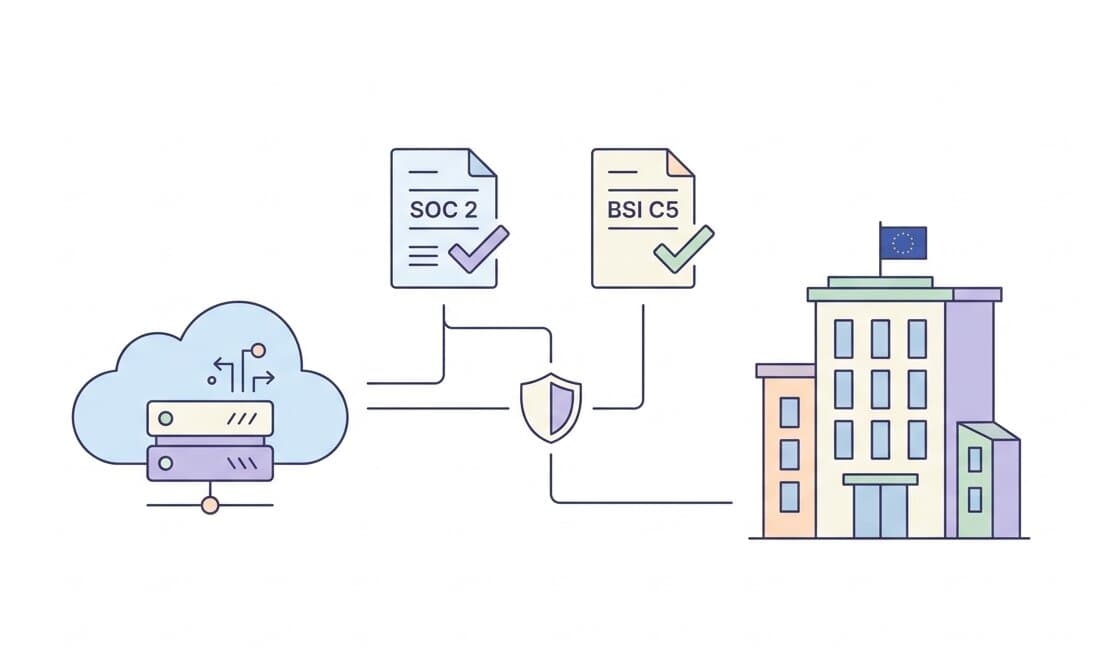
None of this makes a SOC 2 audit report irrelevant to a German financial buyer — it just isn't sufficient on its own. A well-evidenced SOC 2 Type 2 report demonstrates exactly the kind of sustained operational control discipline that DORA's ICT risk management framework is built around: access management, change management, incident response, monitoring. German risk teams evaluating vendors still want to see this, and a credible SOC 2 reporting history gives them a foundation to build their DORA-specific due diligence on top of, rather than starting from zero.
Where SOC 2 falls short is in the areas DORA specifically legislates that fall outside a typical SOC 2 auditor's scope: the contractual specifics DORA mandates (audit rights, exit strategies, subcontracting disclosure clauses), the four-hour incident classification timeline, and Threat-Led Penetration Testing for critical providers. A vendor relying solely on "we have SOC 2" to answer a DORA-driven vendor questionnaire will find the conversation stalls quickly once the buyer's risk team starts asking about the Register of Information or contractual exit provisions.
What Vendors Selling Into German Financial Services Actually Need to Prepare
Contractual readiness matters as much as technical controls. DORA requires financial entities to build specific clauses into every ICT third-party contract — SLAs, audit rights, termination and exit rights, and incident notification obligations. Being ready to negotiate these terms, rather than being caught off guard by them, meaningfully shortens a German enterprise sales cycle.
Incident reporting alignment. If your incident response process can realistically support a customer's four-hour DORA classification window — and, separately, feed into their BSI reporting obligations under NIS2 — say so explicitly in your security documentation rather than making the buyer's risk team dig for it.
Subcontractor transparency. DORA's Register of Information requirement means your German customer needs visibility into your own subcontractor chain, not just your direct relationship. Being able to hand over a clean, current list of your critical subprocessors — the same discipline SOC 2 auditors expect around vendor risk management — pays off doubly here.
Positioning SOC 2 accurately. Be precise in security questionnaires and RFPs about what your SOC 2 Type 2 report demonstrates versus what falls outside it. A German risk team that catches a vendor overstating SOC 2's coverage of DORA-specific requirements will scrutinise everything else in the response far more closely.
The Bigger Pattern: Germany's Sovereignty and Resilience Push
This isn't happening in isolation. Germany's financial regulators, working through BaFin's DORA implementation guidance built on the existing BAIT and VAIT supervisory frameworks, have signalled that DORA compliance is now the reference standard, replacing those older IT supervisory requirements entirely by the end of 2026. Vendors already familiar with BAIT-aligned German institutions have a head start, but DORA meaningfully raises the bar in third-party oversight, resilience testing, and the formalised Register of Information — areas that go well beyond what BAIT, or a standard SOC 2 audit, previously required.
Where Accorp Fits In
Accorp Partners works with SaaS and technology companies navigating exactly this gap — helping teams understand what their existing SOC 2 compliance program actually demonstrates to a German financial buyer, where DORA and NIS2 introduce genuinely separate obligations, and how to position both honestly in an RFP rather than discovering the gap mid-negotiation with a German bank's risk committee.
Frequently Asked Questions
1. Does a SOC 2 Type 2 report satisfy DORA requirements for a German financial client?
Partially. It demonstrates operational control maturity that supports DORA's ICT risk management expectations, but it doesn't cover DORA-specific requirements like the Register of Information, contractual exit clauses, or Threat-Led Penetration Testing.
2. Do vendors need to comply with both DORA and NIS2 for German deals?
Often yes, in parallel — DORA takes precedence as lex specialis wherever the two frameworks overlap for financial-sector ICT risk, but NIS2 still applies in areas DORA doesn't specifically cover.
3. Is DORA compliance mandatory or voluntary, unlike SOC 2 reporting?
Mandatory. Unlike a SOC 2 audit, which financial institutions choose to require of vendors, DORA is a binding EU regulation for in-scope financial entities themselves, which is why they push equivalent expectations down onto their vendors contractually.
4. What's the fastest way for a vendor to show DORA readiness alongside SOC 2 compliance?
Maintain a current, accurate subcontractor and subprocessor list, be ready to negotiate DORA-specific contract clauses, and be explicit in security questionnaires about exactly what your SOC 2 auditor tested versus what falls outside that scope.