.svg)
.svg)
.svg)
LRS vs ODI — Which Route Should an Indian Founder Use to Fund Their Foreign Company
Compare LRS and ODI for overseas investments by Indian founders. Understand FEMA rules, remittance limits, APR filings, and RBI compliance.

Accorp Compliance Team
Our team of compliance experts specializes in PCI DSS, SOC 2, and other security frameworks to help businesses achieve and maintain compliance.
You've built an Indian company. You're setting up a foreign subsidiary — Delaware, Singapore, Dubai, wherever. You need to move money from India to fund it. Your bank asks how you want to route the remittance. And suddenly you're staring at two options — LRS and ODI — with no clear explanation of which one applies to you, what the limits are, or what happens if you get it wrong.
Nobody explains this in plain language for founders. This article does exactly that.
The Core Confusion — Individual vs Company as Investor
The first thing to understand is that LRS and ODI are not two versions of the same thing. They govern two entirely different investors.
LRS (Liberalised Remittance Scheme) applies to resident individuals — you personally, as a human being with a PAN card and a bank account. When you, as an individual, want to move money from India to a foreign company — whether to subscribe to shares, fund a subsidiary, or make a capital contribution — you do it under LRS.
ODI (Overseas Direct Investment) under the ODI Rules 2022 applies to Indian entities — your Indian Private Limited Company, your LLP, your partnership. When your Indian company wants to invest in a foreign subsidiary, that investment travels under the ODI framework.
Same destination. Completely different regulatory track. Different caps, different forms, different filing timelines, and different annual compliance obligations once the money has moved.
This distinction matters enormously because most founders are both: they are individuals who personally hold shares in a foreign entity, and they are directors of an Indian company that also holds shares in the same foreign entity. Both positions carry separate FEMA obligations. Satisfying one does not satisfy the other.
LRS: What It Covers, What It Caps, and Where It Breaks Down
The Liberalised Remittance Scheme permits every resident individual to remit up to USD 250,000 per financial year (April to March) for a range of permissible purposes — including overseas direct investment in an unlisted foreign company, overseas education, travel, and maintenance of close relatives abroad.
The USD 250,000 cap is a consolidated ceiling. It covers all permissible transactions combined across the financial year. So if you remit USD 150,000 for an overseas investment in July, your remaining LRS headroom for the year is USD 100,000 — across all purposes, including travel and education. The cap resets on April 1. Unused amounts do not carry forward.
For founders with co-founders: each individual has their own USD 250,000 cap. A founding team of four can collectively remit up to USD 1 million in a single year if each person is making a personal investment in the foreign entity. This is sometimes called "family pooling" and is a legitimate planning tool for early-stage founders trying to capitalise a foreign holding company above the individual cap.
Where LRS breaks down is when the capitalisation requirement exceeds what individuals can collectively remit in a single year, or when the Indian company — rather than the individual founders — needs to be the investor of record in the foreign entity for tax, structuring, or investor relations reasons.
Three LRS restrictions founders often miss:
First, under LRS you cannot remit borrowed funds for investment purposes. The money must come from your own resources — salary, savings, dividends received. Using a personal loan to fund an LRS investment is a FEMA violation.
Second, LRS does not permit investment in foreign entities engaged in financial services, unless specific conditions are met. A founder setting up a fintech holding company offshore should verify the permitted activity scope before routing under LRS.
Third, the round-tripping prohibition is absolute. If you remit money from India under LRS to a foreign company, and that foreign company then invests the same money back into an Indian entity — or subscribes to shares of an Indian startup — you have violated the round-tripping prohibition under FEMA, regardless of how the transaction is structured on paper. This is one of the most common structuring errors in Indian startup ecosystems and one of the most difficult to fix after the fact.
ODI: The Company Route, the 400% Cap, and the Compliance Stack
When the Indian company — rather than the individual founder — is investing in a foreign subsidiary, the transaction is governed by the Overseas Investment Rules 2022 as Overseas Direct Investment.
The ODI route applies when an Indian entity acquires 10% or more of the equity in an unlisted foreign entity, or makes any investment for strategic control in a foreign entity regardless of percentage. Below 10% in a listed entity is Overseas Portfolio Investment (OPI) — a separate category with lighter compliance requirements.
The investment cap under ODI is materially different from LRS. An Indian entity can invest up to 400% of its net worth in overseas entities through the automatic route — meaning without prior RBI approval. Net worth is calculated from the last audited balance sheet, and the 400% ceiling covers the aggregate of all financial commitments: equity investments, loans extended to the foreign subsidiary, and guarantees issued on its behalf.
A newly incorporated Indian company with ₹1 lakh in paid-up capital has a net worth of approximately ₹1 lakh — meaning its ODI capacity under the automatic route is approximately ₹4 lakh. That is effectively zero for any meaningful foreign investment. This is why many early-stage startups route the initial capitalisation of their foreign holding company through individual LRS rather than ODI — the Indian entity simply does not have the balance sheet to support meaningful ODI at inception.
As the Indian company grows and builds net worth through retained earnings and paid-up capital, the ODI capacity grows proportionally. A company with ₹10 crore in net worth can invest up to ₹40 crore in overseas subsidiaries under the automatic route without seeking RBI approval.
The Filing Obligations — What Actually Happens After the Money Moves
This is the part most founders never hear about until it becomes a problem.
Under LRS (individual investing):
Form A2: Submitted to the AD Bank at the time of each remittance, declaring the purpose code (S0001 for equity investment)
Form FC: Filed through the AD Bank within 30 days of making the investment, generating a UIN (Unique Identification Number) for the investment
Share certificates: Must be submitted to the bank within 6 months of remittance as evidence the investment was actually made
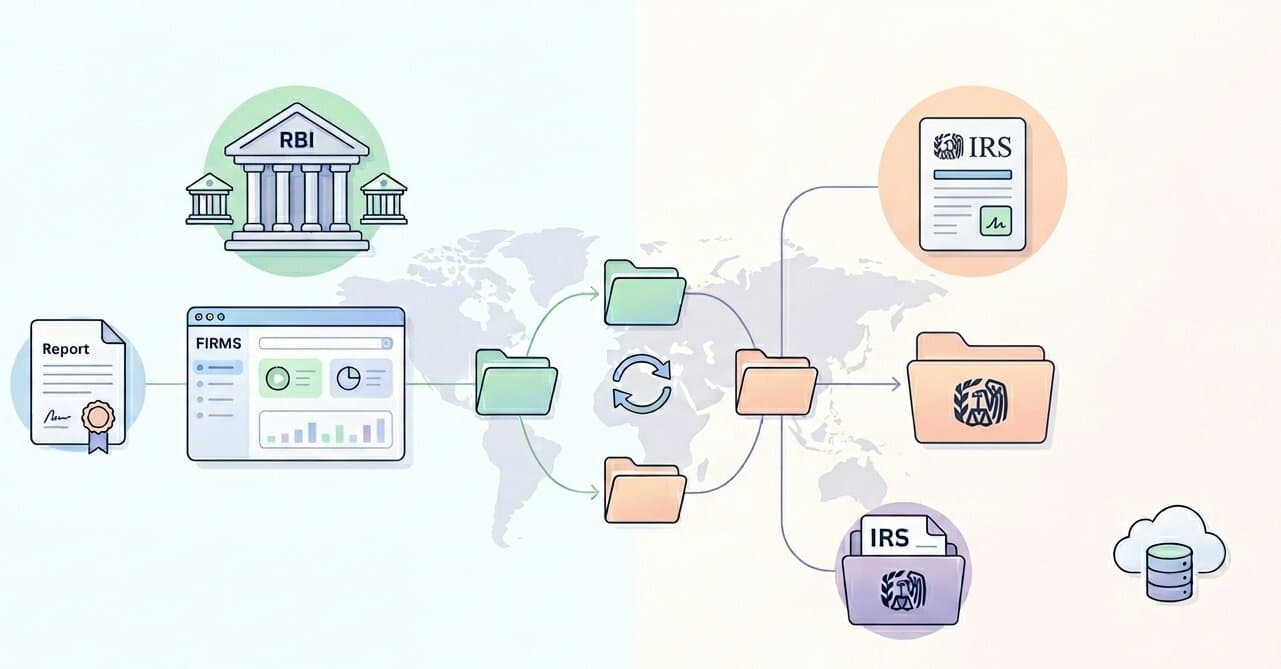
Annual Performance Report (APR): Filed by December 31 each year for every foreign entity in which you hold ODI — covering the entity's audited financial statements for the previous calendar year. This is the overseas subsidiary audit requirement that catches founders off guard most often
Under ODI (Indian company investing):
Form FC: Filed within 30 days of every financial commitment — every equity infusion, every loan to the foreign subsidiary, every guarantee issued
APR (Annual Performance Report): Filed by December 31 each year for every foreign subsidiary — covering audited financials of the foreign entity. This is the foreign subsidiary audit compliance requirement that most companies miss
FLA Return (Foreign Liabilities and Assets): Filed by the Indian company directly on the RBI FLAIR portal by July 15 each year, covering all ODI positions as of the end of the Indian financial year
APR filing for foreign subsidiaries requires the foreign entity's accounts to be audited — not just management accounts — for the period ending December 31 of the reporting year
The APR — The Single Most Missed Filing in Indian FEMA Compliance
The Annual Performance Report deserves its own section because it is the most consistently missed filing in the entire FEMA compliance stack for Indian founders with overseas subsidiaries.
Here is what founders do not understand about the APR deadline: it is December 31, not March 31. Unlike almost every other Indian compliance deadline — income tax, GST, MCA, FLA — the APR uses the calendar year, not the Indian financial year.
This means the APR due December 31, 2025 covers the foreign subsidiary's financials for the year ending December 31, 2024. A founder who incorporated their Singapore subsidiary in March 2024 and assumed their first APR was not due until after the March 2025 financial year close is wrong — their first APR was already due December 31, 2024.
In August 2025, the RBI issued a directive that makes missing APRs directly consequential: any Indian entity with unresolved ODI reporting violations cannot make any new overseas investment until those violations are fully regularised. This means a startup that missed its Singapore subsidiary APR in 2023 and 2024 cannot now set up a US entity, cannot extend a loan to the existing Singapore company, and cannot issue a guarantee — all new overseas financial commitments are blocked until the historic filings are filed with the applicable Late Submission Fee and the RBI's records are clean.
The Late Submission Fee starts at ₹7,500 and scales based on the transaction value and the length of delay. For large transactions missed over multiple years, the LSF can become significant — but it is still far cheaper and faster than the compounding process under Section 15 of FEMA, which involves RBI adjudication and can take months to resolve.
Choosing Between LRS and ODI — The Decision Framework
For most Indian founders, the question is not either/or. It is sequencing and structure.
Use LRS when:
The investment is being made personally as an individual founder or co-founder
The amount is within USD 250,000 per person per year (or can be split across co-founders)
The Indian company is newly incorporated and lacks the net worth to support meaningful ODI
The foreign entity is a holding company or operating entity in which you want personal direct ownership
Use ODI when:
The Indian company — not the individual — needs to be the legal investor of record in the foreign subsidiary
The investment exceeds what LRS can accommodate, and the Indian company has sufficient net worth
The structure involves the Indian company as a parent company with the foreign entity as a wholly owned subsidiary
Institutional investors in the Indian company require the corporate ownership chain to be clean
The most common structure for Indian founders building a global company: The Indian company invests in the foreign subsidiary through ODI, establishing a clear parent-subsidiary relationship. Individual founders may also hold a small personal stake in the foreign entity through LRS. Both positions carry separate filing obligations, and both need their own APR filed annually.
What Happens at the Overseas Subsidiary Audit Stage
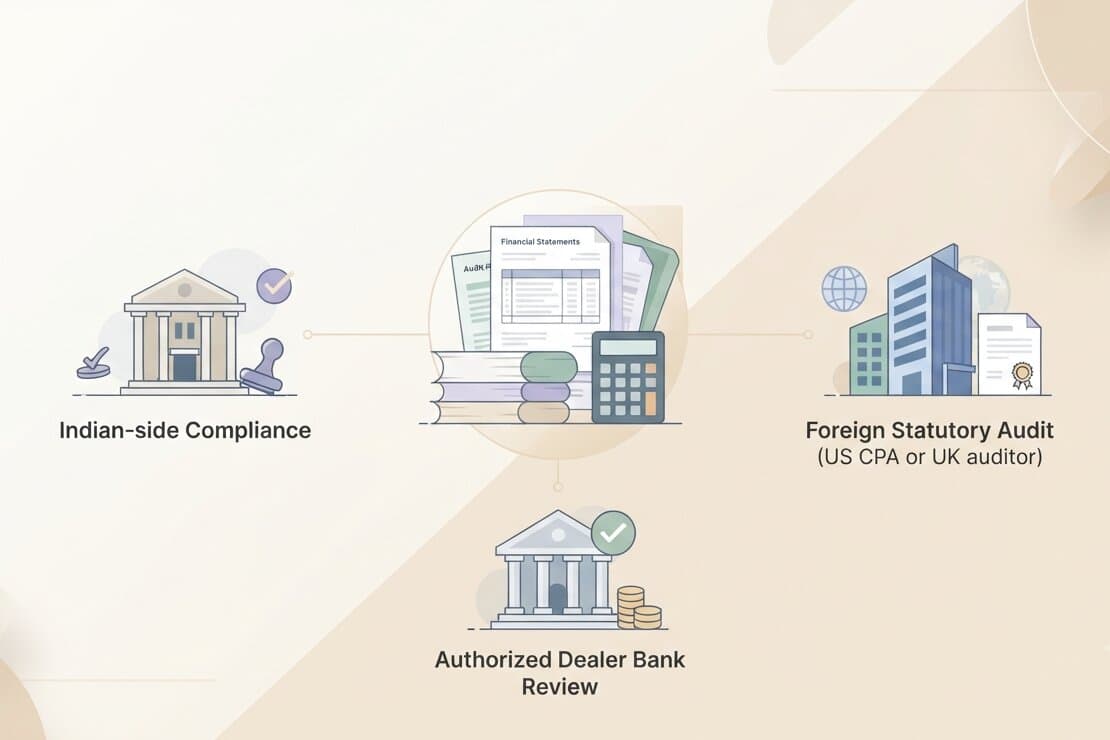
The APR obligation requires the foreign subsidiary's accounts to be audited by an auditor acceptable under the laws of that country. For a Delaware C-Corp, that means a US CPA firm. For a Singapore Pte Ltd, that means a Singapore-licensed auditor.
This requirement catches founders who treat their foreign subsidiary as a dormant shell — assuming that because the entity has no external revenue, it does not need audited accounts. It does, for FEMA APR purposes, regardless of operational status. A foreign subsidiary with zero revenue still has equity capital on its balance sheet, and the RBI requires audited confirmation of that position annually.
For newly incorporated foreign entities in their first year, where the accounts may not yet be audited by the December 31 deadline, the RBI allows the APR to be filed with unaudited financials — provided this is disclosed in the filing and audited figures are submitted once available. Filing with unaudited figures without disclosure is itself a compliance deficiency.
The August 2025 RBI Directive — Why ODI Compliance Cannot Be Deferred
Before August 2025, missing an APR was a penalty risk — annoying and correctable, but not immediately operationally consequential. The August 2025 directive changed that calculation entirely.
Any Indian entity with an unresolved ODI reporting violation — a missed APR, a delayed Form FC, an unreported change in the foreign subsidiary's shareholding — is now blocked from making any new overseas financial commitment until the violation is regularised. No new equity investment. No new loans to subsidiaries. No new guarantees.
For a startup in growth mode — raising a round, adding entities, extending intercompany loans — this block can halt expansion plans mid-execution. And because it surfaces during investor due diligence, it affects fundraising timelines in exactly the way that matters most.
The practical message: ODI compliance is not a back-office administrative task. It is a front-line business continuity issue.
How Accorp Partners Manages This for Indian Founders
The LRS vs ODI distinction, the APR filing calendar, the foreign subsidiary audit requirement, and the post-August 2025 RBI compliance environment form a connected compliance system — not a collection of isolated filings.
Accorp Partners works with Indian founders who have overseas subsidiaries on the full ODI and FEMA compliance stack: Form FC filings, APR coordination with the foreign subsidiary's auditor, FLA return preparation, and resolution of historic filing gaps through the Late Submission Fee mechanism before they block new investment activity.
For founders who are at the structuring stage — deciding whether the individual or the Indian company should be the investor in the foreign entity — Accorp provides the structural analysis before the first remittance is made, not as a remediation exercise after the structure is already in place.
Learn more: accorppartners.com/services/cpa_services/apr
The Bottom Line
LRS and ODI are not interchangeable. They govern different investors, carry different caps, and generate different annual compliance obligations. The choice between them is not primarily a tax question — it is a structural question that determines your compliance footprint for as long as the foreign entity exists.
Get it right at the first remittance. Because the August 2025 RBI directive means that getting it wrong is no longer a soft risk — it is a hard block on your next move.