.svg)
.svg)
.svg)
Can Indian Employees of GCCs Hold Foreign Parent Company Shares — FEMA Rules Explained
Understand the Supreme Court ruling on spouse-owned property, inheritance rights, and what NRI families should know about wills and succession laws.

Accorp Compliance Team
Our team of compliance experts specializes in PCI DSS, SOC 2, and other security frameworks to help businesses achieve and maintain compliance.
Walk into any major Global Capability Centre in Hyderabad, Bengaluru, or Pune today and you will find engineers, product managers, and senior leaders who receive part of their compensation in the form of equity from the US or UK parent company. RSUs that vest quarterly. Stock options from a Nasdaq-listed parent. Performance shares from a London-listed holding company.
It has become one of the most common features of GCC compensation in 2026. For companies, the employee stock option plan or RSU programme is a retention tool that globalises the employee experience — the Indian employee owns a piece of the same parent company that their US or Singapore colleagues own a piece of. For employees, it is potentially their most valuable financial asset.
What most employees and many HR teams do not fully understand is the regulatory dimension sitting underneath this arrangement. When an Indian resident receives and holds shares of a foreign company — whether through an employee stock ownership plan, restricted stock units, or any other employee share ownership arrangement — that holding is governed by India's foreign exchange law. The 2022 Overseas Investment framework rewrote how the RBI treats these situations, and the rules are not the same as they were three years ago.
This article explains exactly what Indian GCC employees can and cannot do, what reporting is required, and what happens at the point of selling foreign shares.
Is it legal for Indian employees to hold foreign company shares?
Yes. Indian residents can legally receive, hold, and eventually sell shares of a foreign company received through their employment — including stock options for employees, RSUs, employee share option plans, and similar equity instruments. The Foreign Exchange Management (Overseas Investment) Rules and Regulations, 2022, which replaced the older FEMA 120 regime, explicitly permit this. No prior RBI approval is required for an Indian resident employee to participate in a foreign parent company's employee stock option scheme.
This applies whether the shares come from a US C-Corp listed on Nasdaq, a UK company listed on the London Stock Exchange, a Singapore-incorporated holding entity, or an unlisted foreign parent. The fundamental permission exists, and it extends to the full range of equity incentive structures — the employee stock option plan, the RSU, the employee share purchase scheme, and performance share awards.
How the oi framework classifies foreign esop shares
Under the Overseas Investment Rules 2022, ESOPs and RSUs in an overseas parent company are generally classified as Overseas Portfolio Investment (OPI) — provided the individual employee's holding is below 10% of the equity capital of the foreign company and does not confer control. This is stated expressly for employee stock ownership acquired by resident individuals.
This classification matters for two reasons.
First, it means the holding is not Overseas Direct Investment (ODI). ODI carries heavier compliance requirements — Form ODI, Annual Performance Reports, the 400% net worth cap. An employee who holds 500 vested RSUs in their US employer's parent company is not making an ODI. They are holding OPI, which is a fundamentally lighter regulatory category.
Second, it determines the applicable LRS framework. Post-OI Rules 2022, the value of ESOP shares acquired — including cashless RSU allotments — counts toward the individual's LRS utilisation for the financial year. This is the detail that catches most GCC employees off guard. Even a cashless RSU vest — where the employee never wires money abroad and simply receives shares that are automatically net-settled — is treated as an overseas investment and counts toward the individual's USD 250,000 annual LRS limit.
The lrs angle — and why it matters for high-value esop grants
The Liberalised Remittance Scheme allows Indian resident individuals to remit up to USD 250,000 per financial year for permitted transactions including overseas investments, education, and travel. Before the 2022 OI Rules, cashless RSU vests were treated differently and often did not count toward this limit.
That changed in August 2022. Where employees remit funds abroad — for example, to pay an exercise price or to buy shares under an ESOP plan — the payment must route under the LRS, which is capped at USD 250,000 per individual per financial year. And since the OI Rules now bring cashless RSU vests within the OPI framework, even those transactions are tracked against the annual LRS ceiling.
For a mid-level GCC employee with a modest RSU grant, the USD 250,000 ceiling is rarely a concern. For a senior engineering manager or GCC head with a significant stock option plan or multi-year RSU programme vesting simultaneously, the cumulative vest value can come close to or exceed the LRS limit in a single financial year. This requires proactive tracking — employees need to know the vested value at the point of allotment, not just at the point of sale.
The practical implication: if your annual vest value — including all RSU settlements and ESOP exercises during the April-to-March Indian financial year — is approaching USD 200,000, speak to a FEMA advisor before the next vesting event, not after.
What changes after the shares are in your hands
Once the employee holds foreign company shares, three things need to be tracked: holding, sale, and repatriation.
There is no mandatory holding period for foreign shares received through an employee stock ownership plan. Indian residents can hold foreign shares received through employment for as long as they wish. There is no requirement to sell within a fixed window. The Indian resident can hold the foreign shares for any length of time and is not forced to sell within a fixed window.
When the shares are eventually sold, sale proceeds should generally be repatriated to India within 180 days of receipt, unless reinvested through a permitted route. The proceeds from the sale of foreign listed shares must come back into the employee's Indian bank account — NRE or NRO does not apply here, since the employee is an Indian resident — within this window. Leaving sale proceeds sitting in a US brokerage account indefinitely after the sale is a FEMA violation.
The employee has one alternative to repatriation: reinvesting the sale proceeds into another permitted overseas investment through the LRS framework. This works if the employee wants to hold a diversified overseas portfolio. But the reinvestment must happen within the 180-day window and must be in a permitted category.
The tax picture — two stages, no shortcuts
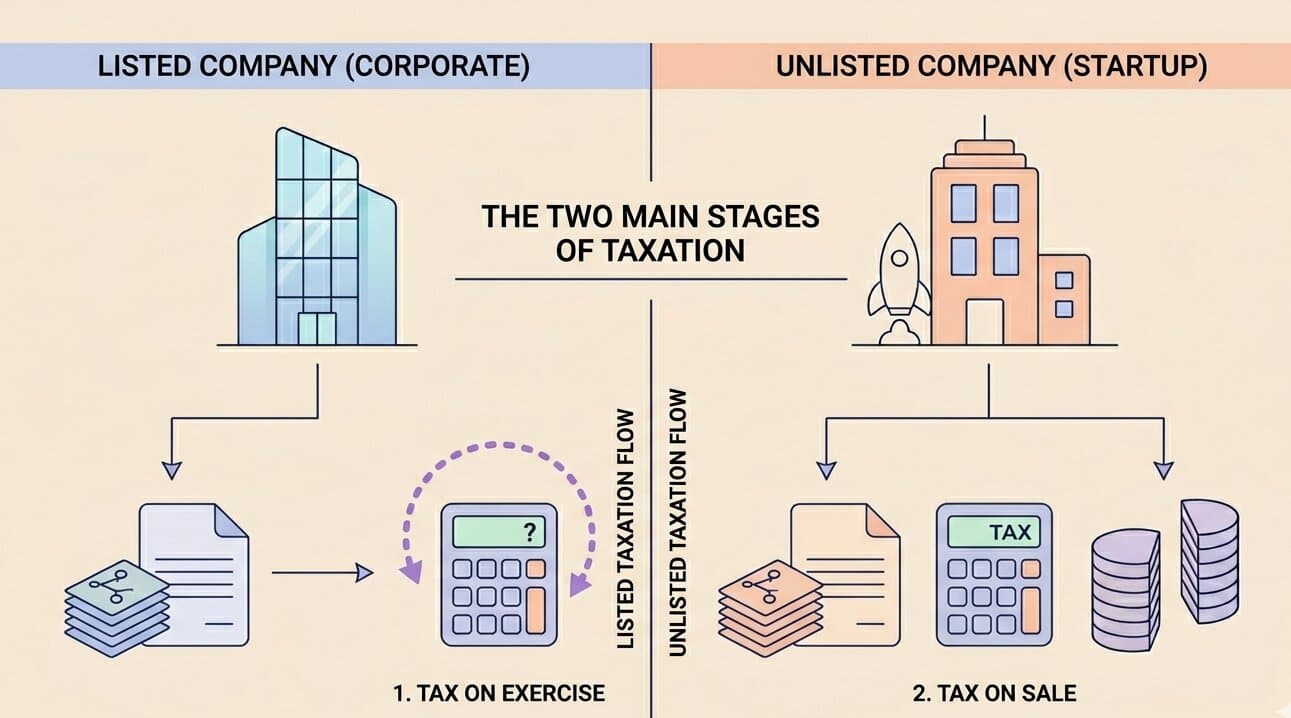
The taxation of foreign shares received through an employee share ownership plan follows the same two-stage structure as domestic ESOPs, but with additional complexity at each stage.
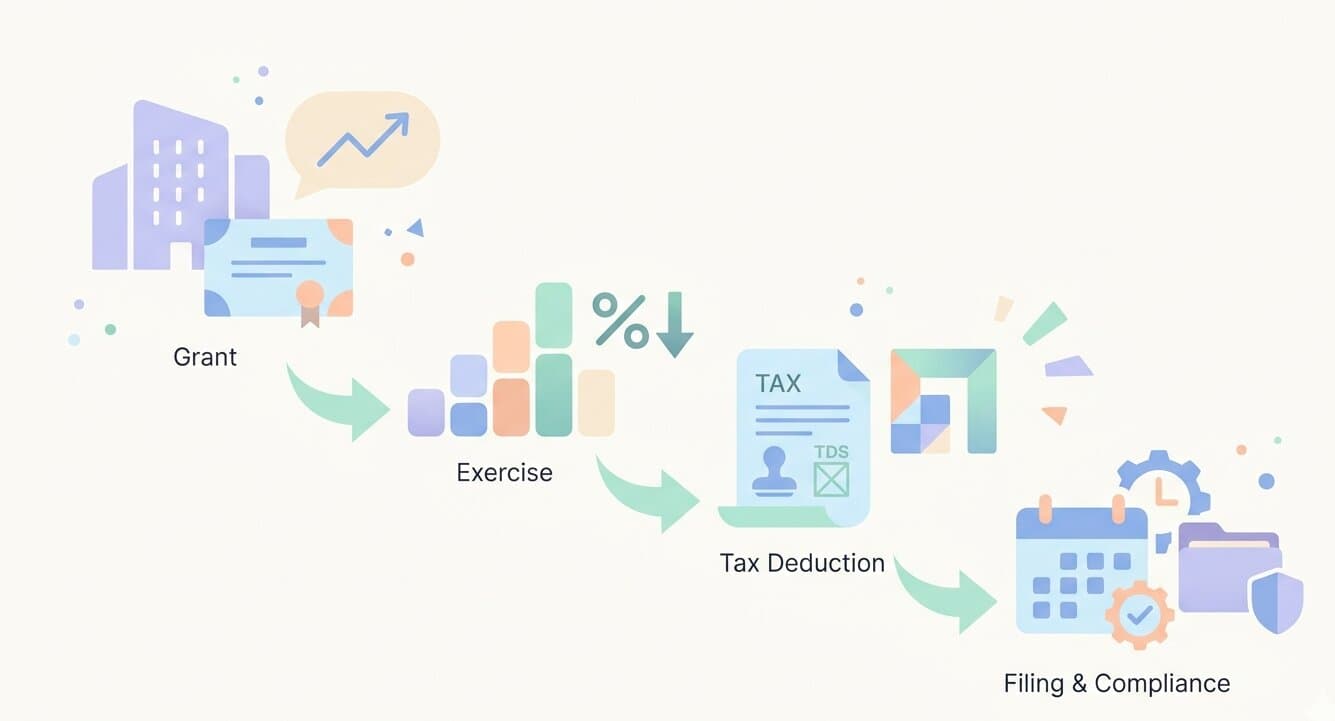
Stage 1 — at vesting or exercise: The difference between the FMV of the foreign shares on the vesting date (converted to INR at the RBI reference rate on that date) and the exercise price paid is treated as a perquisite — salary income in the hands of the employee. The Indian employer — the GCC subsidiary — is responsible for computing this perquisite and deducting TDS from the employee's payroll in the month the shares vest. The Indian subsidiary cannot wait for the employee to file their own return. TDS deduction in payroll is a mandatory employer obligation.
For RSUs, which involve no exercise price, the entire FMV of the shares at vesting is the perquisite. For stock options under an employee stock option scheme, the perquisite is the FMV at exercise minus the exercise price.
Stage 2 — at sale: When the employee sells the foreign shares, the gain from the sale is capital gains. For shares of a foreign listed company, gains are calculated as sale proceeds (in INR, using the exchange rate on the sale date) minus the FMV at vesting (which was the perquisite base). The applicable rate depends on the holding period from the allotment date.
Under the Income Tax Act, 2025 — effective April 1, 2026 — listed foreign shares held for more than 24 months from allotment qualify as long-term capital assets. Long-term gains on listed foreign shares are taxed at 12.5% without indexation benefit. Short-term gains — on shares held for 24 months or less — are taxed at the applicable income slab rate.
One nuance for mobile employees: if the employee relocated from India to the US or UK during the vesting period, a portion of the perquisite may be attributable to work done outside India. India's taxing rights on the non-India portion depend on the applicable DTAA. Most GCCs that move employees internationally mid-vesting-cycle underestimate the apportionment complexity and end up with either overcollected TDS or audit queries.
What the Indian subsidiary must file — form opi and the semi-annual cycle
The FEMA reporting obligation for cross-border employee stock ownership plans sits at the employer level, not the employee level. If the ESOP cost is charged back to the Indian subsidiary, the Indian entity is required to file Form OPI on a semi-annual basis through its Authorised Dealer bank. These filings are due within 60 days from the end of March and September each year.
Form OPI — Overseas Portfolio Investment — captures the details of shares issued under the employee share option plan or RSU programme to Indian resident employees. It records the number of employees, the value of shares granted and vested, and the reporting period. The Indian subsidiary submits it through its AD bank to the RBI.
Two points that GCC compliance teams regularly get wrong.
The filing obligation is triggered by grant — not just by vesting or exercise. The Indian subsidiary's obligation to track and report the foreign employee stock ownership plan begins when options are granted, not when they vest.
Recharges from the parent for ESOP costs change the compliance picture. If the US or UK parent charges the Indian subsidiary for the cost of the esop stock grants, that intercompany charge is a transfer pricing transaction. It must be benchmarked at arm's length and reported in the Indian subsidiary's Form 3CEB. The Form OPI filing obligation and the transfer pricing documentation obligation are both triggered by the same recharge — they are not alternatives.
What GCC employees should do before the next vesting date
Track your cumulative LRS utilisation for the current financial year before the next vest. If you have already received significant equity compensation in the April-to-March year, the next vest may push you toward or beyond the USD 250,000 ceiling.
Confirm that your employer's payroll system is computing TDS correctly on the perquisite. The FMV must be converted at the RBI reference rate on the vesting date. If the employer is using a different rate or a different date, the TDS calculation is wrong — and the exposure for the shortfall falls on the employer.
Do not leave sale proceeds in a US brokerage account after selling. The 180-day repatriation requirement is a FEMA obligation, not a suggestion. Proceeds from selling esop shares should be wired back to your Indian bank account within this window.
Maintain a record of the vesting date, the FMV on that date, the exercise price paid (if any), and the sale date and sale price for every share received through the employee stock option plan or RSU programme. These records are required for your capital gains calculation when you eventually sell — and the Indian tax return for the year of sale requires specific disclosure.
How accorp partners helps GCC companies and employees
For Indian subsidiaries of foreign companies offering cross-border employee stock ownership plans, Accorp Partners handles the full compliance stack: Form OPI semi-annual filings, TDS computation and payroll coordination on perquisite income at vesting, transfer pricing documentation for ESOP recharges, and capital gains tax advisory for employees at the point of sale.
For GCC companies setting up a cross-border employee stock option scheme or RSU programme for their Indian team for the first time, Accorp's ESOP advisory team coordinates the regulatory mapping — FEMA, income tax, and transfer pricing — so that the employee share ownership plan is correctly structured from the first grant letter.
Learn more about Accorp Partners' ESOP advisory and cross-border compliance services here:
https://accorppartners.com/services/cpa-services/esop
FAQs
Q: Do Indian GCC employees need RBI approval to receive shares from their US parent company?
A: No. Receipt of RSUs or ESOPs from a foreign company by an Indian resident employee is a permitted route. No prior RBI approval is required. The shares are classified as Overseas Portfolio Investment under the OI Rules 2022 and the employee can hold them without any prior permission. The compliance obligation sits at the employer level — the Indian subsidiary files Form OPI semi-annually.
Q: Does a cashless RSU vest — where no money leaves India — count toward the LRS limit?
A: Yes. Post-OI Rules 2022, the value of ESOP shares acquired — including cashless RSU allotments — counts toward the individual's LRS utilisation for the financial year. The LRS ceiling of USD 250,000 per financial year applies even when no actual cash is remitted abroad. The value of shares received on vesting is counted at the FMV converted to INR on the vesting date.