.svg)
.svg)
.svg)
ESOP Tax Rules: Unlisted vs Listed Companies — What Changes and Why It Matters Top pick
Listed and unlisted ESOPs follow different tax, FMV, LTCG, and TDS rules. Avoid costly compliance and valuation mistakes.

Accorp Compliance Team
Our team of compliance experts specializes in PCI DSS, SOC 2, and other security frameworks to help businesses achieve and maintain compliance.
If you're a startup founder, HR leader, or employee navigating an Employee Stock Option Plan (ESOP), one of the most critical things to understand is how taxation works — and more importantly, how it differs depending on whether your company is listed or unlisted. ESOP tax rules in India are not one-size-fits-all, and getting them wrong can lead to unexpected tax bills, compliance penalties, or even legal trouble.
This guide breaks down exactly how the ESOP plan is taxed at every stage — from grant to exercise to sale — for both listed and unlisted companies. Whether you're setting up an ESOP scheme for the first time or trying to understand your employee stock ownership benefits, this is the one article you need to read.
What Is an ESOP? A Quick Recap
An Employee Stock Option Plan (ESOP) — also referred to as an employee share option plan, employee stock ownership plan, or employee share ownership plan — gives employees the right to purchase company shares at a pre-agreed price (called the exercise price or grant price) after a defined vesting period.
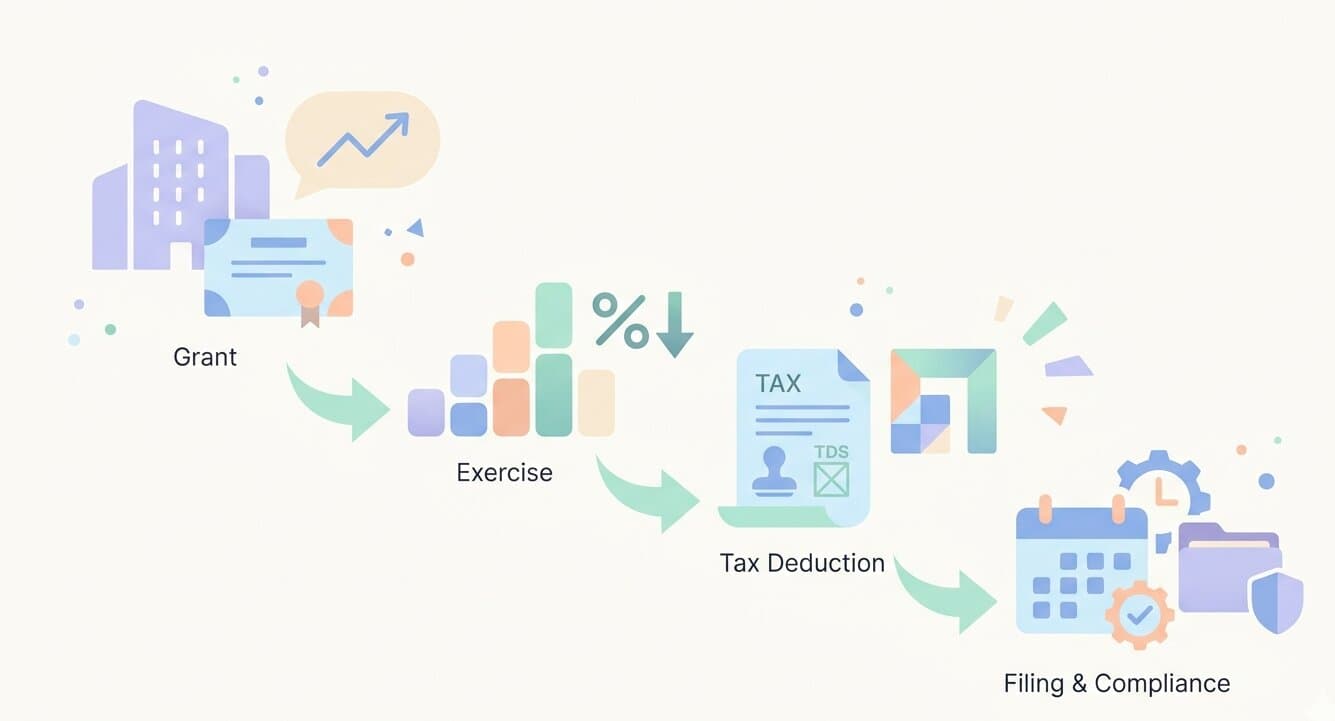
The ESOP scheme typically works in four stages:
Grant — The company grants options to the employee
Vesting — Options vest over a period (usually 1–4 years)
Exercise — The employee exercises the option and buys shares
Sale — The employee sells the shares in the open market or back to the company
Each of these stages has different tax implications — and those implications change significantly depending on whether the company is listed on a recognized stock exchange or remains unlisted (typically a private startup).
Stage-by-Stage ESOP Taxation: Listed vs Unlisted Companies
Stage 1: Grant of Options — No Tax (Both Listed & Unlisted)
At the grant stage, no tax is applicable in either case. The employee receives only the right to buy shares in the future — not the shares themselves. This applies uniformly under the Income Tax Act, 1961, and there is no difference between listed and unlisted companies at this point in the ESOP employee journey.
Stage 2: Exercise of Options — Taxed as Perquisite (Salary Income)
This is where the first significant tax event occurs — and where the rules between listed and unlisted companies begin to diverge.
When an employee exercises their ESOP stock options, the difference between the Fair Market Value (FMV) of the shares on the date of exercise and the exercise price paid by the employee is treated as a prerequisite and taxed as salary income under Section 17(2) of the Income Tax Act.
How FMV is determined differs between the two:
Criteria | Listed Companies | Unlisted Companies |
FMV Determination | Average of opening & closing price on exercise date (BSE/NSE) | Valuation by SEBI-registered merchant banker or independent valuer |
Valuation Frequency | Real-time / daily market price | Point-in-time valuation (typically annual) |
Transparency | Publicly available | Internal / private |
TDS Applicability | Employer deducts TDS at slab rate | Employer deducts TDS at slab rate |
The Startup ESOP Tax Deferral — A Game Changer for Unlisted Companies
Under the Finance Act 2020, eligible DPIIT-registered startups can allow their employees to defer TDS payment on ESOP exercise by up to 5 years, or until the employee leaves the company, or until the shares are sold — whichever comes first.
This means employees in ESOP companies that qualify as startups don't have to pay tax at exercise even though the perquisite income is recognized. This is a major advantage of the employee stock option scheme in unlisted startup environments and makes ESOPs significantly more attractive as a retention tool.
Listed companies do not get this deferral benefit — employees must pay tax immediately upon exercise.
Stage 3: Sale of Shares — Capital Gains Tax
Once the employee sells their ESOP stock, the profit from the sale is treated as capital gains. The classification — short-term or long-term — and the applicable tax rate differ significantly between listed and unlisted companies.
Listed Companies — Capital Gains at Sale
Holding period for Long-Term Capital Gains (LTCG): More than 12 months from the date of exercise
LTCG Tax Rate: 12.5% (post Finance Act 2024) on gains exceeding ₹1.25 lakh in a financial year
Short-Term Capital Gains (STCG): If sold within 12 months — taxed at 20%
STT (Securities Transaction Tax) is applicable on listed shares sold on a recognized exchange
Cost of acquisition for capital gains = FMV on the date of exercise (already taxed as perquisite)
Unlisted Companies — Capital Gains at Sale
Holding period for Long-Term Capital Gains (LTCG): More than 24 months from the date of exercise
LTCG Tax Rate: 12.5% without indexation (as per Finance Act 2024 amendments)
Short-Term Capital Gains (STCG): If sold within 24 months — taxed at applicable income tax slab rate
No STT is applicable on unlisted shares
Cost of acquisition = FMV on the date of exercise
Tax Category | Listed Companies | Unlisted Companies |
LTCG Holding Period | 12 months | 24 months |
LTCG Tax Rate | 12.5% (above ₹1.25L) | 12.5% (no indexation) |
STCG Tax Rate | 20% | Applicable slab rate |
STT Applicable | Yes | No |
IPO Lock-in Impact | N/A | Counted from original exercise date |
What Happens When an Unlisted Company Gets Listed (IPO)?
This is one of the most commonly asked questions around ESOP valuation and employee stock ownership planning. When a startup goes public through an IPO, the ESOP shares held by employees transition from unlisted to listed shares.
Here's what changes and what stays the same:
The holding period for LTCG is recalculated from the original date of exercise — not from the IPO date
If the employee held the shares for more than 12 months before the IPO (as unlisted shares), they may qualify for LTCG on listed shares post-IPO
The FMV used for the perquisite at the time of exercise remains the cost of acquisition
Post-IPO sale proceeds are subject to STT and listed company LTCG rules
This transition phase requires careful ESOP planning and ideally a conversation with a CPA or ESOP advisor before the IPO lock-in period ends.
TDS Obligations for Employers Under the ESOP Scheme
Whether your company is listed or unlisted, the employer is responsible for deducting TDS on the perquisite value at the time of exercise. The TDS is calculated at the employee's applicable slab rate and must be deposited with the government before the due date.
For unlisted startups with the DPIIT deferral benefit, the TDS obligation is deferred — but the employer must maintain proper records and file Form 12BAA or the relevant declaration to claim the deferral.
Non-compliance with TDS obligations under an ESOP employee owned structure can attract penalties under Section 201 of the Income Tax Act — so employers must ensure accurate FMV valuation, timely TDS deduction, and correct ROC filings (PAS-3) post-exercise.
ESOP Valuation — Why It's Critical for Both Listed and Unlisted Companies
ESOP valuation is the backbone of the entire tax calculation. An incorrect valuation can lead to under-deduction of TDS, incorrect capital gains computation, and regulatory non-compliance.
For listed companies, the FMV is straightforward — it's the average of the opening and closing market price on the exercise date.
For unlisted companies, the valuation must be done by a SEBI-registered Category I Merchant Banker or an IBBI-registered valuer using approved methodologies such as:
Discounted Cash Flow (DCF) method
Comparable Company Multiple (CCM) method
Net Asset Value (NAV) method
Black-Scholes model (primarily for option pricing, not share FMV)
Key Compliance Checklist for ESOP Companies
Draft and adopt a board-approved ESOP scheme in line with Companies Act 2013 and SEBI (SBEB) Regulations 2021 (for listed companies)
Pass EGM/Board resolution approving the ESOP plan and file MGT-14 with the ROC
Obtain FMV valuation from a registered valuer before each exercise window
Deduct TDS at the applicable slab rate at the time of exercise (or defer for eligible startups)
File PAS-3 with the ROC within 30 days of allotment of shares upon exercise
Maintain Ind AS 102 (Share-Based Payments) accounting entries in financial statements
Issue updated share certificates and update the cap table after each exercise
File Form 12BA with employee salary TDS returns
Common Mistakes Companies Make With ESOP Tax Compliance
1. Using incorrect FMV: Many unlisted companies use rough valuations or internal estimates instead of a SEBI/IBBI-registered valuer report — leading to tax disputes.
2. Missing PAS-3 filings: Every allotment of shares upon ESOP exercise must be filed with the ROC via PAS-3 within 30 days. Delays attract late fees under the Companies Act.
3. Not accounting for Ind AS 102: Startups often skip the share-based payment expense recognition in their P&L — which becomes a problem during audits and fundraising due diligence.
4. Ignoring the startup deferral: DPIIT-registered startups that don't claim the TDS deferral under Section 192(1C) are making their employees pay tax unnecessarily early.
5. Incorrect capital gains calculation: Using the exercise price instead of the FMV as the cost of acquisition for capital gains purposes is a very common error.
Final Thoughts
ESOP taxation is genuinely complex — and the difference between a listed and unlisted company setup is significant enough to change how employees experience their employee stock ownership plan financially. If you're a startup building out your first ESOP scheme, or a scaling company preparing for an IPO and transitioning your ESOP structure, getting the tax and compliance framework right from day one saves enormous trouble later.
At Accorp Partners, we provide end-to-end ESOP advisory — from scheme drafting, IBBI-registered valuation, and Ind AS 102 accounting, to PAS-3 ROC filings, TDS compliance, and audit-ready documentation. Our CPA-led team has helped founders across 40+ countries structure ESOP plans that are investor-ready and fully compliant.
Consult Accorp Partners to structure transparent, compliant, and high-impact ESOP plans that benefit both companies and employees.