.svg)
.svg)
.svg)
Form ESOP Under FEMA — When Indian Companies Issue ESOPs to Non-Resident Employees and What Gets Filed
Granting ESOPs to non-residents? Understand RBI Form ESOP, FC-GPR, filing timelines, FEMA rules, and compliance requirements for Indian companies.

Accorp Compliance Team
Our team of compliance experts specializes in PCI DSS, SOC 2, and other security frameworks to help businesses achieve and maintain compliance.
An Indian company hires a sharp engineer who happens to be a US citizen working out of Bangalore on a long-term visa. Or it brings on a director based in Singapore. Or it extends its employee stock option plan to someone at its wholly owned subsidiary in Dubai. In every one of these situations, the moment that person is granted stock options, the transaction stops being a purely internal HR matter and becomes a foreign exchange transaction that RBI wants to know about.
Most founders and HR teams don't realise this until it's flagged in a due diligence checklist ahead of a funding round or, worse, during a statutory audit. The compliance obligation is called Form ESOP, and it exists specifically for the direction that gets overlooked — an Indian company issuing options to people who are not Indian residents, as opposed to an Indian employee receiving options from a foreign parent (which is a separate filing altogether, governed by different rules).
Two Directions, Two Completely Different Filings
This is the single most common point of confusion, so it's worth being precise about it upfront.
Track one is an Indian company granting ESOPs to a non-resident — a foreign national on its own payroll, an NRI or OCI employee, or an employee/director of its holding company, joint venture, or wholly owned overseas subsidiary. This falls under the Foreign Exchange Management (Non-Debt Instruments) Rules, 2019, read with the FEMA (Mode of Payment and Reporting of Non-Debt Instruments) Regulations, 2019, alongside Section 62 of the Companies Act and, for listed companies, SEBI's ESOP regulations. This is the scenario Form ESOP is built for.
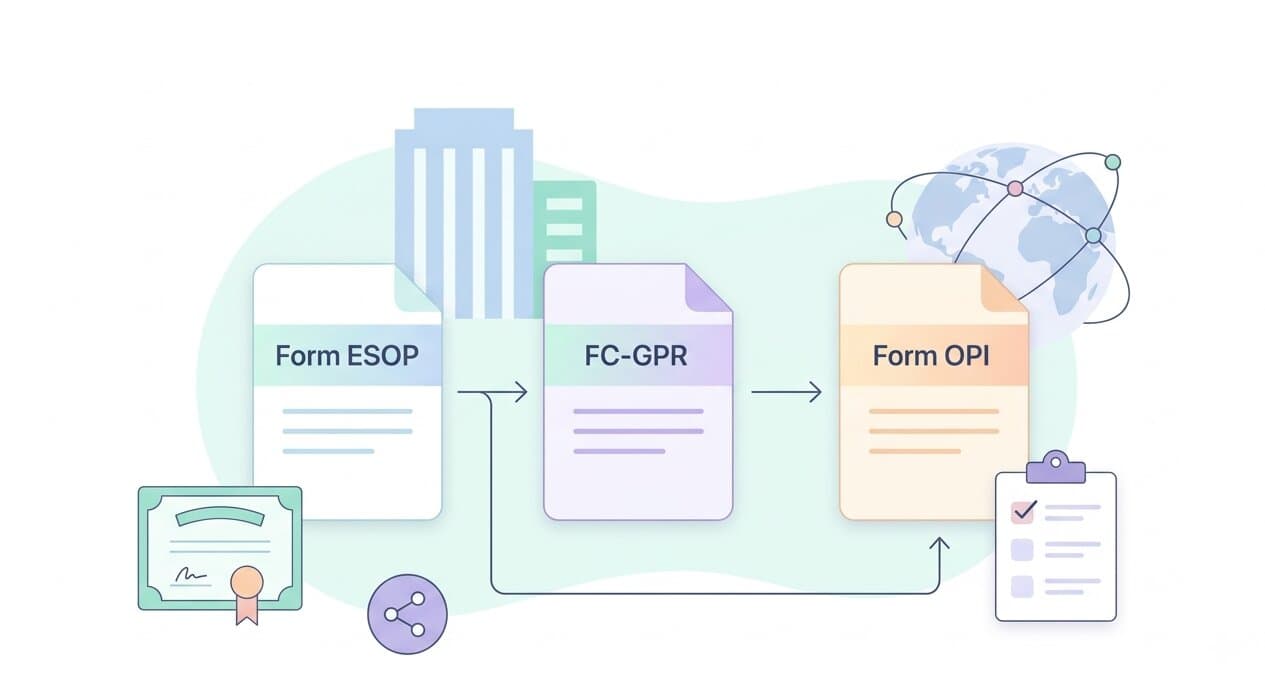
Track two runs the other way — a foreign parent company granting stock options to its Indian employees. That's governed by the Overseas Investment Rules, 2022, and reported through Form OPI on a half-yearly basis. It's a different form, a different filing cadence, and a different set of obligations entirely.
Companies that operate with a global workforce often need to track both simultaneously, but they are not interchangeable, and filing one when the other applies is a compliance gap that tends to surface at the worst possible time — usually when a new investor's counsel starts asking pointed questions during diligence.
Who Actually Counts as a Non-Resident Employee Here
This is broader than most HR teams assume. It covers foreign nationals employed directly by the Indian company, Indian citizens who've become non-residents (NRIs) or Overseas Citizens of India (OCIs) who remain part of the workforce, and — this is the part companies most often miss — employees or directors of the Indian company's holding company, joint venture, or wholly owned overseas subsidiary, even if that person has never set foot in India.
A common blind spot: an Indian company with a small overseas subsidiary extends its stock option plan to two or three people working exclusively out of that subsidiary's office abroad. Because none of them are on the Indian payroll and none of them have any India-facing role, the filing obligation gets missed entirely. The residency status of the option holder is what triggers Form ESOP, not their reporting line or physical location relative to the Indian entity.
What Form ESOP Actually Reports, and When
Form ESOP is filed on the RBI's FIRMS portal by the Indian company through its Authorised Dealer (AD) bank, and it needs to be filed within 30 days of the date the ESOPs are issued — meaning the grant date, not the vesting date and not the exercise date. This is where a lot of companies trip up procedurally: the 30-day clock starts running the moment the grant letter goes out and the board resolution is passed, not when the employee actually becomes a shareholder.
At the grant stage, no valuation is required under FEMA. The compliance obligation here is purely about reporting that a grant has been made to a non-resident — the RBI wants visibility into the commitment, even though no shares have actually changed hands yet and no capital has technically flowed.
The valuation requirement shows up later, at exercise. Once the non-resident employee exercises their options and shares are actually allotted, that's a fresh, separate reporting event — filed as Form FC-GPR, not Form ESOP — and this is where fair value matters. The shares can't be priced below fair value, determined either by the discounted cash flow method or another internationally accepted valuation methodology, certified by a Category I Merchant Banker or a Chartered Accountant. The valuation report used for this filing needs to be current — not older than 90 days from the date of allotment — which means companies with employees exercising options at different points across the year can't rely on a single stale valuation done at the start of the financial year.
Put simply: grant triggers Form ESOP within 30 days, no pricing involved. Exercise and allotment trigger Form FC-GPR, with a fresh fair-value certification behind it. Two forms, two triggers, two different compliance clocks.
Why This Trips Up Otherwise Well-Run Companies
The mistakes here are rarely about not knowing FEMA exists. They're procedural.
The most frequent one is treating the grant and the exercise as a single event for compliance purposes, when they're not. A company diligently files Form FC-GPR when shares are allotted but never realises Form ESOP should have been filed 30 days after the original grant — sometimes a year or more earlier. By the time this gets caught, it's a compounding matter with the RBI rather than a straightforward filing.
The second common mistake involves esop companies operating with lean finance teams who don't have a standing relationship with an AD bank for this specific purpose, so filings queue up and slip past the 30-day window without anyone noticing until an external auditor or a due diligence request surfaces the gap.
The third is assuming Start-up India recognition removes the obligation entirely. DPIIT-recognised startups do get certain relaxations — more flexibility in pricing methodology, in particular — but the requirement to file Form ESOP for non-resident employees within the prescribed timeline still applies. Recognition simplifies parts of the process; it doesn't exempt the company from it.
The Broader Picture: Why RBI Cares About This at All
It's worth understanding why this filing exists, because it makes the obligation easier to take seriously. From RBI's perspective, an Indian company issuing equity-linked instruments to a non-resident is, functionally, a form of inbound foreign investment — even when structured as employee ownership rather than a direct equity round. The Form ESOP and subsequent FC-GPR filings feed into RBI's broader tracking of foreign investment into Indian entities, which is the same database that gets checked when a company later raises a priced round, undergoes an acquisition, or lists publicly. A gap in this trail doesn't just sit quietly — it becomes a documented inconsistency that surfaces exactly when a company can least afford it, typically during investor due diligence.
For companies granting stock options for employees across borders as part of a genuinely global hiring strategy, treating this as a one-off HR task rather than an ongoing compliance function is where things go wrong. The obligation doesn't end at the first grant — it recurs every time a new non-resident joins the ESOP plan, and every time an existing non-resident employee exercises.
A Practical Checklist Before the Next Grant Goes Out
Confirm the option holder's residency status under FEMA, not just their nationality — an Indian citizen who has become a non-resident is still covered.
File Form ESOP through the company's AD bank on the FIRMS portal within 30 days of the grant date, not the vesting or exercise date.
Keep the grant documentation (board resolution, individual grant letter) organised, since AD banks will ask for it at the time of filing.
Track exercise dates separately, and arrange a fresh fair-value certification — no older than 90 days — before filing Form FC-GPR on allotment.
If the company is DPIIT-recognised, confirm which specific relaxations apply rather than assuming blanket exemption.
Learn More- https://accorppartners.com/services/cpa-services/esop
Frequently Asked Questions
1. Does Form ESOP apply if the non-resident employee never actually exercises their options?
Yes. Form ESOP reports the grant itself, within 30 days of issue, regardless of whether the options are later exercised. Exercise triggers a separate filing, Form FC-GPR.
2. Is a valuation required to file Form ESOP?
No. Valuation isn't required at the grant stage under FEMA. It becomes relevant only at exercise and allotment, when Form FC-GPR is filed.
3. Who is responsible for filing Form ESOP — the company or the employee?
The Indian company files it, through its Authorised Dealer bank on the RBI's FIRMS portal. The obligation sits with the employer, not the option holder.