.svg)
.svg)
.svg)
My Foreign Subsidiary's Financial Year Doesn't End March 31 — When Is My APR Actually Due?
APR is due by December 31 regardless of your subsidiary's year-end. See how year-end affects reporting timelines, audit planning, and compliance.

Accorp Compliance Team
Our team of compliance experts specializes in PCI DSS, SOC 2, and other security frameworks to help businesses achieve and maintain compliance.
This question comes up every single year from clients with a US subsidiary on a calendar year-end, or a UK/Singapore entity on a March or April year-end. The instinct is to assume the APR deadline shifts to match — that somehow the filing clock is tied to when your specific subsidiary's books close. It isn't.
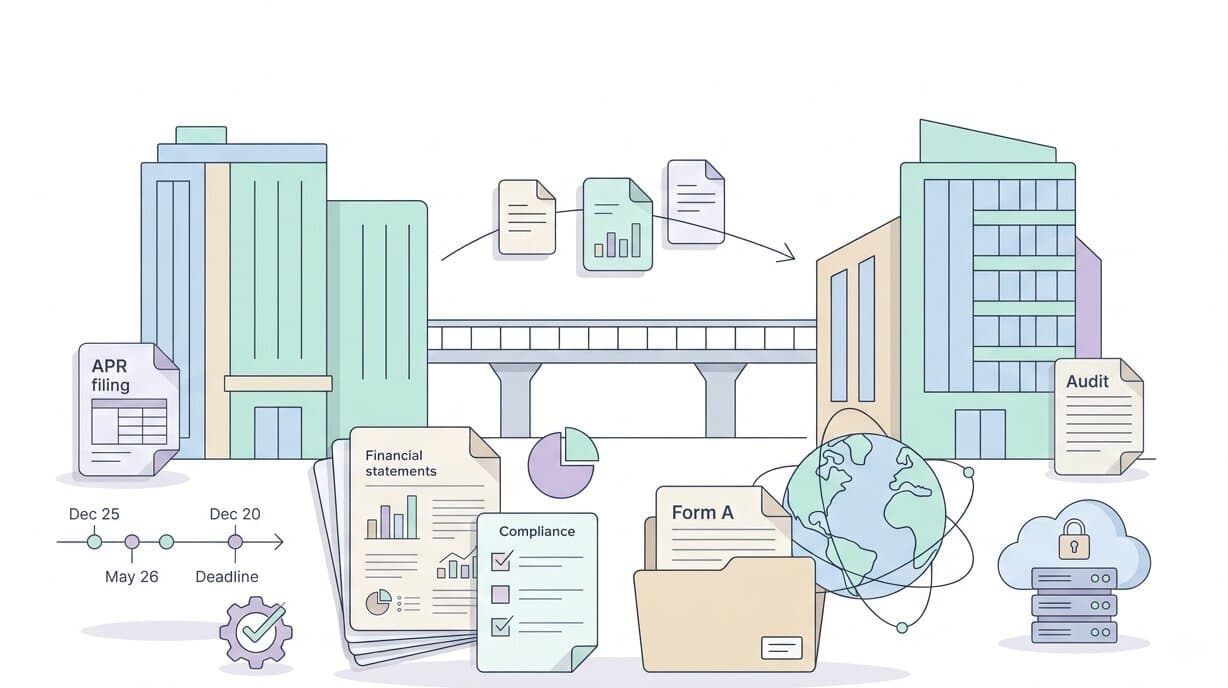
The APR deadline is fixed: December 31, every year, for every foreign entity, regardless of what date your subsidiary's own accounting year ends. What changes based on your subsidiary's year-end isn't the filing date — it's which set of audited numbers you're required to have ready in time to meet it.
Why the confusion exists in the first place
It's a reasonable place to get confused, because the original APR framework wasn't a fixed calendar date at all. The legacy Form ODI Part-II instructions (still referenced in older RBI documentation) stated that the APR should be submitted within 30 days of the expiry of the statutory period for finalisation of the host country's audited accounts — or, where the host country has no such statutory period, within 6 months of the close of the relevant accounting year. Under that framework, your filing deadline genuinely did move based on your subsidiary's own year-end and the host country's audit-completion rules.
That's no longer how it works in current practice under the Master Direction – Overseas Investment and the 2022 OI Rules/Regulations. The deadline has been consolidated into a single, uniform date — December 31 — for every Indian entity, for every foreign subsidiary, irrespective of the subsidiary's own accounting calendar. If your advisor is telling you the deadline "depends on your subsidiary's audit timeline," they're describing a rule that predates the current framework.
What actually depends on your subsidiary's year-end
Your subsidiary's accounting year-end doesn't move your deadline — but it does determine which financial year's numbers you're reporting, and how much runway you have to get them audited before December 31 arrives. Two worked examples make this concrete.
Example A — US subsidiary, calendar year-end (Jan–Dec)
Your US WOS closes its books December 31, 2025. A US audit or CPA engagement typically wraps within a few months into the new year. By the time your APR is due — December 31, 2026 — you're reporting the audited FY2025 financials (Jan 1, 2025 – Dec 31, 2025). That's roughly a 12-month lag between the subsidiary's year-end and the APR filing deadline — plenty of runway for the audit to be completed well in advance.
Example B — UK-style subsidiary, April–March year-end
Your UK subsidiary closes its books March 31, 2026. Under UK Companies Act timelines, a private company's accounts are typically finalised well within 9 months of the year-end — meaning audited FY2025–26 accounts should be ready by roughly December 2026. That timing lines up almost exactly with the December 31 APR deadline for the same financial year that just closed — a far tighter runway than the US example, with much less margin for delay.
The takeaway: entities with a March/April year-end are working against a much shorter effective window between year-end and APR deadline than entities with a calendar year-end. If your subsidiary's audit process runs even slightly behind schedule, a March-year-end entity has almost no buffer left before December 31 — while a December-year-end entity has nearly a full year of cushion.
The practical checklist this creates
Identify your subsidiary's actual year-end — don't assume it mirrors the Indian financial year (April–March) just because the Indian parent runs on that calendar.
Work backward from December 31, not forward from your subsidiary's year-end, to build your internal filing timeline.
Flag short-runway jurisdictions early. If your subsidiary's year-end sits anywhere between January and April, you're on a compressed timeline and should be engaging the host-country auditor by mid-year, not waiting until October.
Confirm which financial year you're actually reporting before you start compiling data — this is one of the most common errors we see in draft APRs, where the wrong year's figures get mapped against the current filing.
Learn More- https://accorppartners.com/services/cpa-services/apr