.svg)
.svg)
.svg)
Foreign subsidiaries financials are not rupees - how to tackle that
Learn how currency conversion impacts APR filing India, overseas subsidiary audit, FEMA reporting, and ODI compliance.

Accorp Compliance Team
Our team of compliance experts specializes in PCI DSS, SOC 2, and other security frameworks to help businesses achieve and maintain compliance.
One of the biggest practical challenges Indian companies face while managing overseas subsidiaries is currency conversion. A foreign entity may maintain its books in US Dollars, British Pounds, Canadian Dollars, Singapore Dollars, or Euros, but RBI reporting under APR filing India often requires financial information to be reviewed and reconciled from an Indian compliance perspective.
At first glance, converting foreign financial statements into INR may appear simple. In reality, currency conversion can create major reporting mismatches during overseas subsidiary audit reviews, especially when exchange rates fluctuate significantly during the financial year. Many Indian businesses face RBI clarification requests because overseas financials, investment balances, and inter-company transactions are not properly reconciled after conversion.
For companies operating global subsidiaries, understanding how to manage foreign currency reporting is critical for maintaining foreign subsidiary audit compliance and avoiding ODI compliance risks.
This article explains the key challenges involved in converting overseas financials, how RBI evaluates foreign currency reporting, and the best practices businesses should follow during APR filing for foreign subsidiaries.
Why Currency Conversion Matters in APR Filing India
Foreign subsidiaries maintain accounts based on the local currency of the country where they operate.
For example:
US entities use USD
UK companies use GBP
Canadian subsidiaries use CAD
Singapore businesses use SGD
However, Indian parent companies must still report overseas investment performance under FEMA and ODI regulations.
As a result, APR filing India often requires:
Financial statement analysis
Investment reconciliation
Overseas exposure tracking
Inter-company transaction review
all from an INR reporting perspective.
Improper conversion methods can create inconsistencies between:
RBI records
Overseas audited financials
ODI disclosures
Parent company accounts
How Overseas Subsidiary Audit Reviews Currency Reporting
An overseas subsidiary audit validates whether overseas financial records are accurate and properly disclosed.
During the audit process, businesses must often reconcile:
Capital investments
Revenue figures
Loan balances
Related-party transactions
Net worth calculations
Currency conversion errors may directly affect these disclosures.
Why Exchange Rate Fluctuations Create Reporting Problems
Currency values rarely remain stable throughout the year.
For example:
An overseas investment made when USD-INR was 78 may appear very different if the exchange rate becomes 84 later
Revenue converted at one rate may not match balance sheet values converted at another rate
Without consistent methodology, RBI may identify:
Reporting mismatches
Incorrect valuation disclosures
Inconsistent investment balances
This becomes a major issue during APR filing for foreign subsidiaries.
Common Currency Conversion Mistakes Businesses Make
1. Using Different Exchange Rates Across Reports
Some businesses:
Use one exchange rate for accounting
Another for RBI reporting
A separate rate for internal MIS reports
This creates reconciliation gaps during foreign subsidiary audit compliance reviews.
2. Ignoring Historical Investment Values
Capital infusion into foreign subsidiaries should often be tracked carefully based on:
Original remittance values
Historical exchange rates
ODI reporting disclosures
Many businesses incorrectly apply current exchange rates to old investments.
3. Delayed Financial Reconciliation
Indian parent companies and overseas subsidiaries often finalize accounts separately.
This causes mismatches in:
Inter-company balances
Loan disclosures
Revenue reporting
Currency adjustments
RBI’s Focus Areas During Currency Review
1. Accuracy of Overseas Investment Reporting
RBI examines whether:
Investments match remittance records
Financial commitments are correctly disclosed
Currency conversions remain consistent
2. Net Worth and Profitability Analysis
Changes in exchange rates can affect:
Overseas subsidiary valuation
Profitability reporting
Net worth calculations
RBI may seek clarification if sudden fluctuations appear unusual.
3. Related-Party Transaction Reconciliation
Cross-border transactions between:
Indian parent companies
Overseas subsidiaries
Step-down entities
must reconcile accurately despite currency differences.
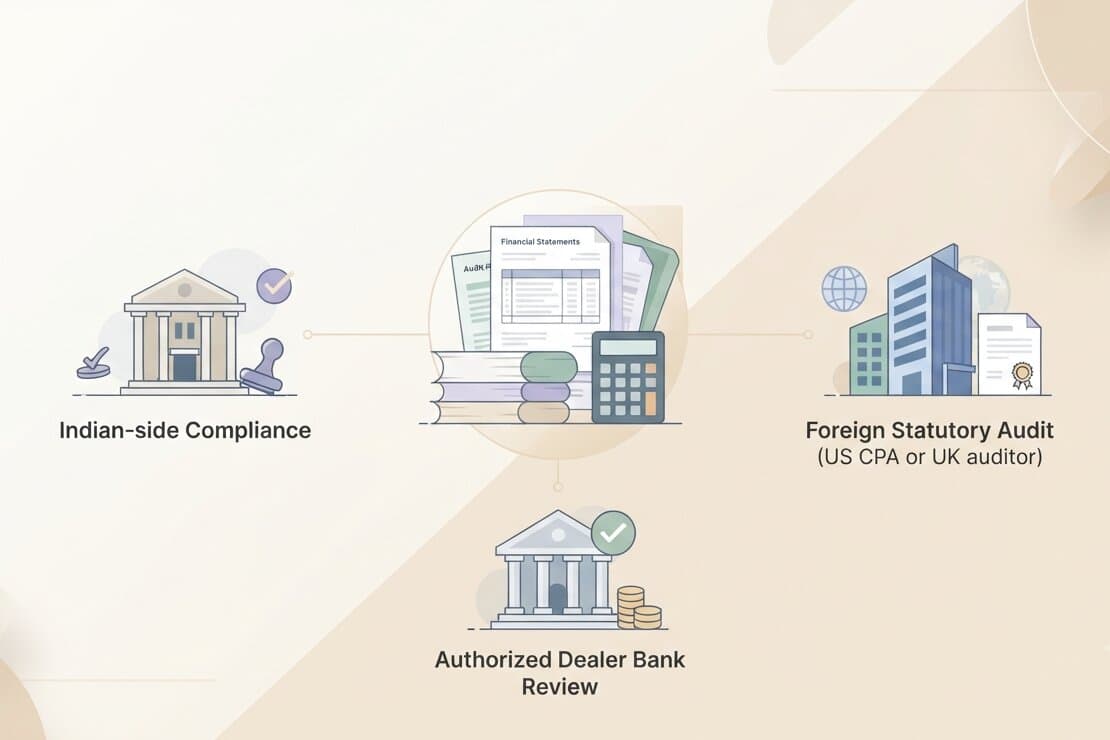
The Role of Foreign Auditors in Currency Reporting
Overseas subsidiaries may work with:
A US CPA for APR filing
A UK auditor for APR filing
Local auditors in Singapore, Australia, or Canada
These professionals generally certify financial statements under local accounting rules.
However, FEMA reporting expectations under RBI may still require:
Additional reconciliation
ODI-specific disclosures
INR-based reporting adjustments
This is why foreign statutory audits alone may not fully address Indian reporting requirements.
Best Practices for Managing Currency Conversion in APR Filing
Create a Standard Conversion Policy
Businesses should establish:
Approved exchange rate sources
Uniform reporting methods
Consistent accounting treatment
This reduces reconciliation errors.
Maintain Detailed Investment Records
Companies should preserve:
Original remittance documents
Historical exchange rates
Share allotment records
ODI filing acknowledgements
Strong documentation improves foreign subsidiary audit compliance.
Coordinate Between Indian and Overseas Finance Teams
Regular communication helps reconcile:
Inter-company balances
Funding records
Currency adjustments
Financial disclosures
before APR filing deadlines approach.
Conduct FEMA Reviews Separately
Local accounting compliance may not fully satisfy RBI reporting expectations.
Businesses should separately review:
ODI disclosures
FEMA obligations
APR reporting consistency
Currency conversion methodology
How Technology Helps Simplify Overseas Reporting
Many companies now use centralized accounting systems that:
Track multi-currency transactions
Automate exchange rate updates
Improve financial reconciliation
Reduce reporting delays
Technology-driven reporting can significantly improve APR filing accuracy.
Why Accurate Currency Reporting Matters
Proper financial reconciliation supports:
Smooth APR filing India
Faster RBI approvals
Better overseas investment monitoring
Strong banking relationships
Reduced FEMA compliance risks
Even small currency conversion errors can create major reporting discrepancies over time.
Conclusion
Managing overseas financial statements in multiple currencies is one of the most important challenges during APR filing India and overseas reporting under FEMA regulations. Since foreign subsidiaries maintain accounts in local currencies, businesses must carefully reconcile investments, profits, loans, and related-party transactions before submitting APR filings.
A well-managed overseas subsidiary audit, combined with standardized currency conversion practices and strong documentation, helps businesses improve foreign subsidiary audit compliance and reduce ODI compliance risks.
Whether companies work with a US CPA for APR filing, a UK auditor for APR filing, or global accounting professionals, accurate currency reporting remains essential for maintaining long-term RBI compliance and supporting successful international expansion.
Also Read: APR Audit vs Statutory Audit for Overseas Subsidiaries
FAQs
Q1. My overseas subsidiary maintains books in USD. Do I need to convert everything to INR for APR filing?Not entirely, but RBI requires you to reconcile and report overseas investments from an Indian compliance perspective. You don't submit INR financials, but your figures must be consistent and properly converted when required for ODI disclosures.
Q2. Exchange rates keep changing throughout the year. Which rate do I use for APR?
Use the closing rate for balance sheet items and the average rate for income and expenses. The key is consistency — using different rates across different reports is what creates mismatches and RBI queries.
Q3. We invested in our US subsidiary two years ago at a different exchange rate. Do we use that old rate or the current one?
For capital infusion, track the original remittance value at the historical rate it was sent. Applying today's rate to old investments is a common mistake that creates incorrect ODI disclosures.
Q4. Our Indian accounts and overseas subsidiary accounts don't match after currency conversion. What should we do?
This usually happens due to timing differences or inconsistent rate usage. Reconcile inter-company balances, loan figures, and funding records before the APR deadline. Don't wait until December — start early so there's time to fix gaps.
Q5. Does my US CPA or UK auditor handle the currency conversion for RBI reporting?
No. They certify financials under local accounting rules only. The INR reconciliation, ODI disclosures, and FEMA-specific adjustments are a separate exercise that needs to be handled by your Indian compliance team.