.svg)
.svg)
.svg)
My Overseas Company's Financial Year Is Different from India – How Do I Handle the APR Audit?
Manage APR audit India smoothly despite different financial years. Ensure ODI compliance with accurate overseas subsidiary audit reporting.

Accorp Compliance Team
Our team of compliance experts specializes in PCI DSS, SOC 2, and other security frameworks to help businesses achieve and maintain compliance.
Expanding globally brings exciting opportunities, but it also introduces new compliance responsibilities. One common challenge Indian companies face is managing the APR audit when their overseas subsidiary follows a different financial year than India.
In India, the financial year runs from April to March. However, many foreign countries follow completely different reporting periods. For example, US companies usually follow January to December, while other countries may use customized financial years. This difference can create confusion during APR audit India compliance if not handled properly.
The good news is that different financial years are completely manageable when you understand how overseas subsidiary audit requirements work under ODI compliance rules.
This guide explains how to manage the APR audit process when your overseas entity follows a different financial year and how to avoid common compliance mistakes.
Why Financial Year Differences Matter in APR Audit India
The APR audit is a mandatory compliance requirement for Indian businesses with overseas investments. It helps regulators verify the financial position and operational status of foreign subsidiaries.
When the overseas company follows a different accounting period, businesses often struggle with:
Matching Indian reporting timelines
Coordinating overseas audits
Aligning financial statements with ODI compliance requirements
Meeting RBI reporting expectations
Managing delays in auditor certifications
Without proper handling, these issues can weaken foreign subsidiary audit compliance and lead to delays or rejection by the AD Bank.
Which Financial Year Should Be Used for APR Audit?
This is the most important point businesses must understand.
The APR Audit Uses the Overseas Entity’s Financial Year
The APR audit must always be based on the audited financial statements of the foreign entity — not the Indian company’s financial year.
Example:
Indian Parent Company: April–March
US Subsidiary: January–December
In this case, the APR audit India submission should use the US entity’s January–December audited financials.
This approach ensures:
Proper overseas investment compliance
Alignment with local accounting laws
Accurate subsidiary compliance reporting
Strong FEMA compliance
Why APR Audit Is More Important Than Just APR Filing
Many companies mistakenly treat APR as only a filing formality. In reality, the APR audit is the most critical part of the entire compliance process.
The audit validates:
Financial accuracy
Shareholding structure
Investment reporting
Capital utilization
Operational transparency
Without a proper overseas subsidiary audit, the APR process becomes weak and vulnerable to regulatory objections.
Key Audit Requirements for Different Financial Years
When financial years differ, companies must focus heavily on audit quality and documentation.
1. Overseas Audited Financial Statements
Your foreign entity must prepare audited financial statements according to local accounting standards.
These generally include:
Balance Sheet
Profit & Loss Statement
Notes to Accounts
Auditor’s Report
This forms the foundation of the APR audit India process.
2. Country-Specific Auditor Certification
Different countries require different qualified professionals.
For US Entities
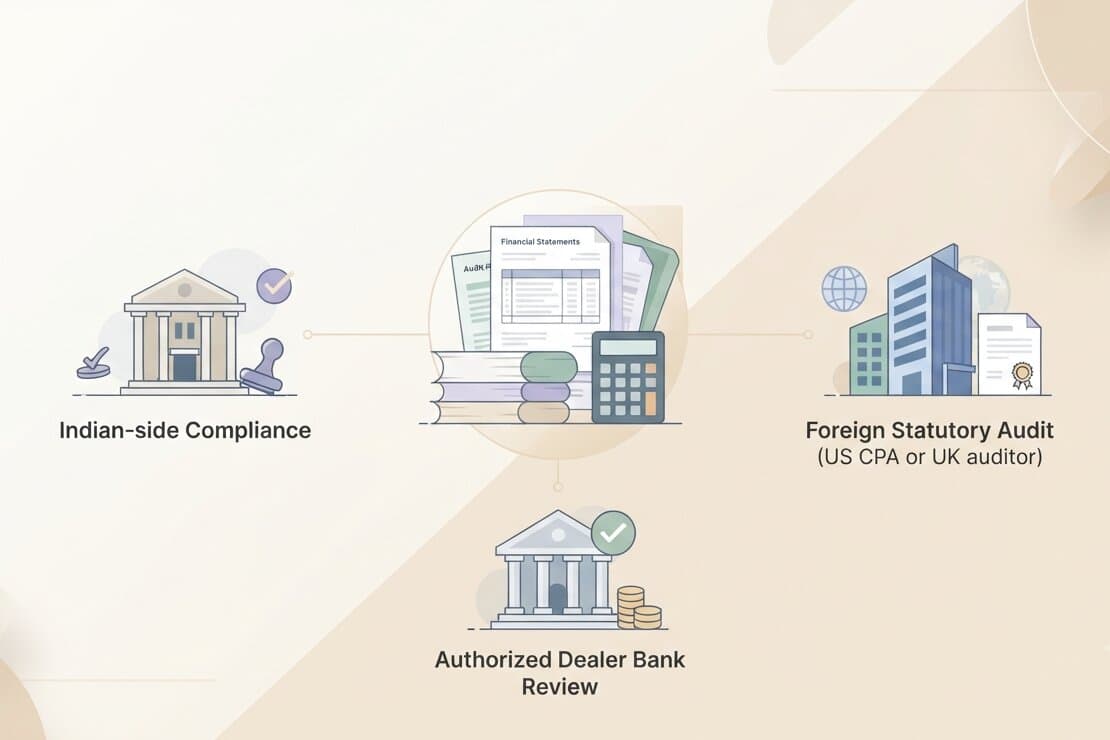
A US CPA for APR filing is typically required because Indian banks recognize CPA-certified reports for US companies.
For UK Entities
A UK auditor for APR filing registered with recognized accounting bodies is generally accepted.
This is a crucial part of foreign subsidiary audit compliance.
3. ODI Data Verification
The APR audit must match ODI records exactly.
Key details that must be verified:
Investment amount
Shareholding percentage
Loans and guarantees
Capital contributions
Entity details
Even small inconsistencies can create issues during APR audit review.
Common APR Audit Challenges with Different Financial Years
Delayed Overseas Audit Completion
Different reporting periods often delay financial statement preparation.
Result:
Late audit completion
Last-minute compliance pressure
Increased risk of errors
Coordination Problems Between Teams
APR audit requires coordination between:
Internal finance teams
Foreign auditors
Indian Chartered Accountants
AD Banks
Poor coordination creates inconsistencies and delays.
Incorrect Reporting Period
Some companies incorrectly use India’s financial year instead of the overseas entity’s financial year.
This is one of the most common causes of APR audit India rejection.
Weak Documentation
Missing audit reports or incomplete financial records weaken:
ODI compliance
FEMA compliance
Subsidiary compliance reporting
Best Practices for Smooth APR Audit Compliance
Start the Audit Early
Do not wait until the filing deadline approaches.
Early preparation gives enough time for:
Overseas audits
Financial reviews
ODI reconciliation
Certification processes
Work with Qualified Global Auditors
Always engage:
A qualified US CPA for APR filing
A recognized UK auditor for APR filing
Experienced Indian compliance professionals
This strengthens international business compliance.
Maintain Proper Financial Records
Keep organized records of:
Investments
Shareholding changes
Loans
Remittances
Financial statements
Well-maintained records simplify the APR audit significantly.
Review Everything Before Submission
Before submission:
Reconcile ODI records
Verify financial data
Check audit certifications
Confirm reporting periods
A final review reduces rejection risk.
How Professional Support Improves APR Audit Accuracy
Managing APR audit India internally becomes difficult when multiple jurisdictions and reporting standards are involved.
Professional support helps by:
Coordinating with global auditors
Managing overseas subsidiary audit requirements
Ensuring FEMA compliance
Improving documentation quality
Reducing rejection risks
Streamlining RBI reporting requirements
Expert guidance becomes especially valuable when dealing with different financial years across countries.
Conclusion
Different financial years should never become a compliance obstacle—but they can create major APR audit complications if handled incorrectly.
The key is understanding that the APR audit must always follow the overseas entity’s audited financial year while remaining fully aligned with ODI compliance and RBI reporting requirements.
By working with qualified professionals, such as a US CPA for APR filing or UK auditor for APR filing, maintaining accurate financial records, and focusing on strong overseas subsidiary audit practices, businesses can ensure smooth and compliant reporting every year.
A properly managed APR audit India process not only protects your company from regulatory issues but also strengthens your long-term international business compliance framework.
Read Also: My Overseas Company Made a Loss – Do I Still Need to File APR in India?