.svg)
.svg)
.svg)
Click to Pay and Network Tokenization: How IT Change Your PCI Scope
Click to Pay and network tokenization reduce PCI DSS scope, but key compliance, audit, and security obligations still remain.

Accorp Compliance Team
Our team of compliance experts specializes in PCI DSS, SOC 2, and other security frameworks to help businesses achieve and maintain compliance.
Every few months, a merchant tells me, in almost the same words, “We’ve moved to Click to Pay, so our PCI scope is basically gone now.” I understand why they think that — the card networks have marketed Click to Pay hard as the checkout of the future, and network tokenisation genuinely is one of the most meaningful scope-reduction tools to come along in years. But as a Qualified Security Assessor who has walked more than one client through this exact conversation during a PCI DSS audit, I can tell you the reality is more nuanced than “scope basically gone.”
This piece walks through what Click to Pay and network tokenisation actually do to your cardholder data environment (CDE), what stays in scope regardless, and what you should expect a PCI DSS QSA to ask for when reviewing a checkout built around these technologies.
What Click to Pay Actually Is
Click to Pay is the joint initiative from Visa, Mastercard, American Express, and Discover, built on the EMV Secure Remote Commerce (SRC) standard. Instead of a customer typing in a 16-digit card number, expiry date, and CVV every time they check out on a new site, Click to Pay recognises a returning shopper (typically by email or a device-based lookup) and pulls their stored payment credential from the card network’s own cloud — not from the merchant’s servers.
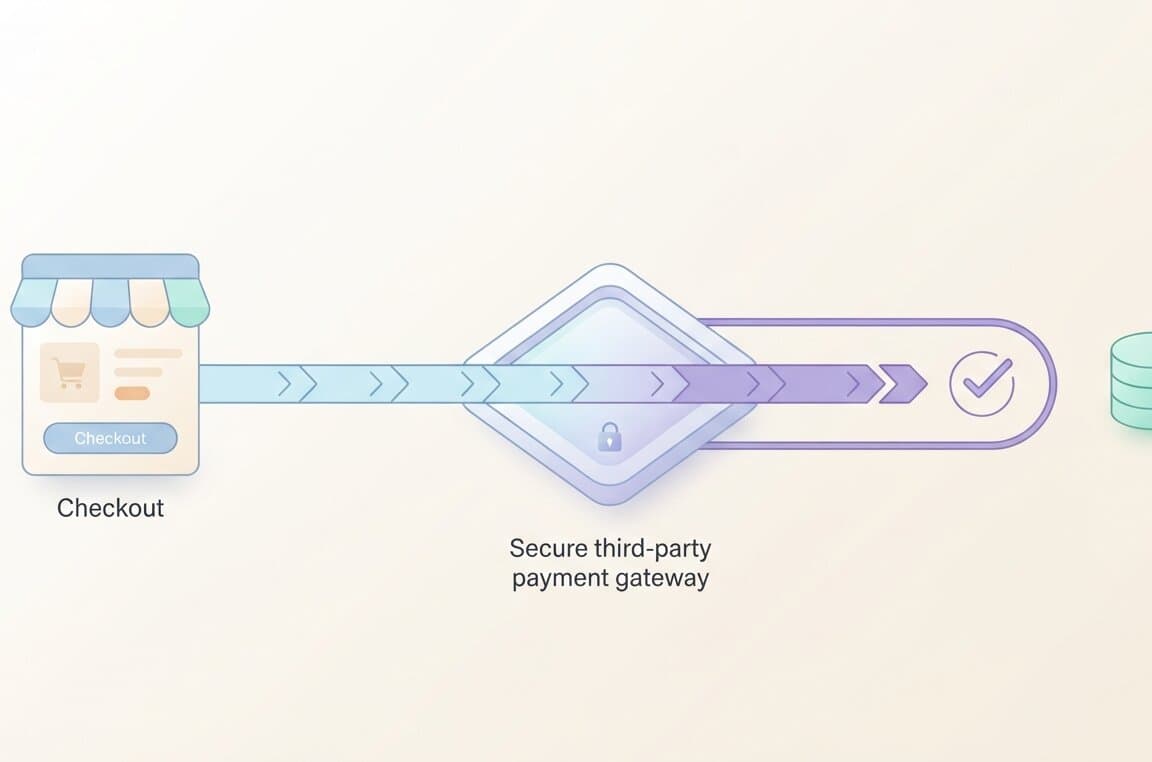
The critical detail for compliance purposes: the payload that comes back to your checkout page is not a raw PAN. It’s a network token — a surrogate value tied to a specific cryptogram, generated fresh for that transaction, that has no reversible mathematical relationship to the underlying card number outside of the issuing network’s own vault. Your servers receive and pass along this token; they never see, store, or process the actual card number at any point in a properly built integration.
That’s a meaningfully different architecture from the “type your card number into our form” checkout that most PCI SAQs were originally written around.
Network Tokens vs. Merchant Vault Tokens: A Distinction Auditors Actually Care About
This is where a lot of merchants get their terminology tangled, and it matters for how a PCI compliance audit is scoped.
Merchant vault tokens are generated by your own payment gateway or processor. When a card is first submitted, the gateway swaps it for a token and hands that token back to you for storage. The token protects your systems, but it’s only meaningful within your own processing relationship — it doesn’t travel with the customer to another merchant, and it doesn’t survive a card being reissued without some manual re-tokenization step.
Network tokens — the kind used by Click to Pay, Apple Pay, Google Pay, and modern card-on-file setups — are issued directly by the card network itself, through services like Visa Token Service (VTS), Mastercard Digital Enablement Service (MDES), or the American Express Token Service. These tokens are portable; they update automatically when the underlying card is reissued (no more failed recurring payments because a customer got a new card number), and they typically carry a modest lift in authorisation rates because issuers trust a network-verified token more than a raw PAN typed into a random web form.
For PCI DSS purposes, both types can reduce scope, but network tokens go further precisely because your systems are structurally further removed from the PAN. Merchant vault tokens still require you to prove your tokenization environment meets the PCI DSS Tokenization Guidelines; network tokens shift more of that burden onto the network’s own certified infrastructure.
Where PCI Scope Actually Shrinks
When Click to Pay or network tokenisation is implemented correctly, here’s what genuinely comes out of scope:
● The checkout form itself. If customers are authenticating through the network’s SRC-based flow rather than typing a PAN into your page, your web application no longer directly handles cardholder data during that transaction.
● Storage systems. If you’re only ever storing the network token — not the PAN, not a detokenizable value under your own control — those storage systems can be excluded from many PCI DSS Requirement 3 controls, since the token has no exploitable relationship back to the card number.
● A meaningful share of your SAQ. Depending on your architecture, moving to network tokenisation can take a merchant from a lengthy SAQ D down to something closer to an SAQ A or A-EP, because so much of the cardholder data handling has moved to the network and payment gateway.
Where PCI Scope Still Applies — Don't Skip This Part
This is the section I spend the most time on during an actual PCI DSS QSA audit, because it’s where most merchants overestimate how much has actually left their environment.
● Token provisioning and enrollment flows. The first time a customer enrols a card with Click to Pay or a network tokenization service, a PAN typically has to be submitted once to the network for tokenization. If that initial submission passes through your servers before being handed to the network, that submission path is in scope, even if every subsequent transaction only ever uses the resulting token.
● Any fallback or manual entry path. Most checkout pages still offer a “enter your card manually” option for customers who aren’t enrolled in Click to Pay or whose token isn’t available for some reason. That fallback path handles raw PANs and remains fully in PCI DSS scope — including Requirement 6.4.3’s script and payment-page integrity controls, which apply regardless of whether most transactions use tokens.
● Your payment gateway and processor relationship. Under PCI DSS 4.0.1’s Requirement 12.3.3, any third-party token service provider — including your gateway or processor handling the Click to Pay integration — has to be documented as part of your third-party security assurance program. You still need their attestation of compliance (AOC) on file, and your assessor will ask for it.
● Detokenization access, if it exists anywhere in your stack. If any system in your environment can call back to the token vault or network service and retrieve a usable PAN — for refunds, disputes, or customer service lookups — that system, and everyone with credentials to access it, stays in scope. A token being “non-reversible” only applies to systems that genuinely cannot detokenize it.
● Distinguishability and fraud-scope questions. PCI SSC guidance flags that if tokens are formatted similarly enough to real PANs, there’s a risk they get treated as payment instruments in your fraud, reporting, or reconciliation tools — which can quietly pull those systems back into scope. Auditors are increasingly testing for this during assessments, particularly where legacy reporting tools weren’t built with tokenization in mind.
What a PCI DSS Audit Will Actually Test in a Click to Pay Environment
If your organization has adopted Click to Pay or network tokenization and is heading into your next PCI compliance audit, expect a PCI certified assessor to ask for:
● A data flow diagram showing exactly where the enrollment/provisioning path sits versus the token-only transaction path.
● Documentation of your tokenization methodology per Requirement 3.7, including how tokens are generated, stored, and whether detokenization is possible anywhere in your environment.
● The AOC and third-party risk documentation for your gateway, processor, and any token service provider, per Requirement 12.3.3.
● Evidence that your manual-entry fallback checkout is still meeting full Requirement 6.4.3 script-monitoring controls.
● A walkthrough of your refund and dispute-handling process to confirm it doesn’t quietly reintroduce PAN access.
Choosing a PCI QSA Who Actually Understands Token Architecture
Not every PCI QSA services provider has kept pace with how fast network tokenization has evolved. When you’re evaluating PCI DSS QSA companies for an assessment involving Click to Pay, it’s worth asking pointed questions:
● Can they clearly distinguish network tokens from merchant vault tokens when scoping your environment, rather than treating “tokenisation” as one blanket category?
● Will they specifically test your enrollment/provisioning flow, or only the steady-state transaction flow?
● Do they have an established approach to reviewing third-party token service provider documentation under 12.3.3?
● Have they handled distinguishability and fraud-tooling scope questions in prior engagements, or is this new territory for them?
A PCI QSA audit that only looks at your happy-path token flow and ignores enrollment, fallback, and detokenization paths will give you a false sense of how reduced your scope really is — and that gap tends to surface at the worst possible time, during an actual breach investigation.
The Bottom Line
Click to Pay and network tokenization are genuinely some of the strongest scope-reduction tools available to merchants right now, and the shift toward network-issued tokens over merchant vault tokens is the right direction for both security and payment performance. But “we adopted Click to Pay” is a statement about your checkout experience, not a PCI DSS compliance conclusion. The real scope boundary depends on your enrollment flow, your fallback paths, your third-party documentation, and whether detokenization access exists anywhere in your stack.
If your organization is rolling out Click to Pay or network tokenization and wants a PCI DSS audit from a team that understands where the real boundaries sit — not just the marketing version of “tokenization removes scope” — Accorp’s PCI certified assessors can map your actual data flows and tell you, specifically, what’s in and what’s out.
Ready to find out how much your PCI scope has really changed? Talk to Accorp’s compliance team about scoping your next assessment.