.svg)
.svg)
.svg)
SOC 2 Report Structure Explained: Example Breakdown and Practical Template
Understand the SOC 2 report structure with a practical example. Learn each section, auditor opinion, controls, and how to review reports confidently.

Accorp Compliance Team
Our team of compliance experts specializes in PCI DSS, SOC 2, and other security frameworks to help businesses achieve and maintain compliance.
Ask most people what a SOC 2 report actually looks like and you'll get a vague answer — "some kind of security certificate," or "a PDF our vendor sent over." In fifteen years of sitting across the table from clients and their auditors, I've seen the same confusion play out constantly: a company either preparing for its first SOC 2 audit, or reviewing a vendor's SOC 2 report as part of due diligence, and having no real sense of what they're looking at beyond the cover page.
That gap matters. A SOC 2 report isn't a certificate and it isn't a pass/fail badge — it's a structured, opinion-based document with five distinct sections, each doing a different job, and knowing how to read it properly is the difference between a five-minute vendor review and a five-week one spent chasing down what the report actually says.
Type 1 vs Type 2: A Quick Distinction Before the Structure Makes Sense
Before breaking down the anatomy of the report, it's worth being clear on which version you're looking at, because the structure is nearly identical but the substance underneath it isn't. A SOC 2 Type 1 report evaluates whether an organization's controls are suitably designed as of a single point in time — a snapshot. A SOC 2 Type 2 report goes further, testing whether those same controls actually operated effectively over an extended review period, typically somewhere between three and twelve months. Type 2 is the version most enterprise buyers actually want to see, because it demonstrates sustained operation rather than a design that existed on paper for one day.
Both report types follow the same five-part skeleton described below. What changes between them is what section four actually contains.
Section One: The Independent Service Auditor's Report

This is the opening section, and it's the part most readers skip past to get to the "real" content — which is a mistake, because it's arguably the single most important page in the entire document. This is the auditor's formal opinion, and it tells you three things immediately: what was examined, over what period, against which Trust Services Criteria, and — critically — whether the auditor's opinion was unqualified (clean), qualified (with reservations), or something more serious.
A clean, unqualified opinion means the auditor found the system description fairly presented and the controls suitably designed and operating effectively for the criteria in scope. Anything short of that — a qualified opinion — is a signal worth reading carefully rather than skimming past, because it usually means specific exceptions were significant enough to affect the auditor's overall conclusion. This section also defines the audit's boundaries explicitly: which trust criteria were tested, and which parts of the system — such as a subservice organisation's own data center — were carved out of scope entirely.
Section Two: Management's Assertion
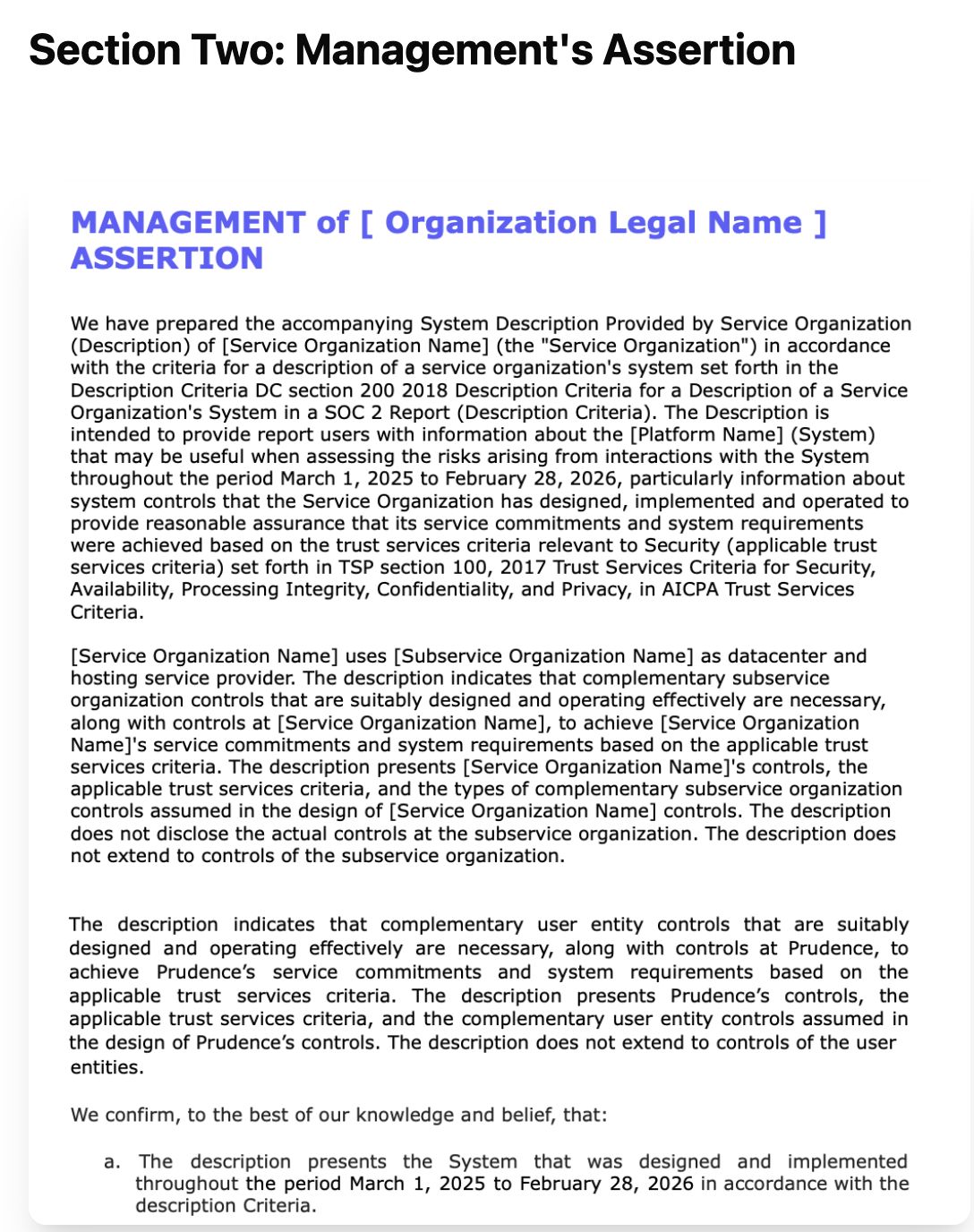
Immediately following the auditor's opinion sits management's own assertion — a statement, written by the company being audited, describing its system and confirming that the description is accurate and that the controls were suitably designed to meet the relevant Trust Services Criteria. This is worth distinguishing clearly from section one: the auditor's report is an independent opinion, while management's assertion is the company's own claim about itself, which the auditor's opinion then either confirms or qualifies.
Reading these two sections together tells you whether the company's own description of its security posture actually matches what an independent party verified — and any daylight between the two is worth a follow-up question.
Section Three: The System Description — Where Most of the Real Information Lives

This is the longest section of a typical SOC 2 report, and it's genuinely worth reading in full rather than skimming, because it's where the operational substance sits. A well-structured system description covers a consistent set of ground: a background and overview of the services being audited, any significant changes to the system during the review period, whether the organization relies on subservice organizations (cloud providers, payment processors, and similar third parties) and how their controls are carved in or out of scope, and the specific service commitments the company has made to its customers regarding security, availability, and confidentiality.
Beyond that, this section typically walks through the five components of the system — infrastructure, software, people, procedures, and data — followed by the boundaries of what's actually in scope (which products, which environments, and explicitly what's excluded). It also covers the control environment itself: how the organization structures accountability, how it runs risk assessment, how it monitors control performance on an ongoing basis, and how information and security-relevant communication flow through the organization. A section on complementary user-entity controls closes this out, spelling out what the client's own customers are responsible for on their end — access management on their side, their own disaster recovery planning, and similar shared obligations the audited company can't control alone.
Section Four: Trust Services Criteria, Controls, and Test Results
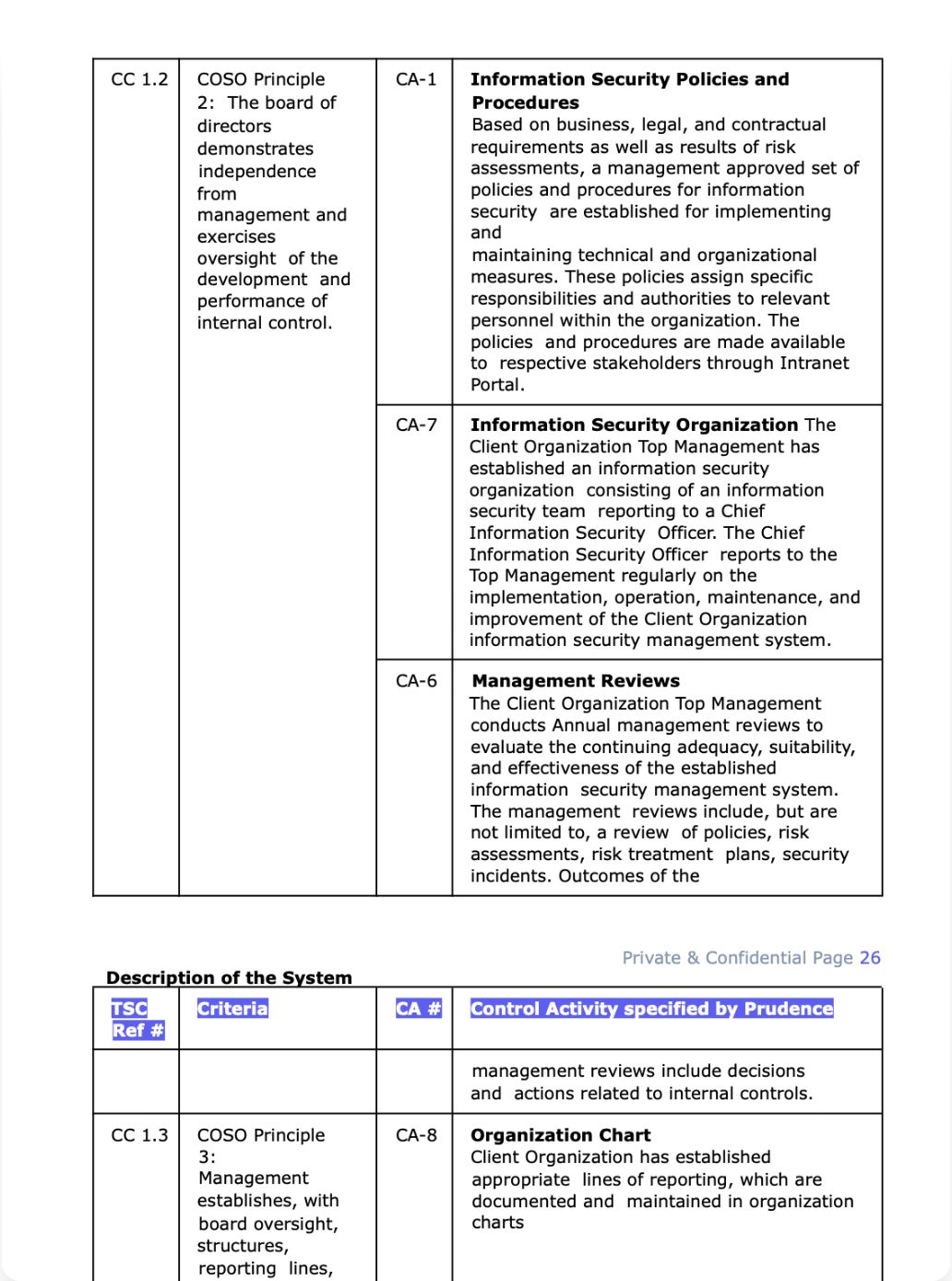
This is the working core of the report, and it's structured differently depending on whether you're looking at a Type 1 or Type 2 report. For each Trust Services Criterion in scope — Security is mandatory, with Availability, Confidentiality, Processing Integrity, and Privacy included based on what the organization actually commits to its customers — this section lists the specific controls the company has implemented, the auditor's test procedures for each one, and the results.
In a Type 2 report, this is where you'll see language describing exactly how a control was tested — inquiry, observation, inspection of evidence, re-performance — and, importantly, whether any exceptions were noted. A report with zero exceptions across every control is the ideal, but it's not automatically a red flag if a small number of minor exceptions appear, provided management's response demonstrates the issue was identified and remediated. What should raise questions is a pattern of exceptions clustered around one control area, or exceptions serious enough to affect the auditor's overall opinion in section one.
Typical control categories covered here include the control environment and organizational structure, risk assessment processes, logical and physical access controls, change management procedures, system operations and incident response, and — where applicable — the additional criteria specific to availability (capacity monitoring, backup and disaster recovery) and confidentiality (data retention, secure disposal).
Section Five: Other Information — Management's Response
Many SOC 2 reports include an optional closing section where management adds context the auditor didn't independently verify — commentary on planned improvements, additional detail on disaster recovery arrangements, or a formal response to any exceptions noted earlier in the report. This section is clearly marked as unaudited, and it's worth treating it that way: useful context, not independent assurance.
A Practical Template for Building or Reviewing a SOC 2 Report
For a company preparing for its first audit, the section-by-section structure above doubles as a practical build checklist: confirm your auditor's opinion scope and criteria upfront, draft a management assertion that matches what the audit will actually test, build out a complete system description covering all nine to ten standard sub-elements rather than a thin summary, map every control to its specific Trust Services Criterion with clear test-ready evidence trails, and decide early whether an optional management response section adds value for your specific audience.
For a reader evaluating a vendor's report, the fastest useful read is: check the opinion type in section one first, check the audit period and scope, skim the system description for subservice organization carve-outs that might matter to your own risk profile, and then go straight to section four for exceptions before deciding whether to accept the report or ask follow-up questions.
Where Accorp Fits In
Accorp Partners works with companies on both sides of this — helping first-time SOC 2 candidates build a system description and control set that will actually hold up under Type 2 testing, and helping companies evaluating a vendor's SOC 2 report interpret what they're actually looking at before signing a contract. If you're heading into your first SOC 2 audit or trying to make sense of a report that just landed in your inbox, it's worth having someone who reads these for a living walk through it with you rather than guessing at what a qualified opinion or a scope carve-out actually means for your specific situation.
Frequently Asked Questions
1. Is a SOC 2 Type 2 report always better than a SOC 2 Type 1 report?
For most enterprise buyers, yes — Type 2 demonstrates sustained control operation over months rather than a design snapshot at a single point in time, which is why most vendor security reviews specifically request Type 2.
2. What does a qualified opinion in a SOC 2 report mean?
It means the auditor found exceptions significant enough to affect their overall conclusion about whether controls were suitably designed or operating effectively — worth investigating further rather than treating as a minor footnote.
3. Are exceptions in a SOC 2 report automatically disqualifying?
No. A small number of minor exceptions with a clear management response and remediation is common and not automatically concerning. A pattern of exceptions clustered in one control area is what warrants closer scrutiny.
4. What's the difference between the auditor's opinion and management's assertion?
The auditor's opinion in section one is an independent conclusion. Management's assertion in section two is the audited company's own claim about its system, which the auditor's opinion then confirms, qualifies, or challenges.