.svg)
.svg)
.svg)
What Does SOC 2 Compliance Really Cost Your Engineering Team?
Discover the hidden engineering cost of SOC 2 compliance. Learn where time is spent, why audits disrupt teams, and how to reduce effort.

Accorp Compliance Team
Our team of compliance experts specializes in PCI DSS, SOC 2, and other security frameworks to help businesses achieve and maintain compliance.
If you ask five engineering leaders how long SOC 2 compliance takes, you'll get five different answers — and all of them will be wrong in hindsight. That's not a knock on anyone's planning skills. It's just how SOC 2 works. It doesn't show up as one clean project on the roadmap. It shows up as a hundred small interruptions spread across months.
At Accorp, we've sat through enough audit cycles — as auditors, as advisors, and as the team fielding evidence requests at 11 p.m. before a deadline — to know that the real cost of SOC 2 compliance isn't the audit fee on the invoice. It's the engineering time nobody budgeted for. This post breaks down exactly where that time goes, why it's so easy to underestimate, and how to keep a SOC 2 audit from quietly eating into your sprint velocity.
Why "SOC 2 Compliance Cost" Is the Wrong Question to Start With
Most companies start their SOC 2 journey by pricing out the audit firm, a compliance tool, and maybe a fractional CISO. That's the visible spend. What rarely makes it into the budget conversation is the engineering hours: the platform engineer configuring audit logging, the backend lead explaining data flow diagrams to an auditor, the on-call engineer pulling access logs at 6 p.m. on a Friday.
We've watched teams walk into a SOC 2 audit expecting two weeks of cleanup work and come out the other side having burned through 200+ hours of engineering time across a quarter. That gap between expectation and reality is the actual story of SOC 2 compliance cost — and it's almost always an engineering time problem before it's a money problem.
Where Engineering Hours Actually Go During a SOC 2 Audit
Engineering effort during a SOC 2 engagement isn't evenly distributed. It clusters around a few predictable phases, and understanding them is the first step to controlling the overall SOC compliance cost.
1. Pre-audit readiness work
This is the phase everyone anticipates — tightening access controls, patching gaps in logging, writing the policies that were "on the to-do list" for a year. It's real work, but it's at least visible. Teams can staff for it, timebox it, and track it like any other project.
2. The evidence-gathering grind
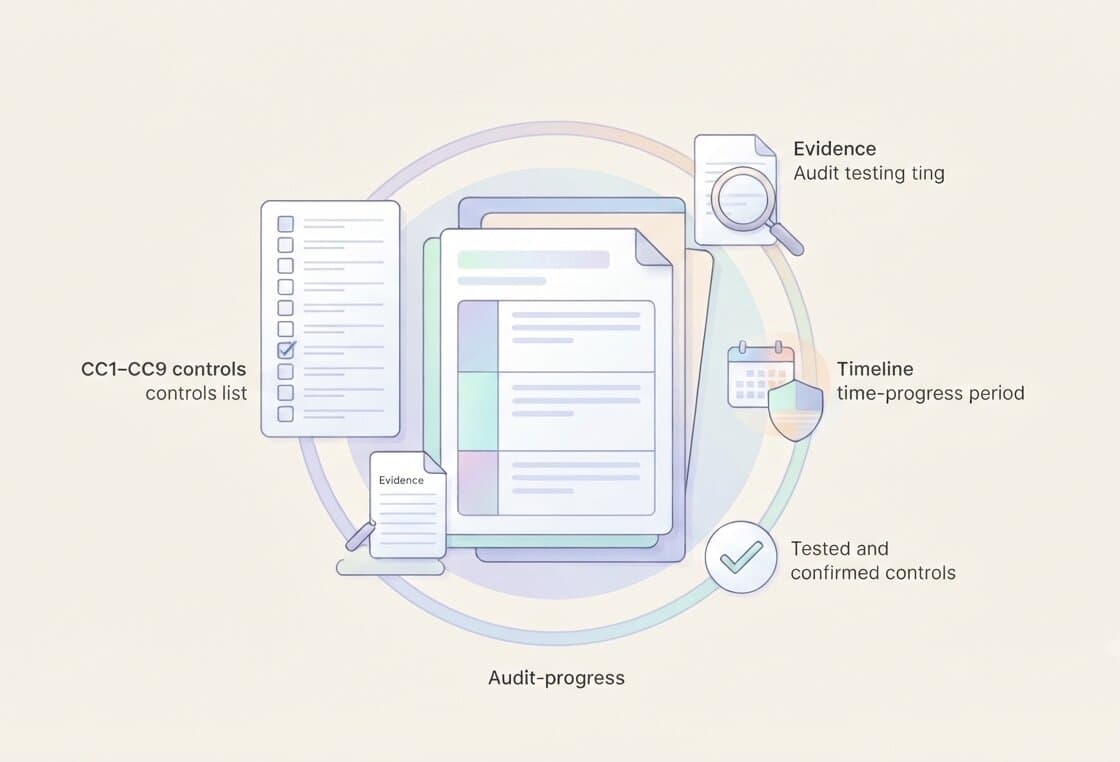
This is where most of the pain actually lives. A SOC 2 audit — especially a SOC 2 Type 2 examination, which evaluates controls over a period of months rather than a single point in time — requires proof, not promises. Auditors want screenshots, exports, config snapshots, and logs tied to specific dates. Every one of those requests lands on an engineer's desk as a "quick favor" that interrupts deep work.
Multiply a five-minute screenshot request by 60 or 80 controls, across several engineers, over several months, and you get a very different number than "quick favor" implies.
3. Auditor Q&A and walkthroughs
Somewhere in the middle of the engagement, an auditor will want to talk to the person who actually built the deployment pipeline or configured the IAM roles. These conversations are short individually but expensive collectively, because they pull senior engineers — the people least likely to have slack in their schedule — into unplanned meetings.
4. The steady hum of ongoing controls
SOC 2 isn't a one-and-done certificate. Especially with a SOC 2 Type 2 report, controls need to keep operating correctly between audits: quarterly access reviews, vulnerability remediation, incident response drills, log retention checks. None of this is dramatic on its own. Added up over a year, it's a recurring tax on engineering capacity that most roadmaps never account for.
The Hidden Cost: Context Switching, Not Just Hours Logged
Here's the part that doesn't show up in any time-tracking spreadsheet. An engineer asked to "just export this one report" isn't losing five minutes — they're losing the twenty or thirty minutes it takes to get back into flow state after the interruption. Compliance requests rarely arrive as scheduled sprint tickets. They show up as a Slack ping in the middle of a debugging session.
That interruption cost is why SOC 2 audits feel far more disruptive than their line-item hours suggest. A control that "only takes an hour a month" can quietly cost an engineering team much more than an hour of actual output, because of when and how that hour gets demanded.
Why Engineering Leaders Consistently Underestimate SOC 2 Costs.
Three patterns show up again and again in the audits we've been part of:
Nobody owns the whole picture. Infrastructure controls sit with platform engineering. Policy sits with security or legal. Evidence collection often falls on whoever's available that week. Because responsibility is split three or four ways, no single person sees — or can estimate — the full time cost.
The evidence lives everywhere. A single control might need proof pulled from your cloud provider, your identity provider, your ticketing system, and a vulnerability scanner — four different tools, four different export formats, one auditor request. That fragmentation is what turns a "simple ask" into an afternoon.
Small tasks don't feel like they add up — until they do. A screenshot here, a policy review there, a five-minute Slack thread confirming MFA is enforced. Each one is forgettable. A full audit cycle's worth of them is not.
What Actually Reduces the Engineering Burden of SOC 2 Compliance
The teams that get through SOC 2 certification with the least disruption tend to do three things differently, regardless of company size.
They assign clear control ownership before the audit starts. Every control — from logging configuration to access reviews — has one named owner. This alone eliminates the "who's supposed to handle this?" Slack threads that eat up so much time.
They automate the collection, not just the controls. Manually screenshotting dashboards every quarter is a losing strategy. Continuous, automated evidence collection — pulling logs and configuration data directly from cloud infrastructure and identity providers — turns audit prep from a scramble into a formality.
They treat compliance as continuous, not seasonal. Instead of a mad dash before the audit window opens, controls are monitored year-round. By the time the SOC 2 report is due, most of the evidence already exists — it just needs to be packaged, not produced from scratch.
How to Estimate Your Own SOC 2 Engineering Cost
Before your next audit cycle, run this exercise with your team:
List everyone who touched compliance work last cycle — not just the security team, but every engineer who exported a log or answered an auditor's question.
Estimate hours honestly, even roughly. Precision matters less than not ignoring the number entirely.
Flag which tasks were repeat requests. Recurring screenshots and manual exports are your clearest automation candidates.
Note which requests interrupted active sprint work. These carry the highest hidden cost and deserve the most attention when planning your next cycle.
This exercise alone tends to surprise engineering leaders — not because the total is shocking, but because almost none of it was visible until it was written down.
The Real Goal Isn't a Cheaper Audit — It's a Predictable One
SOC 2 compliance will always require engineering involvement. Controls have to be built, monitored, and occasionally explained to someone outside the team. That's not going away, and honestly, it shouldn't — a SOC 2 report only means something because real engineering work backs it up.
What separates a smooth SOC 2 audit from a painful one isn't the total hours spent. It's whether that time is planned, owned, and increasingly automated — or whether it keeps arriving as a surprise mid-sprint. Companies that get this right stop treating SOC 2 compliance as an annual fire drill and start treating it as a normal, background part of how their infrastructure runs.
That shift — from reactive scrambling to continuous readiness — is ultimately what makes SOC 2 certification sustainable for an engineering team instead of something they dread every year.
Accorp works with engineering and security teams to make SOC 2 compliance a predictable operational process rather than a recurring engineering fire drill. If your team is losing hundreds of hours a year to audit prep, it may be time to rethink how that evidence gets collected in the first place.