.svg)
.svg)
.svg)
What Happens After SOC 2 — Maintaining Compliance, Annual Renewal, and Bridge Letters
Keep your SOC 2 compliance on track with annual renewals, continuous monitoring, and bridge letters to avoid audit gaps and customer concerns.

Accorp Compliance Team
Our team of compliance experts specializes in PCI DSS, SOC 2, and other security frameworks to help businesses achieve and maintain compliance.
The audit ends, the report gets signed, and the sales team finally has the document security reviewers keep asking for. Then, almost immediately, a customer asks a question nobody prepared for: "Your report period ended four months ago — what's happened since?"
Most of the conversation around SOC 2 focuses on getting to the report — scoping the audit, building controls, surviving the fieldwork. Far less gets said about what happens the day after the SOC 2 audit report is issued, even though that's when a genuinely different set of challenges begins. A SOC 2 report isn't a certificate you earn once and frame on a wall. It's a time-bound attestation, and the moment it's issued, the clock starts running on when it stops being current, useful, and trusted by the customers relying on it.
This is the part of the SOC 2 lifecycle that catches companies off guard most often — not the audit itself, but everything that comes after it.
A SOC 2 Report Has a Shelf Life, and It's Shorter Than People Expect
A SOC 2 Type 2 report covers a specific review period — commonly six or twelve months — and reports on whether an organization's controls operated effectively throughout that window. The report doesn't say anything, formally, about what's happening today. It describes a defined historical period that, by the time a prospect is actually reading the report during a vendor security review, may have ended months earlier.
This creates a real, practical problem. Enterprise procurement and security teams increasingly expect SOC 2 reports to be current — meaning the report period needs to have ended recently enough to be meaningful — and a report whose period ended eight or nine months ago starts raising the exact question no vendor wants during a sales cycle: has this company's control environment held up since then, or has something quietly drifted?
Why Companies Get Caught Off Guard Between Audit Cycles
The most common mistake after a first SOC 2 engagement is treating the audit as a discrete project that concludes with the final report, rather than the first cycle of an ongoing compliance program. Controls that were carefully documented and evidenced during the audit period often loosen once the immediate pressure is off — access reviews slip from monthly to "whenever someone remembers," change management tickets stop getting consistently linked to approvals, and vendor risk reviews (subprocessor management being a particularly common casualty) quietly lapse.
None of this is usually intentional. It's simply what happens when a compliance program's real ownership was, in practice, "get through this audit" rather than "operate this control environment continuously." The gap shows up later, either during the next audit's control testing, or worse, in a customer's security questionnaire asking for evidence of a control that technically stopped being consistently followed the month after the auditor left.
Continuous Monitoring: The Difference Between a Project and a Program
The organisations that maintain SOC 2 compliance well between audit cycles tend to share one structural habit: they treat control operation as something that's monitored continuously, not reconstructed retroactively when the next audit approaches. In practice, this looks like:
Automated or scheduled evidence collection built into the tools controls already run through — access review reminders tied to the identity provider, change management evidence captured automatically from the ticketing system, rather than assembled manually months later
A defined internal owner for each control category, so responsibility doesn't diffuse the moment the audit ends
Periodic internal control self-assessments between formal audits, catching drift early rather than discovering it during the next SOC 2 auditor's fieldwork
A living risk register and subprocessor inventory that gets updated as vendors and tools change, rather than being reconstructed from memory at renewal time
This is also, practically, what keeps the next audit efficient. A company that has maintained continuous evidence collection walks into its annual renewal audit with most of what the SOC 2 auditor needs already assembled. A company that lets things lapse ends up scrambling to reconstruct several months of evidence retroactively — a process that is not only stressful but sometimes simply not possible, since some evidence (like a specific access review having actually happened on a specific date) can't be manufactured after the fact.
The Annual Renewal Cycle
SOC 2 compliance is not a one-time achievement; it's an annual cycle. Most organisations undergo a SOC 2 Type 2 audit annually, both because customers and prospects generally expect a current report — typically issued within the last twelve months — and because a lapsed or stale report tends to trigger exactly the follow-up questions that slow down a deal.
A well-run renewal cycle typically starts well before the previous report period ends — planning the next audit window, confirming there's no gap between when one report period ends and the next one begins, and using any findings or exceptions from the prior audit as a punch list to close out before the new review period starts. Organisations that treat renewal as a fire drill, starting the process only once the old report is visibly stale, tend to end up with exactly the reporting gap that the next section explains how to bridge — imperfectly.
Bridge Letters: A Temporary Fix, Not a Substitute for Timely Renewal
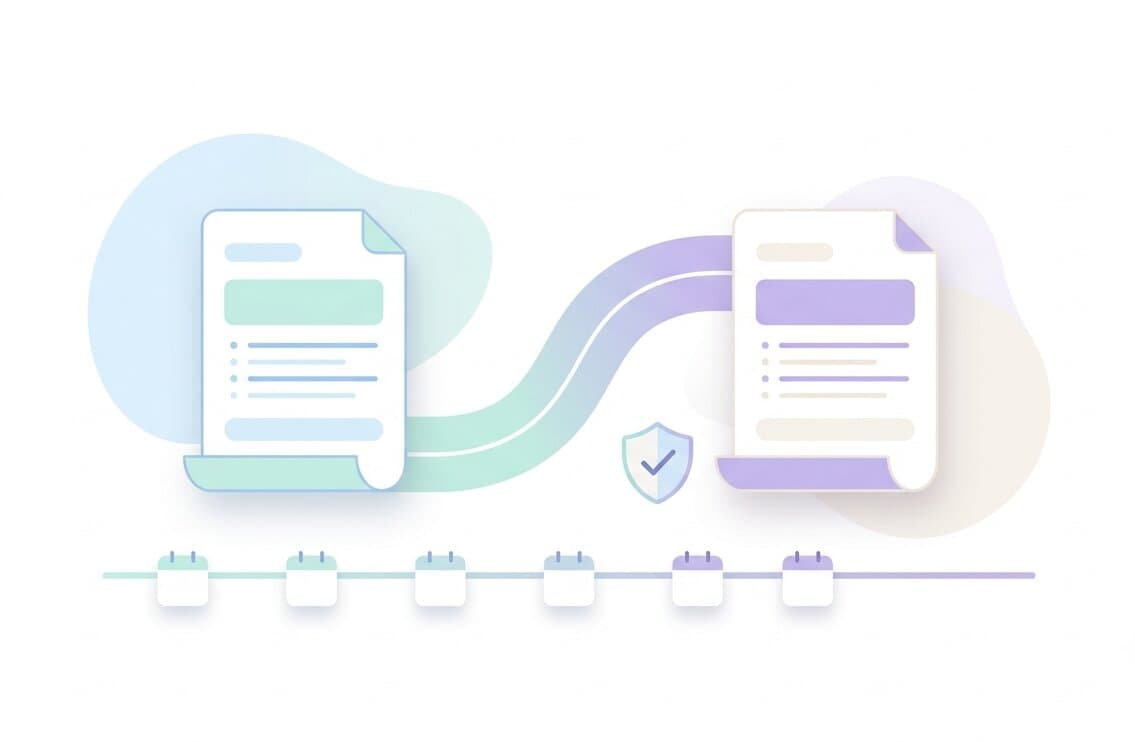
A bridge letter — sometimes called a gap letter — is a document that a SOC 2 auditor or the audited organisation issues to cover the period between the end of the last audited review period and the start of (or completion of) the next one. If a company's SOC 2 report period ended in December, and the next audit's fieldwork won't conclude until the following autumn, a bridge letter can affirm that no material changes to the control environment have occurred in the interim, giving customers and prospects a stopgap document to rely on while the new audit is underway.
Bridge letters are useful, and nearly every organisation running an annual SOC 2 program ends up issuing one at some point. But they come with real limitations that companies sometimes lean on more heavily than they should. A bridge letter is typically a management assertion, not an independently tested opinion — it does not carry the same weight as an actual SOC 2 Type 2 report, and sophisticated security reviewers know the difference. Bridge letters covering long gaps — six months or more — tend to draw more scrutiny, not less, from procurement teams who reasonably wonder why the renewal audit is taking so long to complete. And a bridge letter is not a mechanism for indefinitely deferring the next audit; it's a short-term bridge, not a long-term substitute for consistent, on-schedule SOC 2 reporting.
The organizations that use bridge letters well are the ones that need them the least often — because their renewal audits are scheduled tightly enough behind the prior report period that gaps requiring a bridge letter are short, and the letter itself is a minor formality rather than a document doing a lot of reassurance work on its own.
Building the Post-Audit Program That Actually Holds Up
A few practices consistently separate organisations that maintain SOC 2 compliance smoothly from those that treat every renewal like starting over:
Assign control ownership that survives past the audit team. The person responsible for access reviews, vendor risk, or change management evidence should be the same person operating that control day to day — not someone who only engages with it during audit season.
Build evidence collection into existing workflows, not a separate compliance exercise. Evidence that's a byproduct of how a team already works (automated logs, ticket-linked approvals) is far more reliable than evidence someone has to remember to generate.
Schedule the next audit's fieldwork before the current report period ends. This is the single most effective way to avoid needing a long bridge letter at all.
Treat prior audit exceptions as a remediation punch list, not a footnote. Carrying the same finding into a second consecutive SOC 2 audit report is a pattern that auditors and customers both notice.
Keep the subprocessor inventory and risk assessments current year-round. Vendor management is one of the control areas most likely to visibly lapse between audits, precisely because it depends on ongoing attention rather than a one-time setup.
The Bottom Line
Getting the first SOC 2 report is a milestone. Staying continuously compliant afterwards is the actual discipline — and it's the part of the process that determines whether the second audit is a smooth annual renewal or a stressful reconstruction project. A SOC 2 Type 2 report only means as much as the control environment actually operating behind it, and that operation doesn't pause the day the auditor leaves. Bridge letters exist for a reason and are a legitimate part of a well-run SOC 2 program, but they work best as an occasional, short-term tool — not a recurring patch for a renewal cycle that keeps starting too late.