.svg)
.svg)
.svg)
Does Your SOC 2 Report Actually Satisfy Australia's APP 8? What Cross-Border Data Rules Really Require
Understand how APP 8 differs from SOC 2 and what SaaS companies need for cross-border data transfers, privacy disclosures, and compliance in Australia.

Accorp Compliance Team
Our team of compliance experts specializes in PCI DSS, SOC 2, and other security frameworks to help businesses achieve and maintain compliance.
Every SaaS company selling into Australia eventually runs into a version of this conversation: your prospect's legal or privacy team has read your SOC 2 audit report, seems satisfied with the security posture it describes, and then asks a completely different question — "how are you handling APP 8?" If your compliance program was built primarily around US and European buyers who ask for a SOC 2 report and move on, this can feel like a curveball. It isn't really a curveball, but it is a genuinely separate legal requirement, and assuming your SOC 2 compliance covers it is a mistake that surfaces at exactly the wrong moment — during a Australian customer's final legal review.
This piece walks through what Australian Privacy Principle 8 actually requires, why it's structured around accountability rather than technical controls, and where a strong SOC 2 Type 2 report genuinely helps versus where it simply doesn't reach.
What APP 8 Actually Is
Australian Privacy Principle 8 governs the cross-border disclosure of personal information under Australia's Privacy Act 1988. It was introduced through the Privacy Amendment (Enhancing Privacy Protection) Act 2012, largely in response to the reality that personal information routinely flows across borders in a globalized digital economy, and that Australian individuals needed protection that followed their data even after it left the country.
The core requirement is straightforward to state and considerably more demanding to actually operationalize: before an Australian business — referred to in the law as an "APP entity" — discloses personal information to a recipient located outside Australia, it must take reasonable steps to ensure that overseas recipient handles the information in a way consistent with the Australian Privacy Principles. This applies whenever personal information crosses the border, which for most SaaS companies happens constantly and often invisibly — cloud storage hosted offshore, CRM and marketing platforms running on US infrastructure, payment processors, and increasingly AI tools processing customer data on overseas servers.
Why Accountability Is the Central Idea Behind APP 8
This is the detail that separates APP 8 from a standard security review, and it's the part a SOC 2 audit report simply isn't built to address. Under section 16C of the Privacy Act, if an overseas recipient does something with disclosed personal information that would have breached the Australian Privacy Principles had the Australian business done it directly, the Australian business is treated as having breached the APPs itself. The accountability doesn't transfer to the vendor — it stays with the Australian entity that made the disclosure in the first place.
Practically, this means an Australian company cannot discharge its APP 8 obligations simply by pointing to a vendor's own privacy policy or a vendor's SOC 2 audit report and calling the matter closed. The Australian business remains on the hook if that overseas vendor mishandles the data, regardless of what assurances the vendor's own compliance documentation provides. This accountability structure is precisely why due diligence, enforceable contractual terms, and clear documentation matter so much more here than in security frameworks built around evaluating a vendor's controls in isolation.
The Reasonable Steps Standard: What It Actually Looks Like
APP 8.1 requires that reasonable steps be taken before disclosure — not a guarantee of the overseas recipient's future conduct, but a genuine, documented effort to ensure compliance. In practice, this typically involves reviewing the vendor's privacy and data processing terms in detail, executing a Data Processing Agreement where the vendor offers one, and maintaining a clear internal record of which categories of personal information go to which overseas recipients, in which countries.
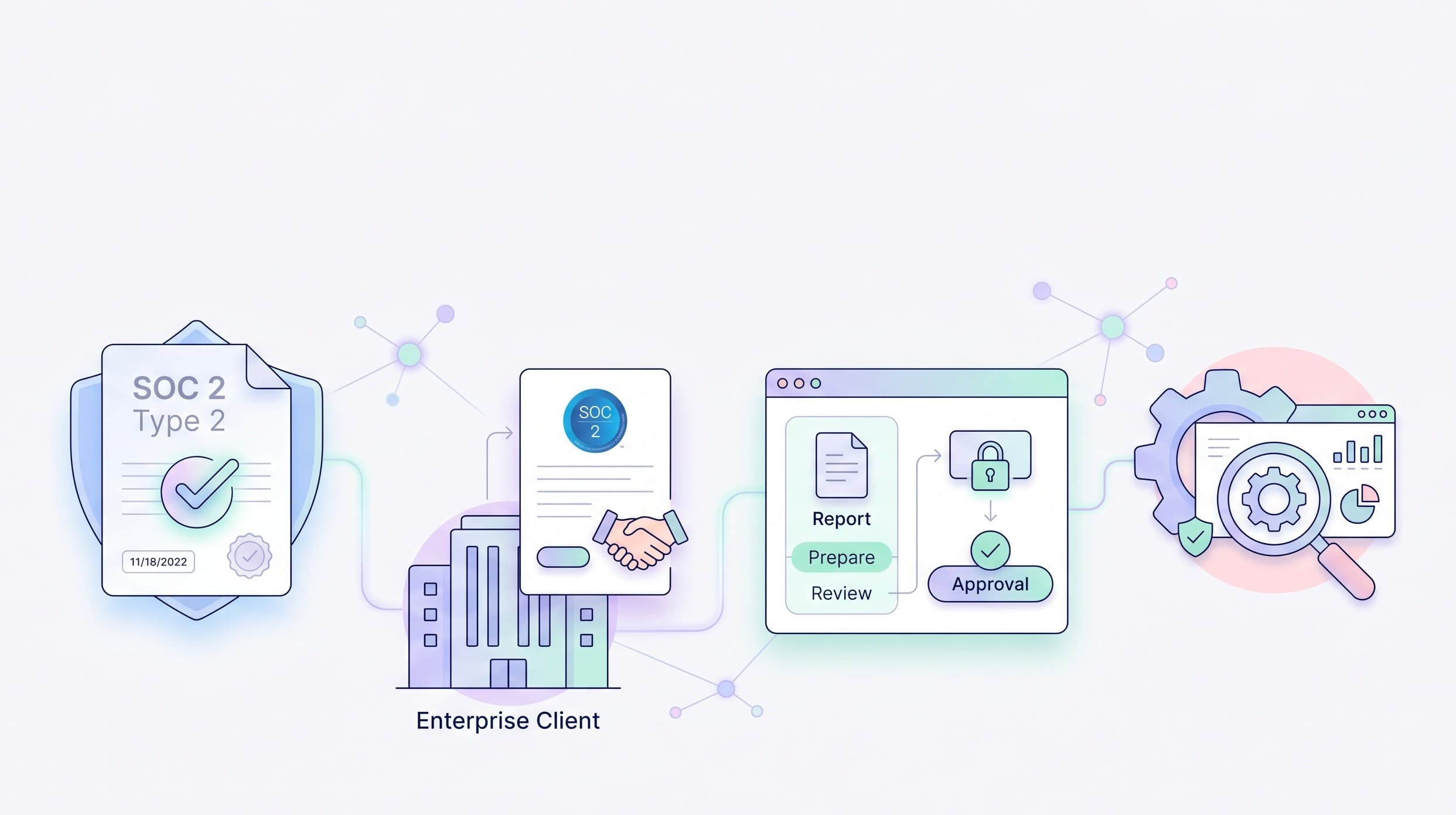
This is where a company's SOC 2 reporting genuinely contributes something useful, even though it isn't the whole answer. A well-documented SOC 2 Type 2 report demonstrating consistent, sustained operation of access controls, encryption, and monitoring gives an Australian customer's privacy team meaningful evidence to support their own "reasonable steps" assessment of you as a vendor. It's supporting evidence within their compliance process — not a substitute for the contractual and disclosure obligations APP 8 separately requires.
Where SOC 2 Compliance Falls Short of APP 8's Requirements
A few specific APP 8 obligations sit entirely outside what a SOC 2 auditor examines during a typical engagement:
Data Processing Agreements with enforceable APP-equivalent terms. SOC 2 doesn't require or evaluate the presence of a specific contractual instrument obligating a vendor to handle data consistently with Australian privacy law. This has to be built and executed as its own deliverable.
Privacy policy disclosure of overseas recipients and destination countries. APP 8 compliance generally expects that an entity's privacy policy or APP 5 collection notice discloses the categories of overseas recipients and the countries personal information may be sent to. A SOC 2 audit report says nothing about the content or completeness of a company's public-facing privacy disclosures.
The accountability chain itself. Even with excellent technical controls — precisely the kind a SOC 2 Type 2 audit would validate — an Australian business remains legally accountable if its vendor mishandles data downstream. No amount of SOC 2 reporting rigor on the vendor's side removes that legal exposure from the Australian entity making the original disclosure.
The Exceptions to APP 8 — and Why They Rarely Apply Cleanly to SaaS Vendors
APP 8 includes a defined set of exceptions where the reasonable steps and accountability requirements don't apply, and it's worth understanding these because vendors sometimes assume they qualify when they don't.
Informed consent. An individual can consent to a disclosure after being expressly told that APP 8 protections may not apply and that the overseas recipient may not be bound by the Australian Privacy Principles. This consent has to be genuinely informed and specific — buried boilerplate language in a lengthy privacy policy generally doesn't meet this bar.
Reasonable belief in substantially similar protection. If the disclosing entity reasonably believes the recipient's country has a privacy law regime substantially similar to the APPs, with genuine enforcement mechanisms individuals can actually use, this exception can apply. This is a judgment call that requires real analysis, not an assumption based on a country's general reputation.
Disclosure to an entity with an "Australian link." Where the overseas recipient itself has a sufficient connection to Australia to be directly covered by the Privacy Act, it's treated differently — the entity is essentially already bound by Australian law directly, which changes the accountability calculus.
For most foreign SaaS vendors selling into Australia, none of these exceptions apply automatically, which means the reasonable-steps obligation and the underlying accountability structure remain the operative framework.
What This Means Practically for a SaaS Company Selling Into Australia
Inventory every system that touches Australian personal information. This needs to go beyond your primary application — CRM, support tooling, analytics, payment processing, and any AI or data processing subprocessors all count if they're hosted or headquartered outside Australia.
Put a Data Processing Agreement in place with your own overseas subprocessors. If you're a non-Australian vendor and your infrastructure itself relies on further offshore subprocessors, your Australian customer's due diligence may reasonably extend to asking how you've addressed that chain too.
Disclose specifically, not generically. A privacy policy that's silent on overseas disclosure, or that vaguely references "international transfers" without naming categories of recipients and countries, doesn't meet the standard Australian privacy teams are trained to look for.
Present your SOC 2 audit report as supporting evidence, framed correctly. Rather than letting an Australian buyer assume your SOC 2 Type 2 report addresses APP 8 directly, be explicit: "our SOC 2 reporting demonstrates the following operational controls; here separately is our Data Processing Agreement and disclosure framework addressing APP 8's cross-border requirements." This kind of precision reads as considerably more credible to a privacy-literate reviewer than an implied assumption of coverage.
Why This Matters More as Enforcement Attention Increases
The Office of the Australian Information Commissioner has continued refining its guidance on Chapter 8 of the Australian Privacy Principles, reflecting ongoing regulatory attention to how cross-border data flows are actually being managed in practice — not just documented in policy. For SaaS vendors building a long-term Australian go-to-market strategy, treating APP 8 as a genuine compliance workstream, distinct from but complementary to an existing SOC 2 compliance program, is increasingly the expectation rather than an edge case a handful of sophisticated buyers happen to ask about.
Where Accorp Fits In
Accorp Partners works with SaaS companies expanding into Australia — helping map what an existing SOC 2 audit report genuinely demonstrates to an Australian buyer's privacy team, and where APP 8's specific reasonable-steps, disclosure, and accountability requirements need their own dedicated documentation and contractual work rather than being assumed as already covered.
Frequently Asked Questions
1. Does a SOC 2 Type 2 report satisfy APP 8's cross-border transfer requirements on its own?
No. It provides useful supporting evidence of operational control maturity, but APP 8 separately requires reasonable steps like Data Processing Agreements, specific privacy policy disclosures, and an accountability structure that a SOC 2 audit doesn't address.
2. Who remains legally accountable if an overseas vendor mishandles Australian personal data?
Generally, the Australian business that made the original disclosure, under section 16C of the Privacy Act — accountability doesn't automatically transfer to the vendor, regardless of the vendor's own security certifications.
3. Does APP 8 apply if an Australian company's own vendor is headquartered overseas but SOC 2 compliant?
Yes. SOC 2 compliance addresses security control effectiveness, not the specific legal mechanisms — consent, reasonable belief in equivalent protection, or an Australian link — that APP 8 requires for a lawful cross-border disclosure.
4. What's the most common APP 8 gap SaaS vendors overlook?
Privacy policies that are silent, vague, or generic about overseas disclosure, rather than specifically naming the categories of overseas recipients and the countries involved, as Australian privacy teams expect to see.