.svg)
.svg)
.svg)
SOC 2 Subprocessor Management — The Control Area Most Companies Fail
SOC 2 subprocessor management is a common audit challenge. Learn key controls, vendor risk practices, and how to avoid audit exceptions.

Accorp Compliance Team
Our team of compliance experts specializes in PCI DSS, SOC 2, and other security frameworks to help businesses achieve and maintain compliance.
Ask a security engineer to walk through access controls, and they'll do it confidently. Ask them to name every subprocessor with access to customer data, when each one's SOC 2 report was last reviewed, and what happens if one of them gets breached — and the room usually goes quiet.
Auditors who've sat through enough SOC 2 examinations will tell you the same thing: subprocessor and vendor risk management is the control area companies most consistently underinvest in, right up until it shows up as an exception in the SOC 2 audit report. It isn't that companies don't know vendors matter. It's that subprocessor oversight tends to live nowhere in particular — not fully owned by security, not fully owned by legal, not fully owned by procurement — and diffuse ownership is exactly the condition under which a control area quietly rots.
This article looks at why subprocessor management fails so often, what a SOC 2 auditor actually expects to see, and what a defensible, auditable program looks like in practice.
Why This Control Area Is Structurally Hard
Under the AICPA Trust Services Criteria, vendor and business partner risk sits primarily under CC9.2, which requires an organisation to assess and manage risks associated with vendors and business partners before onboarding them, and to monitor that risk on an ongoing basis. On paper, this sounds like any other control. In practice, subprocessor management is harder than most controls for one reason: it depends on artefacts and cooperation from outside the organisation's walls.
Access control evidence lives inside your own identity provider. Change management evidence lives inside your own ticketing system. Subprocessor evidence, by contrast, depends on a third party actually sending you their SOC 2 report, responding to a security questionnaire, or disclosing a downstream subprocessor you didn't know they were using. When the evidence trail runs through someone else's inbox, it becomes the first thing that slips during a busy quarter — and the first thing a SOC 2 auditor notices is missing when reporting season arrives.
What "Subprocessor" Actually Means in a SOC 2 Context
A subprocessor, in this context, is any third-party service provider that processes, stores, or has access to customer data on your organisation's behalf — cloud infrastructure providers, payment processors, customer support platforms, email and communication tools, monitoring and logging services, and any AI or ML vendor with access to production data. The list is almost always longer than companies initially assume, particularly once engineering teams have quietly adopted SaaS tools that never went through a formal vendor approval process.
This is where the first real gap tends to open up: a company can only manage the subprocessors it knows about. An incomplete subprocessor inventory isn't a minor documentation gap — it's the root cause of almost every downstream failure in this control area, because everything else (risk tiering, monitoring cadence, contractual flow-down) depends on first having a complete and current list.
What a SOC 2 Auditor Actually Looks For
When a SOC 2 auditor evaluates subprocessor management, they are generally checking for a consistent, evidenced answer to four questions:
1. Is there a complete, current inventory of subprocessors? Not a list assembled the week before the audit, but one that's maintained continuously, tied to an actual onboarding process, and reconciled periodically against what's actually in use across engineering, IT, and business teams.
2. Was each subprocessor risk-assessed before onboarding? This typically means evidence of a pre-engagement review — confirming the vendor's own security posture, reviewing their SOC 2 report or equivalent certification where one exists, and documenting the decision to proceed, along with any risk mitigations required as a condition of onboarding.
3. Is subprocessor risk monitored on an ongoing basis, not just at onboarding? A SOC 2 Type 2 report specifically evaluates whether controls operated effectively over a review period, typically six to twelve months — which means a subprocessor risk assessment done once, at onboarding, and never revisited is a design that will not survive Type 2 testing. Auditors expect to see periodic reassessment: an annual review cadence at minimum, and evidence that a subprocessor's own updated SOC 2 report or attestation was reviewed when it became available, not just filed away unopened.
4. Are subprocessor relationships appropriately disclosed and contractually governed? This includes data processing agreements or equivalent contractual terms, appropriate confidentiality and security obligations flowed down to the subprocessor, and — particularly relevant for companies serving regulated or privacy-conscious customers — clarity on whether the subprocessor is disclosed to end customers where required.
The Carve-Out vs. Inclusive Method: A Distinction Companies Rarely Understand
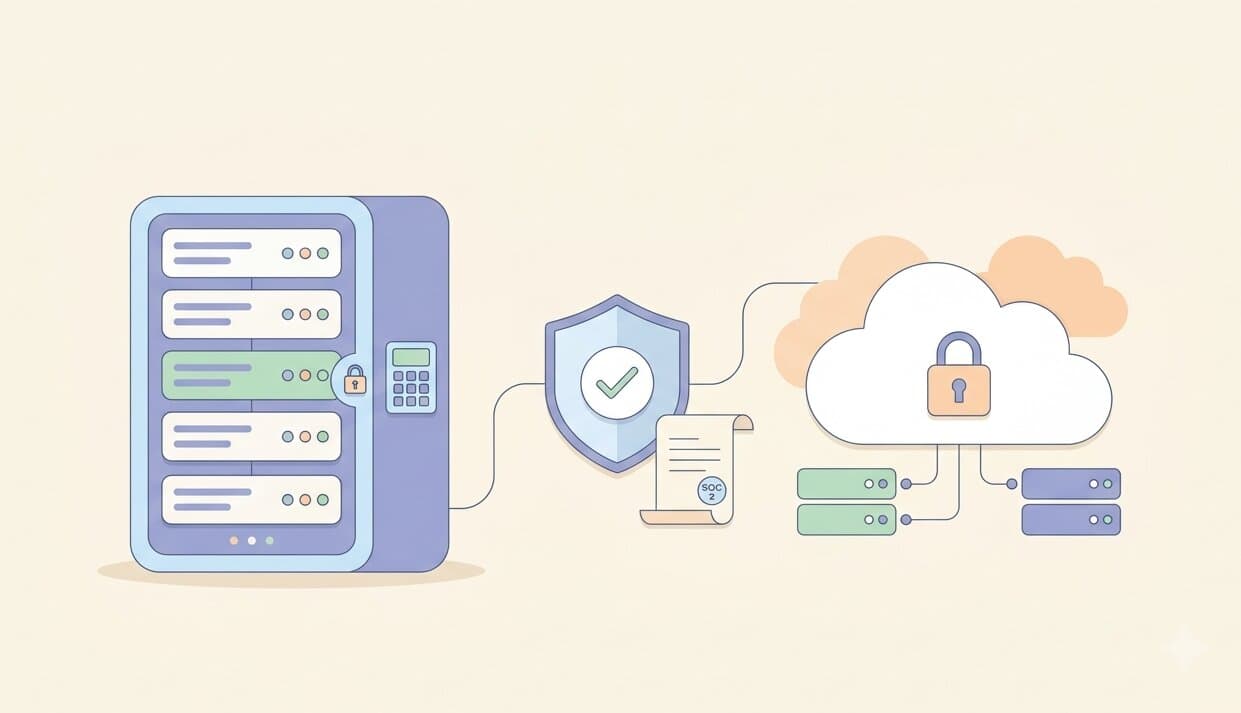
One of the more technical aspects of subprocessor management inside a SOC 2 examination is how the organisation's own SOC 2 report treats its subservice organisations — the term SOC 2 reporting uses for subprocessors whose controls are relevant to the scope of the audit.
Under the carve-out method, the organisation's SOC 2 report excludes the subservice organisation's own controls from direct testing, but the report must still describe the Complementary Subservice Organisation Controls (CSOCs) — the specific controls the organisation is relying on the subservice organisation to have in place. This is where many companies fall short: they name the subprocessor but fail to actually document, monitor, and evidence the specific CSOCs they're relying on, which auditors will flag as an insufficiently supported control.
Under the inclusive method, the subservice organisation's controls are tested directly as part of the primary organisation's own audit — a more rigorous but far less common approach, typically reserved for situations involving a small number of deeply integrated subservice providers.
Most companies default to the carve-out method without realising it comes with its own documentation obligation — simply naming a subprocessor and pointing to their SOC 2 report is not, on its own, sufficient evidence of ongoing control monitoring.
A Practical Framework for Getting This Right
Build a living subprocessor inventory, not a static spreadsheet. Tie subprocessor additions to procurement or vendor-onboarding workflow so new tools can't reach production data without triggering a review. Reconcile this inventory against actual usage (cloud billing, SSO logs, API integrations) at least quarterly — the gap between the "approved" list and the "actually in use" list is where most surprises live.
Risk-tier subprocessors instead of treating them uniformly. A payment processor with access to full transaction data warrants a different level of scrutiny than an internal analytics tool with no customer PII exposure. Tiering lets a security team focus deep review effort — SOC 2 report review, penetration test summary review, security questionnaire follow-up — where it actually matters, rather than spreading thin, uneven attention across every vendor equally.
Actually read the subprocessor's SOC 2 report, don't just collect it. A genuinely useful subprocessor review reads the report for scope limitations, noted exceptions, and the specific Trust Services Categories covered (a subprocessor's SOC 2 compliance under the Security category alone says nothing about their Availability or Confidentiality controls if your reliance depends on those). Filing an unopened PDF away to show an auditor "we have it" is a common but weak substitute for genuine review.
Set a defined reassessment cadence and stick to it. Annual reassessment at a minimum, with a defined trigger for earlier review — a security incident at the subprocessor, a significant change in the service they provide, or an update to their own attestation status.
Flow down contractual obligations explicitly. Data processing terms, breach notification timelines, and audit rights should be specified in the contract, not assumed. When a subprocessor experiences an incident, the contractual clarity on notification timing is often the difference between a controlled response and a scramble.
Where Companies Most Commonly Fail This Control
The recurring failure pattern, across most SOC 2 Type 2 report exceptions related to vendor management, looks remarkably consistent: an incomplete or outdated subprocessor inventory that misses tools engineering teams adopted informally; a one-time onboarding review that was never repeated during the audit period; subprocessor SOC 2 reports collected but not substantively reviewed for scope or exceptions; and CSOCs referenced in the company's own report description without corresponding evidence that those specific controls were actually monitored.
None of these is an exotic failure. They're the predictable result of an ownership gap — a control area that sits between departments, gets partial attention from several teams, and full attention from none.
The Bottom Line
Subprocessor management fails more often than most SOC 2 control areas for a structural reason, not a competence one: it depends on evidence and cooperation from outside the organisation, and it requires sustained attention across an entire audit period rather than a single point-in-time effort. A company preparing for a SOC 2 audit report — particularly a SOC 2 Type 2 report, which tests operating effectiveness over time — needs a subprocessor program with clear ownership, a continuously maintained inventory, genuine (not superficial) review of each vendor's own SOC 2 compliance posture, and a defined reassessment rhythm. Get that structure in place before the audit window opens, and this becomes one of the more straightforward control areas to evidence. Leave it informal, and it becomes the single most predictable source of exceptions in the final report.