.svg)
.svg)
.svg)
APR for step-down subsidiaries — when does it apply and how to report
APR filing rules for step-down subsidiaries under FEMA ODI regulations, including disclosures, audit requirements, deadlines, and RBI compliance.

Accorp Compliance Team
Our team of compliance experts specializes in PCI DSS, SOC 2, and other security frameworks to help businesses achieve and maintain compliance.
Indian companies with overseas subsidiaries are familiar with the APR filing India obligation — the Annual Performance Report due to the RBI by December 31 each year. But when that overseas subsidiary itself owns another company — a step-down subsidiary (SDS) — the compliance picture becomes more complex, and more frequently misunderstood.
What exactly must an Indian party report about its step-down subsidiaries in the APR? Does a separate APR need to be filed for each step-down entity? When do audited financials become mandatory? And what changes in the step-down structure must be disclosed and when?
This guide answers all of these questions with specific references to the Foreign Exchange Management (Overseas Investment) Rules, 2022, the Overseas Investment Regulations, 2022, and the RBI Master Direction on Direct Investment by Residents in Overseas Entities — the three instruments that collectively govern ODI compliance and APR filing for foreign subsidiaries in the current framework.
What Is a Step-Down Subsidiary?
A step-down subsidiary (SDS) is a foreign entity that is owned — wholly or partially — by an overseas direct investee entity of an Indian party, rather than directly by the Indian party itself.
Example: An Indian IT company (the Indian party) owns 100% of a US LLC (the direct overseas subsidiary / WOS). That US LLC, in turn, owns 75% of a UK private limited company. The UK entity is the step-down subsidiary — it is two layers removed from the Indian parent.
The Indian party has no direct equity in the UK entity. But it has an indirect economic interest through its holding in the US LLC. This indirect relationship creates specific foreign subsidiary audit compliance and RBI reporting requirements under the ODI framework.
The Core Rule: APR Is Filed per Direct ODI Entity, Not per Step-Down
The APR obligation under Rule 23 of the Foreign Exchange Management (Overseas Investment) Rules, 2022 applies to the Indian party with respect to each foreign entity in which it holds an Overseas Direct Investment (ODI).
A separate APR is filed for each direct overseas investee entity. If an Indian company directly holds ODI in three foreign entities — a US LLC, a Singapore Pte Ltd, and a UAE LLC — it files three separate APRs, one for each.
The step-down subsidiary does not generate a separate, standalone APR obligation for the Indian party. The Indian party has no direct ODI in the SDS — its ODI is in the first-tier overseas entity. There is no separate Form ODI Part II for the step-down subsidiary alone.
However — and this is where most companies get tripped up — the APR for the direct overseas entity must include specific disclosures about all step-down subsidiaries within that overseas entity's structure. The step-down subsidiary information is disclosed as part of the parent entity's APR, not separately.
What the APR Must Disclose About Step-Down Subsidiaries
Under the RBI Master Direction and the APR form structure (Form ODI Part II), the Indian party must disclose the following information about step-down subsidiaries within the APR filed for the direct overseas investee:
1. Acquisition or setting up of new step-down subsidiaries Any new step-down subsidiary incorporated or acquired during the reporting period must be disclosed — including the entity name, country of incorporation, nature of business, date of acquisition/incorporation, and the ownership percentage held by the direct overseas subsidiary.
2. Winding up or liquidation of step-down subsidiaries If a step-down subsidiary was wound up, liquidated, merged, or dissolved during the reporting period, this must be reported — including the date of closure and the method of dissolution.
3. Transfer of step-down subsidiary shares If the direct overseas subsidiary transferred its shares in a step-down entity (partial or complete exit), this must be disclosed — including the transferee details, transfer price, and resultant change in shareholding.
4. Changes in shareholding pattern Any change in the ownership percentage of the step-down subsidiary — whether from a new capital raise, share buyback, or secondary transfer — must be disclosed. This includes dilution below or acquisition above key thresholds.
5. Financial data of step-down subsidiaries The APR requires the Indian party to furnish consolidated or consolidated-equivalent financial data covering step-down subsidiaries — specifically, the consolidated net worth, profit/loss, and dividend remittances where the direct overseas entity prepares consolidated financial statements.
Key compliance point from the RBI Master Direction: The APR must disclose any acquisition, setting up, winding up, or transfer relating to step-down subsidiaries or changes in their shareholding pattern during the reporting period. This is a mandatory disclosure field — not an optional one.
When Are Audited Financial Statements Required for Step-Down Subsidiaries?
This is the most practically complex aspect of overseas subsidiary audit compliance for multi-tier structures.
Audited financials of the direct overseas entity
Under the current RBI framework, audited financial statements of the direct overseas entity are mandatory for the APR where:
The Indian party controls the overseas entity (holds more than 50% of voting rights or can determine its financial and operating policies), OR
The Indian party holds 10% or more equity in the overseas entity (direct ODI)
Where audited financials are not yet available by December 31 (because the overseas entity's fiscal year ends after March 31 or because the audit is ongoing), the RBI permits unaudited financials to be submitted initially, with audited financials to be provided within 6 months of the overseas entity's financial year end — or by 31 December of the next year, whichever is earlier.
Audited financials of step-down subsidiaries
For step-down subsidiaries specifically, the RBI's position is more nuanced:
If the direct overseas entity prepares consolidated financial statements (which would consolidate the SDS), the consolidated audited accounts covering the step-down subsidiary satisfy the disclosure requirement for the SDS.
If the direct overseas entity does not consolidate (e.g., because the SDS is held below the consolidation threshold in the overseas jurisdiction), standalone disclosures for the SDS may be required.
For overseas subsidiary audit compliance, where the Indian party's auditor (the statutory auditor of the Indian company) is certifying the APR, they must certify that all dues from overseas entities including step-down subsidiaries have been repatriated to India as required.
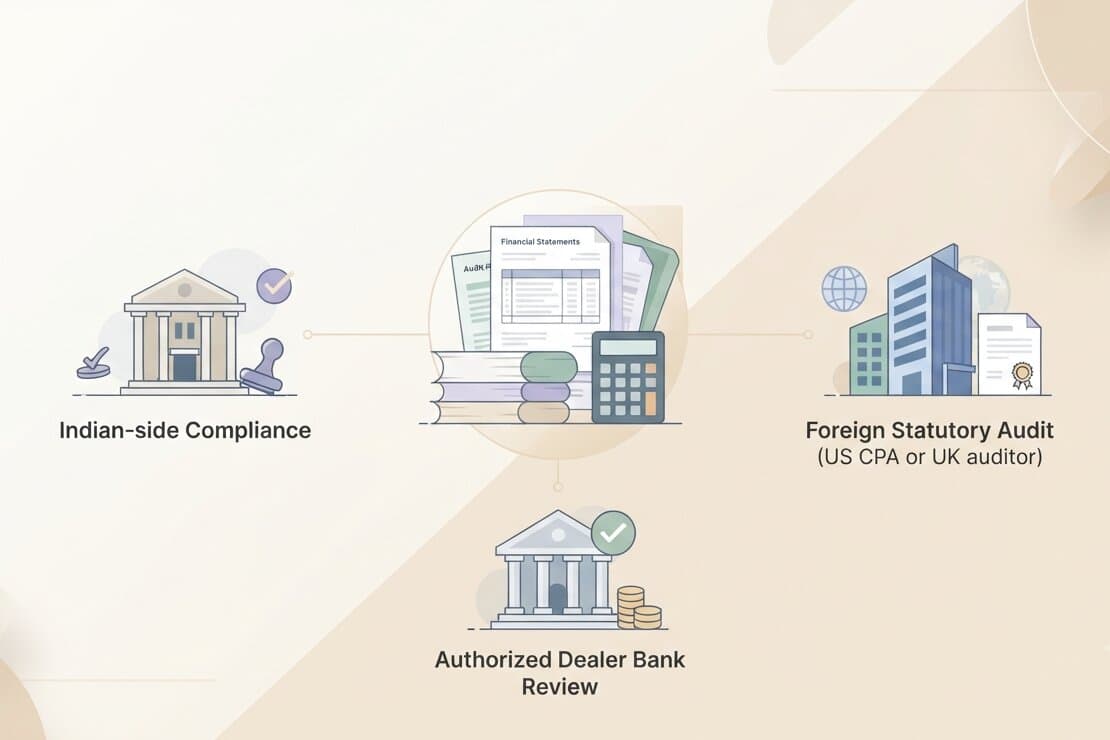
This is where US CPA for APR filing and UK auditor for APR filing requirements arise in practice. The overseas entity's financials must be prepared under the applicable GAAP of the overseas jurisdiction (US GAAP, UK FRS, Singapore FRS) before they can be reported in the Indian APR — and the auditor must be qualified under the laws of that overseas jurisdiction. An Indian CA cannot audit a US LLC's financials under US GAAS. The audit must be conducted by a licensed US CPA firm.
The December 31 Deadline — No Extensions for Step-Down Structures
The APR filing deadline is December 31 each year — for the financial year of the overseas entity that ended on or before the preceding March 31.
This deadline applies equally whether the overseas entity is a simple WOS or the top of a multi-tier step-down structure. Complex step-down structures do not earn additional time.
Common timing challenge for step-down subsidiaries: The Indian party's December 31 APR filing requires consolidated or subsidiary-level financials from its direct overseas entity — which in turn depends on the step-down subsidiary completing its own year-end close and audit on time. In a three-tier structure (Indian party → US LLC → UK subsidiary → Singapore sub-subsidiary), the December 31 deadline requires the entire chain to have completed its financial close by early November at the latest.
Planning implication: Companies with step-down subsidiaries should initiate the overseas entity audit process in August or September — not October or November.
Reporting Structure: How Step-Down Subsidiaries Appear in Form ODI Part II
The APR (Form ODI Part II) is filed through the AD bank which submits it to the RBI's FIRMS portal. Within the form:
Section | What to Report for Step-Down Subsidiaries |
Part A — Overseas entity details | Name, country, UIN of the direct ODI entity only |
Part B — Financial performance | Consolidated financials (including SDS) if consolidated accounts exist; standalone if not |
Part C — Dividends received | Dividends from the direct entity; dividends flowing up from SDS must be traced and disclosed |
Part D — Structural changes | SDS acquisition, winding up, shareholding changes — all during the reporting period |
Part E — Auditor certification | CA/auditor certifies repatriation compliance including from step-down entities |
The UIN (Unique Identification Number) is assigned by the AD bank at the time of the original ODI filing. There is no separate UIN for step-down subsidiaries — the UIN relates to the Indian party's direct investment in the first-tier overseas entity.
Prior-Year Reporting: What If Step-Down Subsidiary Formation Was Never Disclosed?
This is a common issue encountered during overseas investment compliance reviews: an Indian company that set up a step-down subsidiary in a prior year but never disclosed it in the APR for that year.
Under FEMA 1999, the non-disclosure of a step-down subsidiary formation, acquisition, or transfer in the APR constitutes a FEMA violation — specifically a contravention of the disclosure obligations under the Overseas Investment Rules, 2022.
The rectification route is through the RBI's FEMA compounding mechanism — filing a compounding application with the relevant RBI Regional Office, disclosing the violation, and paying the compounding fee. For non-wilful violations of reporting obligations, compounding has typically resulted in fees in the range of ₹50,000 to ₹3 lakh depending on the amount of investment and the duration of non-reporting.
Late APR filing attracts Late Submission Fees (LSF) of ₹7,500 per filing — a low penalty that many companies treat as a cost of delay. But repeated non-disclosure of material structural changes (SDS formation, winding up, transfers) goes beyond an LSF matter and may require compounding.
Penalties for Non-Compliance — APR and Step-Down Disclosure
Violation | Consequence |
APR not filed by December 31 | FEMA violation + LSF of ₹7,500 |
SDS formation not disclosed in APR | FEMA violation — compounding required |
SDS transfer or winding up not reported | FEMA violation — compounding required |
APR filed without audited financials (where required) | Incomplete filing — AD bank may return for rectification |
Future ODI remittances blocked | Until prior APRs are filed and compliant |
The consequences for future investment activity are real: an Indian company that cannot demonstrate clean APR filing history — including complete step-down subsidiary disclosures — will find its AD bank refusing to process new ODI-related remittances. This becomes particularly acute when the Indian company wants to capitalise the step-down subsidiary with fresh funds routed through the direct overseas entity.
How Accorp Partners Handles APR for Step-Down Subsidiary Structures
Accorp Partners is a US CPA and UK ICAEW firm providing APR audit and filing services for Indian companies with overseas subsidiaries — including multi-tier step-down structures in the US, UK, Singapore, Australia, and Canada.
Our APR filing India services for companies with step-down subsidiaries include:
Step-down subsidiary mapping — documenting the full overseas entity tree, identifying each tier requiring disclosure in the APR
Overseas subsidiary audit — licensed US CPA audit of US LLCs and corporations, UK ICAEW audit of UK entities, Singapore ISCA audit for Singapore subsidiaries — producing APR-ready audited financial statements under applicable GAAP
Foreign subsidiary audit compliance — coordinating the audit timeline across multiple jurisdictions to meet the December 31 APR deadline
Form ODI Part II preparation — complete APR preparation, including financial data compilation, structural change disclosures, and repatriation certification
AD bank submission — coordination with the Authorised Dealer bank for FIRMS portal filing
Back-year rectification — FEMA compounding applications for prior-year non-disclosure of SDS formation, winding up, or shareholding changes
ODI compliance calendar management — annual reminder system to initiate the overseas audit in August, ensuring December 31 compliance
Also Read: What Financial Details Go Into an APR? A Section-by-Section Breakdown of Form ODI Part II