.svg)
.svg)
.svg)
Form 5471 and APR: Reconciling Your US Subsidiary's IRS Filing With RBI's
Compare Form 5471 and India APR filing requirements, including filing obligations, financial data, US-person ownership, and cross-border compliance.

Accorp Compliance Team
Our team of compliance experts specializes in PCI DSS, SOC 2, and other security frameworks to help businesses achieve and maintain compliance.
Every Indian company with a US-person co-founder, investor, or officer eventually runs into a compliance blind spot that catches even well-advised teams off guard. The Indian parent is diligently filing its APR every December, reporting the audited financials of its US subsidiary to RBI. Meanwhile, somewhere in a completely separate conversation, a US CPA is telling one of the company's US-citizen shareholders they need to file Form 5471 — and the two conversations rarely happen in the same room, because most people assume both are somehow "the same US filing." They aren't. They run in opposite directions, involve different entities, and are filed by different parties entirely. Understanding exactly how they differ — and where they genuinely do need to be reconciled — is the difference between a clean cross-border compliance picture and a quiet gap that surfaces years later during a funding round's due diligence.
This piece walks through what Form 5471 actually requires, how it differs fundamentally from your APR filing India obligation, and where the two genuinely intersect.
Two Filings, Same Structure, Completely Opposite Direction
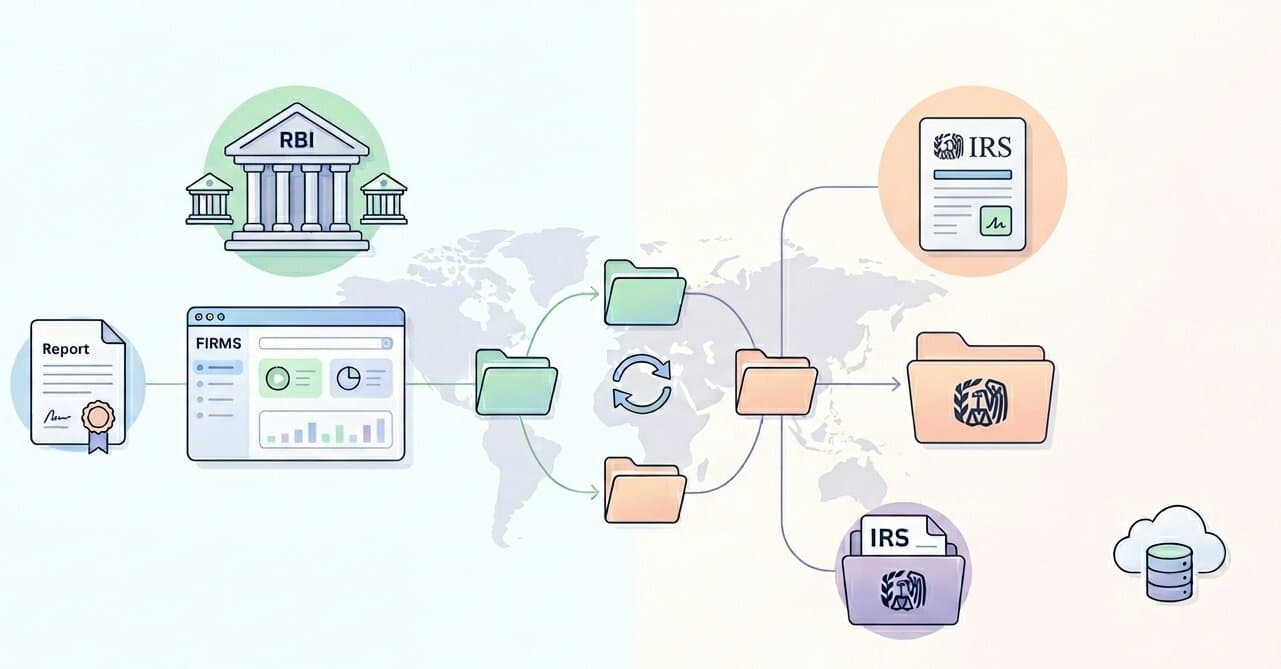
Here's the core confusion, stated plainly: APR filing India tracks an Indian entity's investment outward into a foreign subsidiary. Form 5471 tracks a US person's interest inward, in a foreign corporation from the IRS's perspective — and if a US citizen or green card holder owns 10% or more of your Indian parent company, that Indian company is the "foreign corporation" the IRS cares about, not the US subsidiary you set up through the ODI route.
This is precisely why companies miss the obligation entirely. The Indian company already has a very real, very structured relationship with US compliance — its US WOS files its own US corporate tax return, has its own audit trail, and features prominently in the annual APR audit. It feels like "the US side is handled." But Form 5471, in the most common fact pattern for Indian startups with NRI or US-resident promoters, has nothing to do with the US subsidiary at all. It's about whether any US person holding equity in the Indian entity itself has a separate, personal IRS reporting obligation regarding that Indian company's financials.
What Form 5471 Actually Requires
Form 5471, officially the Information Return of U.S. Persons With Respect to Certain Foreign Corporations, applies to any US citizen, resident, corporation, partnership, trust, or estate that owns at least 10% of a foreign company, directly or indirectly. The IRS organizes filers into distinct categories — a Category 4 filer, for instance, is a US person who had control of a foreign corporation during its accounting period, while Category 5 covers US shareholders of a controlled foreign corporation, one more than 50% owned by US persons collectively.
If your Indian company has a US-citizen co-founder holding 15% equity, that individual is very likely a Category 4 or 5 filer with respect to your Indian entity — which, from the IRS's vantage point, is the foreign corporation. The form is attached to that individual's personal US tax return, generally due by the standard April 15 deadline (or the extended date if applicable), and it requires detailed financial data about the Indian company: balance sheet, income statement, and, depending on the ownership structure, potential Subpart F income or GILTI (now restructured as NCTI under recent US tax legislation) calculations.
The penalties for missing this aren't small. A $10,000 penalty applies per annual accounting period per corporation for a missed or incomplete filing, with additional penalties of up to $50,000 if the failure continues after IRS notice. And critically, dormant or inactive status doesn't create an exemption — a foreign corporation with minimal activity still triggers the filing obligation if the ownership threshold is met.
What the APR Actually Requires — A Reminder
By contrast, your APR audit obligation under FEMA compliance runs the other direction entirely. The Indian entity — as the ODI-making party — must file an Annual Performance Report with RBI by December 31 each year, reporting audited financials of its foreign subsidiary (here, the US WOS), certified by that subsidiary's statutory auditor or an equivalent host-country professional. This is ODI compliance in its most standard form: India-outbound investment, reported by the Indian resident entity, using the foreign subsidiary's financial statements as the underlying evidence.
Notice the entities involved are reversed from Form 5471: APR reports on the US subsidiary using the Indian parent as filer. Form 5471 reports on the Indian parent using a US-person individual as filer. Same corporate family, same cross-border structure, but the "foreign corporation" being reported and the party doing the reporting flip depending on which authority you're talking to.
Where the Two Filings Genuinely Do Intersect
It isn't always a clean separation, and there are real scenarios where the two obligations actually touch each other and need active reconciliation, not just parallel awareness.
If the US WOS itself has US-person officers or directors distinct from the Indian parent's ownership, Category 2 or 3 filing triggers can apply at the individual level for events like acquiring additional stock or taking on an officer role — separate from anything the Indian parent files with RBI.
If your US subsidiary sets up its own step-down subsidiary in a third country, the US WOS — now itself a "U.S. person" for IRS purposes — may need to file Form 5471 regarding that downstream entity, at the same time the Indian parent is separately disclosing that same step-down subsidiary within its own APR filing to RBI. Two different filings, two different authorities, reporting on the identical entity from two different vantage points.
If a US-person promoter's Form 5471 financial disclosures for the Indian parent don't align with what's being reported elsewhere, discrepancies can raise flags during IRS review, particularly around ownership percentage changes, which need to be tracked in real time rather than reconstructed at year-end.
Why the Financial Data Rarely Reconciles Cleanly on Its Own
Even where no direct overlap exists, keeping both filings internally consistent matters more than most companies realize — because a discrepancy discovered later, during due diligence or a compounding review, raises exactly the kind of question nobody wants to answer under time pressure: "why do your two cross-border filings tell different stories about the same company?"
A few structural reasons the numbers don't naturally align: the Indian company's financials feeding Form 5471 are typically prepared under Ind AS or Indian GAAP, while the US CPA needs them recast to reflect US tax reporting conventions. Currency conversion introduces its own variance depending on the exchange rate convention used. And the accounting periods, while both broadly calendar-year, don't always close and get audited on identical timelines — RBI's APR expects the US subsidiary's audited financials on one schedule, while Form 5471 follows the individual filer's own US tax return deadline, which may fall months apart.
Coordinating a US CPA and Your APR Auditor So Both Filings Tell a Consistent Story
The practical fix isn't complicated, but it requires deliberate coordination rather than treating the two filings as unrelated projects run by unrelated professionals. Bringing the US CPA handling Form 5471 for your US-person shareholders into the same conversation as whoever manages your APR audit — ideally with visibility into each other's numbers — catches discrepancies while they're still easy to explain, rather than after both filings have already gone out with conflicting figures.
This coordination becomes even more important in multi-country structures. If your US WOS also has a UK-based entity in the chain, you're now coordinating a US CPA for APR filing purposes on one side and a UK auditor for APR filing purposes on the other — each producing audited financials that ultimately need to sit consistently within a single Indian APR filing, while any US-person shareholder's Form 5471 obligations run independently alongside all of it.
What Happens When Nobody Connects the Two
The most common failure pattern isn't a single missed filing — it's that the two obligations exist in separate silos entirely. The Indian company's FEMA compliance team handles APR filing India diligently every year. The US-person promoter's personal tax preparer handles Form 5471 separately, often without ever being told the full ownership structure or being looped into what RBI reporting already contains. Nobody actively reconciles the two, because nobody realizes they're technically part of the same compliance story, just facing in opposite directions.
Where Accorp Fits In
Accorp Partners works with Indian companies carrying both obligations — coordinating APR audit work with the US CPAs handling Form 5471 for US-person shareholders and officers, so both filings draw from a consistent, reconciled financial picture instead of existing as two disconnected compliance tracks that happen to involve the same corporate family.
Frequently Asked Questions
1. Does filing an APR for a US subsidiary eliminate the need for Form 5471?
No. They're unrelated in direction — APR reports the Indian parent's investment in the US subsidiary to RBI, while Form 5471 reports a US person's interest in the Indian parent (or a downstream entity) to the IRS.
2. Who is actually required to file Form 5471 in a typical Indian startup structure?
Any US citizen or green card holder owning 10% or more of the Indian company, or serving as an officer or director in specific triggering circumstances — the Indian company itself doesn't file Form 5471.
3. Does a US step-down subsidiary need to be reported to both RBI and the IRS?
Yes, potentially — the Indian parent discloses it within its APR filing, while the US WOS, as a US person, may separately owe Form 5471 reporting regarding that same downstream entity.
4. What's the biggest risk of not coordinating these two filings?
Inconsistent financial figures between the two filings, which can raise scrutiny during IRS review or Indian regulatory checks and are far harder to explain retroactively than to reconcile upfront.