SOC 2 Readiness Assessment vs Self-Assessment: Which One Tells You If You're Ready for the Audit
SOC 2 readiness assessment or self assessment? Compare depth, cost and results to learn which one shows you're ready for the SOC 2 audit.

Accorp Compliance Team
Our team of compliance experts specializes in PCI DSS, SOC 2, and other security frameworks to help businesses achieve and maintain compliance.
If you want an honest answer to "are we ready for the SOC 2 audit?", a SOC 2 readiness assessment run by an independent professional is the more reliable test. A SOC 2 self-assessment is a useful starting point, and for a small team with simple systems it may be enough. But it marks your own homework, and the audit will not.
This guide compares the two head-to-head, shows when each one makes sense, and explains what happens afterwards. It also places both inside the wider SOC 2 process, so you can plan the work before the clock starts on your audit period.
What Each One Actually Is
Both tools exist to answer the same question: if an auditor tested our controls today, what would they find? Neither one produces a SOC 2 report. The report is issued only after a formal SOC 2 audit by a licensed CPA firm.
A self-assessment is an internal review. Your own team maps your controls against the Trust Services Criteria, usually in a spreadsheet or inside a compliance platform, and decides where the gaps are. It is quick and cheap, and it forces the team to learn what SOC 2 expects.
A readiness assessment is a structured examination carried out by an external professional, typically a CPA firm or an experienced assurance consultant. They review your policies, test whether controls actually operate, look at the evidence you can produce, and give you a prioritised list of gaps. Think of it as a dress rehearsal for the audit.
Head to Head: Five Questions That Decide It
1. Who is judging?
In a self-assessment, the people who built the controls decide whether the controls are good. That creates blind spots. Teams tend to score intent rather than evidence: "we do access reviews" counts, even if nobody has written one down. A readiness assessment puts an outsider in the judge's seat, someone who has seen how auditors treat the same facts.
2. How deep does it go?
Self-assessments usually stop at the design level. They ask whether a policy exists and whether a control is defined. A readiness assessment goes further. It samples real evidence, checks that controls ran consistently, and looks at whether your system description matches how things actually work. That is the level at which audits fail.
3. What do you get at the end?
A self-assessment gives you a checklist with your own scores. A readiness assessment gives you a gap report with severity, owners and a sequenced remediation plan. It also gives a view on scope, including which Trust Services Criteria to include and whether to start with Type 1 or go straight to Type 2.
4. Who trusts the result?
Investors, enterprise customers and your own board will usually give more weight to a conclusion reached by an outside professional. Neither document is shareable proof of SOC 2 compliance, but a clean readiness result is a better basis for telling a prospect "we expect to be ready by quarter-end".
5. What does it cost in time and money?
A self-assessment costs staff time. A readiness assessment adds a professional fee, although a short one is cheap compared with the cost of a failed or extended audit window. The cost is not only the fee. A mistaken "we are ready" can delay a deal by months.
When a Self-Assessment Is Enough
A self-assessment can carry you a long way when:
Your company is small, with a simple cloud stack and few systems in scope.
You are using a compliance platform that already maps controls and collects evidence.
Someone on the team has been through a SOC 2 audit before and knows what auditors look for.
The report is a nice-to-have, not a condition for a live deal.
Even then, treat it as a first pass. Run it, fix what it finds, and consider an outside review before you fix your audit window.
When You Need a Readiness Assessment
Pay for the external view when:
A signed customer or contract depends on the report and the date.
You have multiple products, regions, vendors or environments in scope.
You are going for a Type 2 report, where controls must work consistently across the period, not just exist on one day.
You have failed an access review, had an incident or changed systems recently.
Nobody internally has led a SOC 2 audit. Our list of things first-timers are rarely told shows why this matters.
As a rule, a readiness assessment is cheapest before the audit window opens. Once the observation period starts, a control that was not working is an exception in every sample, and you cannot fix history.
What a Good Readiness Assessment Covers
A proper review follows the SOC 2 process end to end. Expect it to include:
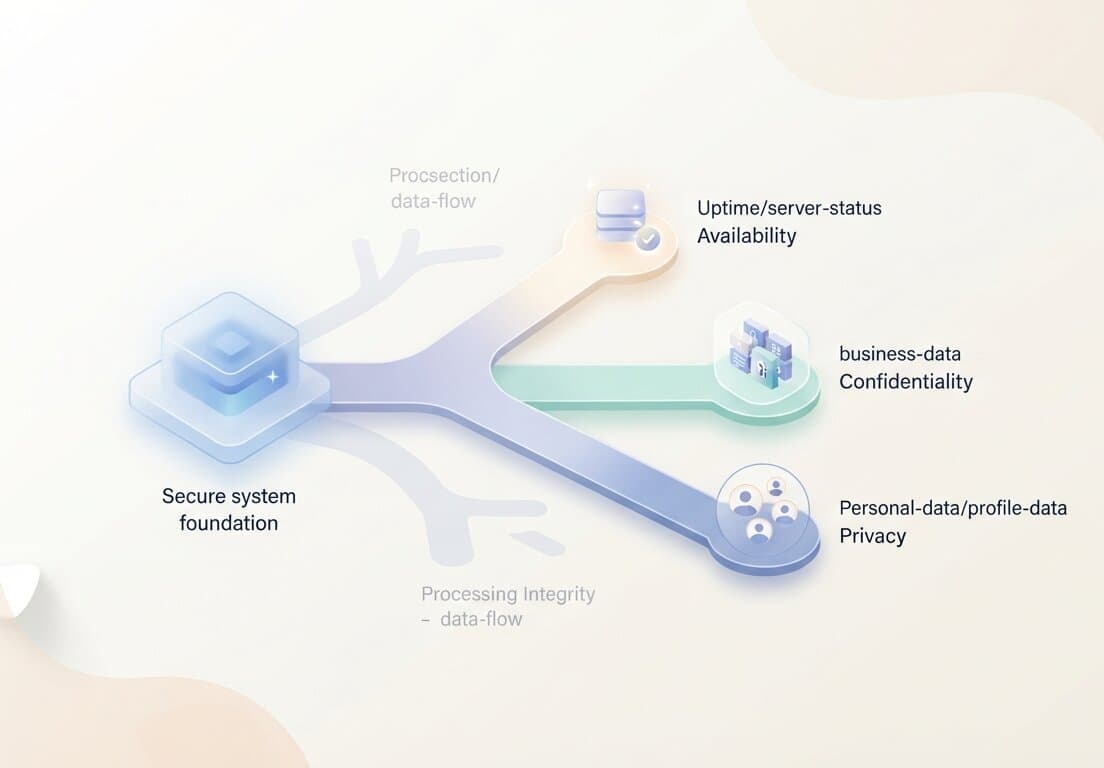
Scope and criteria. Which systems, services and people are in scope, and which Trust Services Criteria apply. Security is always included. Availability, confidentiality, processing integrity and privacy are added when they reflect what you promise customers. Our guide to the five Trust Services Criteria helps you decide.
Control mapping. Your existing controls matched against the criteria, with gaps highlighted.
Policy and documentation review. Whether policies are approved, current and actually followed.
Operating evidence. Samples of access reviews, change records, onboarding and offboarding, vendor reviews and incident handling.
System description review. Whether what you tell auditors matches what your systems do.
Gap report and plan. A prioritised list of fixes, owners and a suggested date for the audit window to open.
The most common gaps found at this stage are missing formal policies, incomplete access reviews, undocumented vendor management and inconsistent evidence. If your team has already reached the end of a self-assessment, these are the areas to double-check.
The Hybrid Approach Many Teams Use
You do not have to choose one forever. A practical path looks like this:
Run a self-assessment first to learn the framework and fix obvious gaps.
Bring in an external readiness assessment once you believe you are close, to challenge your own scoring.
Remediate the gaps found and keep collecting evidence.
Open the audit window only when the control environment is genuinely working.
This keeps professional fees focused on the part where a second pair of eyes helps most.
After the Results: Turning Gaps Into an Audit Window
A gap report is only useful if it leads to a plan. Sort the findings into three groups: gaps that must be closed before the observation period begins, gaps that can be fixed in parallel, and improvements that can wait for the next cycle.
The sequencing matters because of how Type 2 works. Auditors test whether controls operated across the whole window, so a missing control on day one affects every sample after it. Our explainer on why the observation period matters shows how auditors read the window. If you are choosing between report types, our notes on whether a Type 1 report is good enough and why customers ask for Type 2 will help.
Timing also matters commercially. Some teams chase an aggressive timeline, and our roadmap on getting SOC 2 ready in 90 days shows what is realistic and what is not. If you expect a gap between report periods later on, read how bridge letters work.
Red Flags That You Are Not Ready Yet
Whether you used a self-assessment or a readiness assessment, these signs mean you should wait:
Policies exist but nobody can show evidence they were followed.
Access reviews are done informally or irregularly.
You cannot list your vendors and show how you assess their risk.
Different people describe the same control in different ways.
Your system description is out of date.
The score on your own checklist is high, but you have never tested the evidence.
How to Choose a Readiness Provider
Look for a licensed CPA firm or assurance team with real SOC 2 audit experience, not only advisory experience. Ask who will do the work and how many similar companies they have reviewed. Confirm how independence is handled if the same firm may later audit you, because customers sometimes ask. And ask what you get at the end: a clear gap report, a remediation plan and a view on scope, not a generic template. If you are still deciding what SOC 2 compliance means for your business, start with our explainer on what SOC 2 compliance really means.
The Takeaway
A self-assessment tells you what you think is true. A readiness assessment tells you what an auditor is likely to find. If the report affects revenue, use the outside view. If you are small and learning, start with the internal one and then check your work. Either way, finish the gap fixes before the audit window opens, because that is the part you cannot repair afterwards.
Not sure whether you are audit-ready? Talk to Accorp Partners about a SOC 2 readiness assessment, gap remediation and CPA-led audit support.
Frequently Asked Questions
1. Is a SOC 2 readiness assessment the same as a SOC 2 audit?
No. A readiness assessment is a pre-audit review that finds gaps and recommends fixes. It does not produce a SOC 2 report that customers can rely on. Only a formal SOC 2 audit by a licensed CPA firm results in a SOC 2 report.
2. Can we skip the readiness assessment and go straight to the audit?
You can, but it is risky. Without a readiness check, gaps are found during the audit window, where they become exceptions in the report. That can mean a qualified opinion, a delay or a restarted window. For a first audit, the assessment usually pays for itself.
3. Is a self-assessment enough if we use a compliance automation tool?
It can be a strong start, because the tool maps controls and collects evidence. But a tool tells you whether items are present, not whether an auditor will accept them. Many teams still use an outside review to check judgment calls such as scope and system description.
4. How long does a readiness assessment take?
It depends on your size and how organised your evidence is. A smaller company with clear documentation may finish in a few weeks, while complex environments take longer. Remediation is usually the larger block of time, so ask for a plan, not just a report.
5. Can the readiness provider also be our SOC 2 auditor?
Some firms offer both services with safeguards to protect independence. Whether that suits you depends on your customers and your own risk view. If it matters to your buyers, ask the firm how it separates advisory work from audit work, and put the answer in writing.
6. Does a self-assessment count as SOC 2 compliance?
No. SOC 2 compliance is demonstrated by an independent audit report. A self-assessment is an internal tool that helps you prepare. It is useful for planning, but you cannot show it to customers as proof that you meet the criteria.