.svg)
.svg)
.svg)
Delaware Flip Founders: Do You Owe APR on Your US Parent Shares?
Understand APR audit and ODI compliance after a Delaware flip, including FEMA residency, stake, control, co-founder filing, and US subsidiary reporting.

Accorp Compliance Team
Our team of compliance experts specializes in PCI DSS, SOC 2, and other security frameworks to help businesses achieve and maintain compliance.
Somewhere between the term sheet and the closing call, the lawyers say the words "we'll flip to Delaware." Over the next few weeks, a US parent is formed, founder shares are swapped, the Indian company becomes its subsidiary, and everyone moves on to the fundraise. What rarely gets discussed is that you, still a resident of India, now hold equity in a foreign company. That brings a yearly RBI filing with it.
The short answer is that it depends on three things: your residency status, the size of your stake, and whether you control the US company. Here is how each one plays out.
Why a flip creates overseas investment compliance obligations
Under the Overseas Investment Rules, 2022, a person resident in India who acquires unlisted equity in a foreign entity is treated as making overseas direct investment (ODI). The old rule of thumb that ODI only matters above 10% no longer holds for unlisted shares. A founder's allotment of US Inc. shares is therefore an investment under the framework, even if you paid par value or received the shares in exchange for your Indian shares.
Once an investment counts as ODI, ongoing ODI compliance follows. The main one is the Annual Performance Report. So the flip is not only a restructuring exercise. It also starts a foreign investment reporting cycle that continues for as long as you hold the shares.
Test one: are you a resident for FEMA purposes?
Everything starts here. FEMA has its own residency definition, which differs from the income tax residential status test. A founder who has genuinely relocated to the US, and who held the shares as a non-resident, is generally outside the ODI framework for those shares. A founder who still lives and works in India is inside it.
The awkward cases are founders who shuttle between the two countries, or who move back to India after the flip. Their position depends on when residency changed and how the shares were acquired, and it deserves a written analysis rather than an assumption.
Test two: how much do you hold, and do you control the company?
RBI's own APR form offers a relief valve: a resident holding less than 10% of the foreign entity, with no control and no other financial commitment, is not required to file. In practice, that can cover a junior co-founder with a small stake in the US parent.
The difficulty is the word "control." The rules define it broadly, covering the right to appoint a majority of directors and also the ability to influence management or policy decisions through shareholding, agreements or voting arrangements. A co-founder with 8% but a board seat, protective veto rights or a voting agreement may be treated as having control, and then the exemption is gone.
"Other financial commitment" is the second trap. If you have lent money to the US company, or personally guaranteed one of its obligations, the exemption also falls away, however small the shareholding.
When several co-founders are residents
Flips usually involve two or three founders, all still in India. RBI does not want three APRs for the same foreign entity. The investor with the highest stake files, and where stakes are equal, the investors designate one person to file and give the AD bank an undertaking to that effect. It's worth settling this in writing at the time of the flip, because the question comes up again every December.
What APR filing India actually asks for
APR filing for foreign subsidiaries, or for any foreign entity held as ODI, goes through your authorised dealer (AD) bank. The report covers the entity's capital structure, turnover, profit or loss, net worth, dividends and repatriation, loans and guarantees, and details of any step-down subsidiaries.
In a flip, the Indian operating company sits beneath the US parent, so it should be disclosed as a step-down subsidiary and match the structure reported when the ODI was first made. Any change in the shareholding pattern or in the subsidiary structure during the year must also be reported. The form treats an omission here as non-submission.
On timing, a Delaware company with a 31 December year-end files its APR for the year ended December 2025 by 31 December 2026. That is a full year after year-end, which lulls many founders into forgetting about it.
The audit question
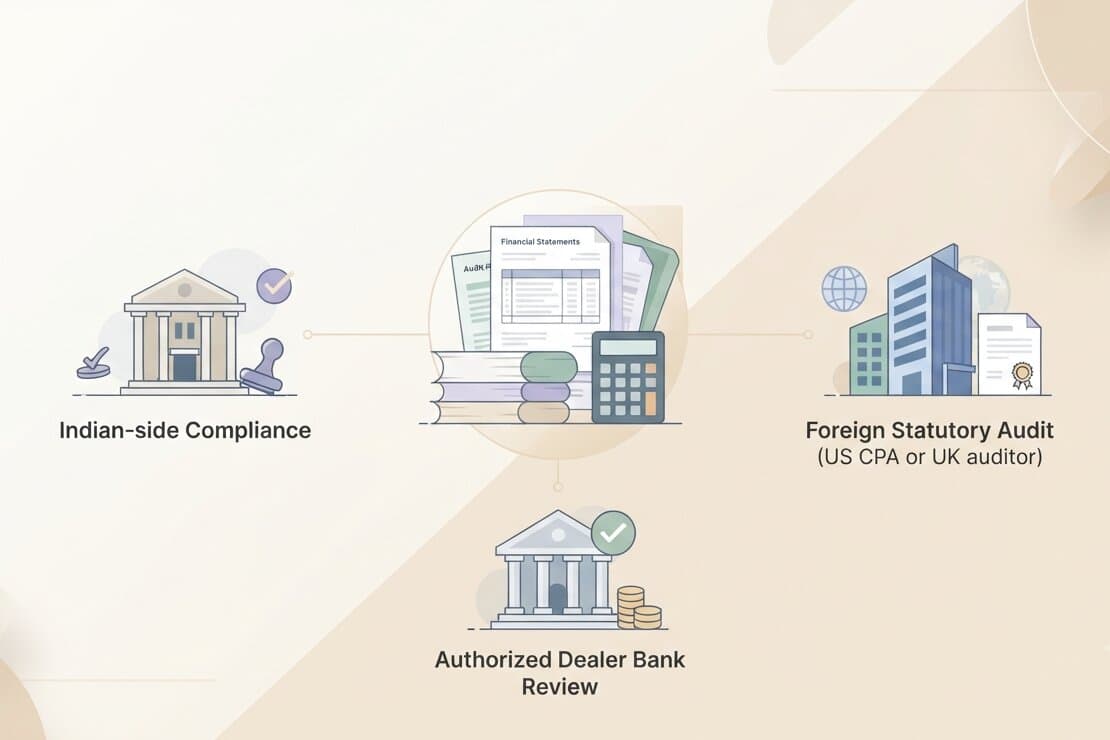
When the founder has control, the APR must be based on audited financial statements of the US company. Delaware has no statutory audit requirement for most private companies, so many founders assume nothing is needed. That's the wrong conclusion. RBI's requirement is separate from local law, and the audit has to be done by a licensed professional in the host country, which for a Delaware company means a US CPA firm.
It helps to separate this from the more familiar scenario. If an Indian company sets up a sales entity in the US, that entity is a foreign subsidiary company of the Indian parent, and the audit of a foreign subsidiary of an Indian company follows the same host-country standard. A flip is the reverse direction, but the audit expectation for the US entity is the same when control exists. Unaudited, certified accounts are permitted only where the investor has no control and the host country doesn't mandate an audit. A founder who holds a majority of a flipped company will rarely qualify.
Mistakes that come up repeatedly
Treating the flip as a legal exercise only. The Indian counsel closes the transaction, and nobody tells the founder about the post-closing filings.
Skipping the share-swap formalities. Swaps are permitted under the framework, but they depend on valuation and on following the prescribed conditions.
Ignoring the two-layer limit. A flip with the Indian company directly under the US parent is one layer, but later additions of holding or operating entities can push the structure past what the rules allow.
Missing the other recurring return. The Indian company, as a recipient of foreign investment, has its own annual FLA return due 15 July. It is a separate filing from the founder's APR.
Forgetting the tax side. A resident founder holding foreign shares also reports them in the foreign assets schedule of the income tax return. FEMA compliance and tax disclosures should tell the same story.
What a miss costs
A late APR can be regularised by paying the late submission fee, currently a flat ₹7,500 per return, if you opt for it within three years of the due date. Beyond that, you are looking at compounding, which is slower and costlier. Under Section 13 of FEMA, penalties for contraventions can reach three times the sum involved. The practical pain usually arrives earlier, when an AD bank declines a remittance or a fresh overseas investment until the APR record is clean.
A quick self-check before 31 December
Are you resident in India under FEMA, and were you resident when the shares were allotted?
Do you hold 10% or more of the US parent, or any stake with control rights?
Have you lent to, or guaranteed anything for, the US company?
Is the US company's year-end audited by a CPA, or at least planned?
Have your co-founders agreed who files?
If the answer to the first question is yes and any of the next three is yes, plan on filing.
Frequently asked questions
1. Does a flip count as round-tripping?
Not automatically. The framework permits it, up to two layers of subsidiaries. The structure should be checked at the time of the flip.
2. I received my US shares for free. Is it still an ODI?
Yes. ODI is about acquiring equity, not about whether you paid cash for it.
3. I own 4% of the US parent and nothing else. Do I file?
Probably not, if you have no control rights and no loans or guarantees. Check your shareholders' agreement before concluding that.