.svg)
.svg)
.svg)
ESOP Exercise Tax Under DPIIT Section 80-IAC: When You Actually Owe Tax
Understand ESOP tax deferral under Section 80-IAC, trigger events, DPIIT rules, and how startup employees are taxed on ESOP exercise.

Accorp Compliance Team
Our team of compliance experts specializes in PCI DSS, SOC 2, and other security frameworks to help businesses achieve and maintain compliance.
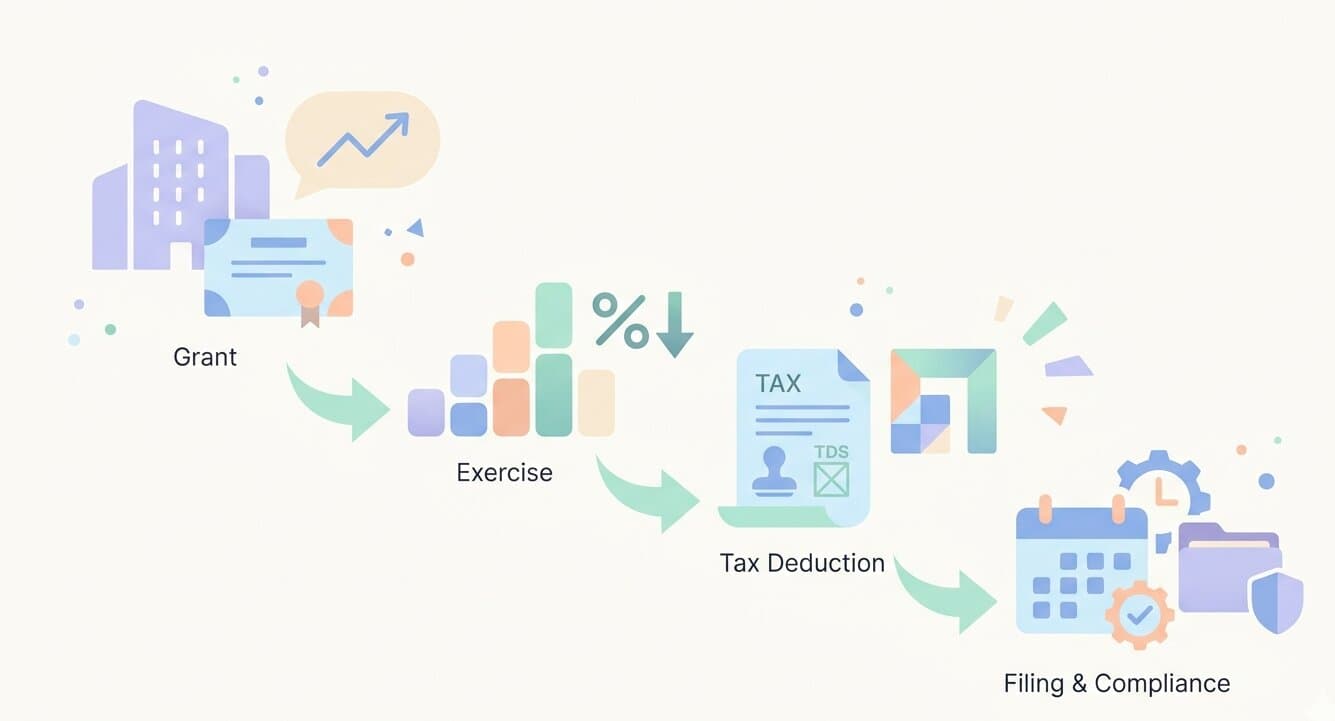
If you work at a DPIIT-recognised startup in India and recently exercised your ESOPs, you may have heard that you don't need to pay tax immediately. That's partially true — but only if your employer qualifies under Section 80-IAC of the Income Tax Act, 1961 (now reflected under Section 140 of the Income Tax Act, 2025).
The confusion around "ESOP tax deferral" has led many startup employees — and even their HR teams — to assume that DPIIT recognition automatically means no tax at exercise. It does not.
This guide explains exactly when ESOP exercise tax is triggered, when it is deferred, and what conditions your startup must meet for you to benefit from the Section 80-IAC tax deferral — with worked examples and the precise legal triggers.
What Is ESOP Perquisite Tax and Why It's a Problem
When you exercise your Employee Stock Options (ESOPs), you are not just buying shares — you are generating a taxable event under the Indian Income Tax Act.
Under Section 17(2)(vi) of the Income Tax Act, 1961, the spread between the Fair Market Value (FMV) of shares on the date of exercise and the exercise price you pay is classified as a perquisite — part of your salary income. This perquisite is taxable in the financial year in which you exercise, regardless of whether you sell the shares.
Perquisite value = (FMV on exercise date − Exercise price) × Number of shares exercised
Worked Example
Exercise price: ₹100 per share
FMV on exercise date: ₹400 per share
Shares exercised: 1,000
Perquisite = (₹400 − ₹100) × 1,000 = ₹3,00,000
This ₹3 lakh is added to your gross salary for that financial year and taxed at your applicable income tax slab — up to 30% plus surcharge and cess. That means a tax outflow of up to ₹93,600 or more, even though you have not sold a single share and received no cash.
Your employer is also required to deduct TDS on this perquisite under Section 192 of the Income Tax Act (Section 392 under the Income Tax Act, 2025) at the time of exercise.
This creates a real cash-flow problem: tax on paper gains, payable in cash, before any liquidity.
The DPIIT Myth: Recognition Alone Does Not Give You Tax Deferral
This is the most common and costly misunderstanding in startup equity taxation.
Being a DPIIT-recognised startup does not automatically qualify your employees for ESOP perquisite tax deferral.
As of April 2026, there are over 1.97 lakh DPIIT-recognised startups in India. Of these, only approximately 3,700 to 4,000 startups — roughly 2% — hold the additional certification required to offer their employees tax deferral under Section 80-IAC.
If your company has DPIIT recognition but not the Inter-Ministerial Board (IMB) certificate under Section 80-IAC, your employees owe perquisite tax at exercise. No exceptions.
What Is the Section 80-IAC ESOP Tax Deferral?
The Finance Act, 2020 introduced a specific provision under Section 192(1C) of the Income Tax Act, 1961 — now Section 392(3) under the Income Tax Act, 2025 — that allows eligible startup employees to defer the payment of perquisite tax from the date of exercise to a later liquidity event.
Critically, this is a deferral, not an exemption. The tax obligation does not disappear. The perquisite value is still calculated at FMV on the exercise date, and the tax liability is computed at the slab rates applicable in the year of allotment — not in the year you eventually pay it.
When Does Deferred ESOP Tax Actually Become Due?
For employees of eligible startups (those with both DPIIT recognition and Section 80-IAC IMB certification), the deferred perquisite tax becomes payable at the earliest of the following three trigger events:
Trigger Event | What It Means |
48 months from end of the assessment year in which shares were allotted | Time-based deadline — even if no shares are sold |
Sale of shares by the employee | Tax due within 14 days of sale |
Cessation of employment | Tax due within 14 days of leaving the company |
The 14-day payment window is strict. Failing to pay within 14 days of a trigger event attracts interest under Section 234B and 234C of the Income Tax Act.
Important: Tax Rate Is Locked at Exercise Year
Even if your trigger event occurs in FY 2028-29, the tax is calculated using the slab rates, surcharge, and cess from the year of allotment — not the year the tax falls due. This is frequently misunderstood by employees who assume their tax bracket at the time of departure or sale will determine the liability.
Who Qualifies as an "Eligible Startup" Under Section 80-IAC?
To enable ESOP perquisite tax deferral for employees, a startup must satisfy both of the following conditions simultaneously:
Condition 1 — DPIIT Recognition
The company must be recognised by the Department for Promotion of Industry and Internal Trade (DPIIT) as a startup under the Startup India initiative. General eligibility criteria include:
Incorporated as a Private Limited Company or LLP
Not more than 10 years from the date of incorporation
Annual turnover of less than ₹100 crore in any previous financial year
Working towards innovation, development, or improvement of products or services
Condition 2 — IMB Certificate Under Section 80-IAC (Mandatory)
In addition to DPIIT recognition, the company must hold a valid Inter-Ministerial Board (IMB) Certificate confirming it qualifies as an "eligible business" under Section 80-IAC.
Additional requirements for Section 80-IAC eligibility:
Incorporated on or after 1 April 2016 (sunset extended to 31 March 2030 under the Income Tax Act, 2025)
Incorporated as a Private Limited Company or LLP only (not proprietorship or traditional partnership firms)
Turnover must not exceed ₹100 crore in any financial year since incorporation
Only when a company meets both conditions — DPIIT recognition AND IMB certification under Section 80-IAC — do employees automatically qualify for deferral. Employees do not apply individually; eligibility flows from the employer's status.
What Happens If You Leave the Company Before Selling Shares?
This is where many startup employees are caught off-guard.
If you exercised your ESOPs at a startup with Section 80-IAC deferral status, and then resign or are terminated before selling the shares, the full perquisite tax becomes due within 14 days of your last working day — regardless of whether you have received any money from the shares.
You will owe tax on illiquid shares that you may not be able to sell for months or years. This is a critical planning point that employees must factor in before exercising ESOPs at a pre-IPO or unlisted startup.
Key question to ask your HR team before exercising: "Does the company hold both DPIIT recognition and an IMB certificate under Section 80-IAC — and is the certificate currently valid?"
ESOP Tax After Exercise: Capital Gains at Sale
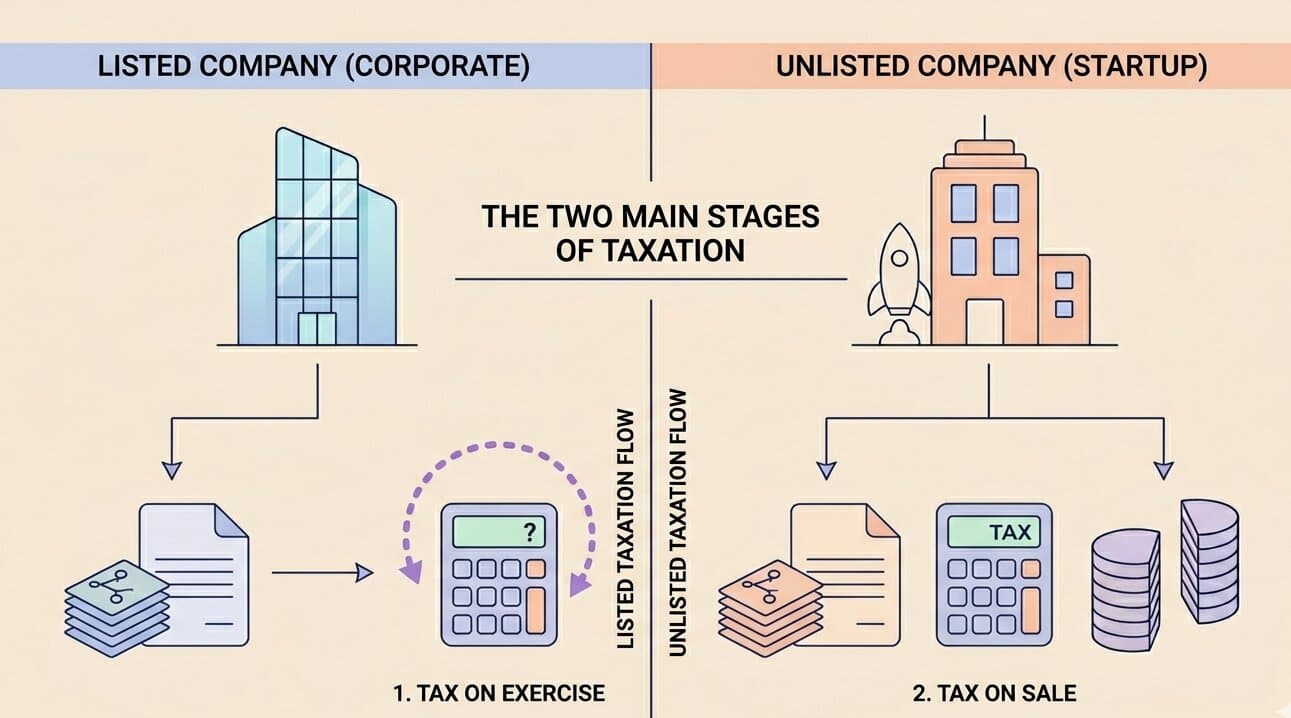
Once you sell your exercised shares, a second stage of taxation applies — capital gains tax.
The FMV on the exercise date (which was used to calculate the perquisite) becomes your cost of acquisition for capital gains purposes. The gain from that FMV to the eventual sale price is taxed as capital gains.
Holding Period | Classification | Tax Rate |
Listed shares held > 12 months | Long Term Capital Gains (LTCG) | 12.5% above ₹1.25 lakh (FY 2024-25 onwards) |
Listed shares held ≤ 12 months | Short Term Capital Gains (STCG) | 20% |
Unlisted shares held > 24 months | Long Term Capital Gains (LTCG) | 12.5% without indexation |
Unlisted shares held ≤ 24 months | Short Term Capital Gains (STCG) | Applicable slab rate |
Note: Holding period for capital gains is measured from the date of allotment (exercise date), not from the date you eventually pay the deferred perquisite tax.
The New Income Tax Act, 2025: What Changes for ESOP Taxation?
The Income Tax Act, 2025 (effective 1 April 2026) re-numbers provisions but does not change the substantive rules on ESOP perquisite taxation.
Section 17(2)(vi) → Equivalent provision under the 2025 Act
Section 192(1C) → Section 392(3) of the 2025 Act
Section 80-IAC → Section 140 of the 2025 Act
If your company's ESOP scheme documents, grant letters, or board resolutions reference the old section numbers, these should be reviewed and updated. The legal effect is unchanged, but referencing outdated provisions in compliance documents can create issues during audits or IT scrutiny.
How Many Startups Actually Qualify Right Now?
The numbers are stark:
1.97 lakh+ DPIIT-recognised startups in India (as of April 2026)
~3,700 to 4,000 hold IMB certification under Section 80-IAC
That is roughly 2% of all DPIIT-recognised startups
The government is reportedly examining an extension of the ESOP perquisite tax deferral to all DPIIT-recognised startups — a proposal under consideration ahead of Union Budget 2026-27. If passed, this would be the most significant change to startup ESOP taxation since the Finance Act, 2020.
Until that happens, the deferral remains available to a very small fraction of the startup ecosystem.
5 Common Mistakes Startup Employees Make on ESOP Taxation
1. Assuming DPIIT recognition = automatic tax deferral It does not. Ask for the IMB certificate confirmation before exercising.
2. Not planning cash for perquisite TDS (for non-deferral startups) At non-80-IAC startups, TDS is deducted immediately. A large exercise can reduce your take-home salary to near zero for months. Calculate in advance.
3. Exercising without understanding the cessation trigger If you plan to leave the company, exercise timing matters critically. Exercising shortly before resignation can create a large tax bill due within 14 days with no liquid proceeds.
4. Using exercise price as the capital gains cost base The cost of acquisition for capital gains purposes is the FMV on exercise date — not the exercise price. Using the exercise price results in double taxation of the perquisite gain.
5. Ignoring cross-border ESOP disclosures If you are an NRI or RNOR with foreign ESOPs, Schedule FA disclosure in your ITR is mandatory. Missing this is one of the most frequent compliance gaps in cross-border ESOP structures.
How Accorp Partners Helps With ESOP Compliance
Accorp Partners is a CPA-led firm that helps Indian companies and their employees navigate ESOP compliance from scheme design through exercise, valuation, and tax reporting.
Our ESOP services include:
ESOP scheme drafting under Companies Act, 2013 — PAS-3, MGT-14, SH-6 filings
IBBI Registered Valuer FMV reports for Black-Scholes-based exercise pricing
Ind AS 102 audit-ready workings for share-based payment accounting
TDS compliance at exercise — Form 24Q reporting, Annexure II
Section 80-IAC eligibility review — verifying DPIIT + IMB status before employees exercise
Cross-border ESOP compliance — FEMA, FC-GPR, RBI reporting for employees with foreign-parent options
Whether your startup qualifies for Section 80-IAC deferral or not, getting the exercise-stage compliance right matters. Errors in FMV computation, TDS deduction, or PAS-3 filings attract ROC penalties and income tax scrutiny.
Consult Accorp Partners to structure transparent, compliant, and high-impact ESOP plans that benefit both companies and employees.
Frequently Asked Questions
Q: Does DPIIT recognition automatically give my employees ESOP tax deferral?
No. DPIIT recognition is a necessary but not sufficient condition. The company must also hold a valid IMB certificate under Section 80-IAC. Only ~2% of DPIIT-recognised startups currently have this.
Q: If my startup qualifies under Section 80-IAC, is the ESOP tax eliminated?
No — it is deferred, not eliminated. The perquisite is still taxed at the slab rates applicable in the year of allotment. Only the payment timing is postponed to the earliest of the three trigger events.
Q: What are the three trigger events for deferred ESOP tax?
The deferred tax becomes due at the earliest of: (1) 48 months from the end of the assessment year of allotment, (2) sale of the shares, or (3) cessation of employment.
Q: What happens to deferred ESOP tax if I resign?
The full deferred tax becomes payable within 14 days of your last working day, even if you hold illiquid, unsold shares. Plan accordingly before deciding to exercise and then resign.
Q: Which tax rate applies to deferred ESOP perquisite tax?
The tax is calculated at the slab rates, surcharge, and cess applicable in the year of allotment — not the year the trigger event occurs.