.svg)
.svg)
.svg)
Case Study: Why a US SaaS Company Chose India for its Development and Innovation Center
Discover how SaaS companies cut costs, access top engineering talent, leverage startup incentives and scale operations in India.

Accorp Compliance Team
Our team of compliance experts specializes in PCI DSS, SOC 2, and other security frameworks to help businesses achieve and maintain compliance.
Company Profile
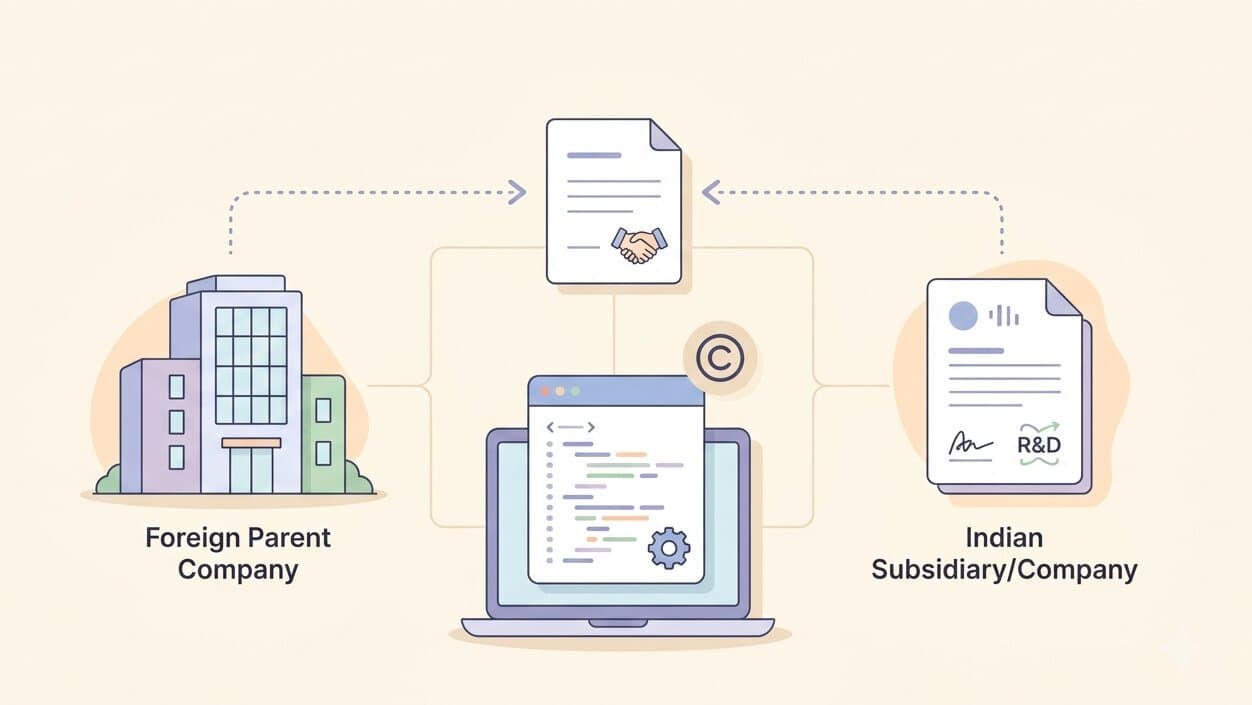
Parent Company: Delaware C-Corporation
Industry: Cybersecurity SaaS
ARR: USD 10 Million
Employees: 45
Expansion Requirement:
The company requires software developers, AI engineers, security analysts, DevOps engineers, and SOC team members. The founders evaluated Poland, Romania, Mexico, Philippines, Vietnam, and India.
Challenge 1: Access to Skilled Engineers
The company requires:
- 20 Software Engineers
- 5 AI Engineers
- 5 DevOps Engineers
Annual Savings:
US Cost: 30 employees × $140,000 = $4.2 Million
India Cost: 30 employees × $30,000 = $900,000
Annual Saving: $3.3 Million
Challenge 2: Export Income is GST Free
The Indian subsidiary develops software exclusively for the US parent.
Exports of software services generally qualify as export of services.
Benefits:
- No GST charged to overseas customers
- Refund of eligible input GST credits
Challenge 3: Startup India Tax Holiday
If the Indian subsidiary qualifies under Startup India and Section 80-IAC:
Eligible Profit: ₹10 Crore
Potential tax savings can significantly improve startup runway.
Challenge 4: Patent and IP Protection Support
Possible benefits:
- Patent filing reimbursement
- Trademark reimbursement
- International patent support
- Reduced government fees
Example:
Patent Filing Budget: ₹20 lakh
Potential reimbursement: 50%-100% depending on applicable schemes.
Challenge 5: Research & Development Support
The company establishes an AI Research Center in Bengaluru.
Potential support includes:
- State innovation missions
- Academic collaborations
- Research grants
- Incubation programs
Challenge 6: GCC Incentives
The company creates a 500-employee Global Capability Center in Hyderabad.
Potential benefits:
- Training subsidies
- Hiring incentives
- Rental support
- Infrastructure assistance
Challenge 7: Rent Reimbursement and Office Setup Support
Several state IT policies provide support for:
- Office lease rentals
- Plug-and-play facilities
- Technology parks
- Co-working infrastructure
Challenge 8: Global Time Zone Advantage
The company operates:
- USA Sales Team
- UK Customer Success Team
- India Engineering Team
Result:
24-hour product development cycle.
Challenge 9: Building a 24x7 Security Operations Center
India enables:
- Follow-the-sun operations
- Lower operating costs
- Large cybersecurity talent pool
Challenge 10: Access to Government Procurement
Benefits:
- Central Government projects
- State Government projects
- Public Sector Undertaking opportunities
Challenge 11: Data Center Incentives
Potential benefits:
- Electricity duty exemption
- Stamp duty exemption
- Infrastructure support
Challenge 12: GIFT City Opportunities
For FinTech, WealthTech, RegTech, and fund administration businesses:
Benefits may include:
- IFSC ecosystem
- Foreign currency operations
- Tax incentives
- Global financial infrastructure
Financial Impact Summary
A mid-sized SaaS company with:
- 30 engineers
- 5 AI specialists
- 5 DevOps engineers
can often reduce operating expenditure by $2–4 million annually while increasing development capacity.
Conclusion
India offers access to world-class engineering talent, lower operating costs, export-friendly GST treatment, startup incentives, patent reimbursement support, R&D ecosystem benefits, GCC incentives, data center incentives, and global delivery capabilities. For technology companies seeking scale, India has become a strategic innovation and growth destination.