.svg)
.svg)
.svg)
Structuring a JV Agreement with an Indian Partner: What Foreign Companies Need to Get Right
Joint venture in India for foreign companies: understand JV structures, shareholder agreements, governance, IP, FDI rules, exits, and incorporation.

Accorp Compliance Team
Our team of compliance experts specializes in PCI DSS, SOC 2, and other security frameworks to help businesses achieve and maintain compliance.
Every foreign company that decides to enter India through a joint venture is making a bet on a relationship, not just a market. Unlike a wholly owned subsidiary, where you control every decision, a JV means sharing ownership, governance, and — eventually — some hard conversations with an Indian partner whose incentives won't always match yours. Most JVs that unravel don't fail because the market opportunity disappeared. They fail because the agreement never anticipated the disagreement that eventually showed up.
This guide covers why foreign companies choose the JV route in the first place, what actually needs to go into the agreement, the governance and exit mechanics that get overlooked most often, and how JV structuring fits into the broader process of setting up in India.
Why Choose a Joint Venture Over a Wholly Owned Subsidiary?
A wholly owned subsidiary gives you full control, and for a lot of foreign entrants that's the simpler and cleaner path. But three recurring reasons still push companies toward a JV structure instead.
Sectoral FDI caps. Certain sectors don't permit 100% foreign ownership. Multi-brand retail, print media, and select defence categories cap the foreign stake below full ownership, which means an Indian partner isn't optional — it's the only way to legally operate at scale in that sector.
Local expertise and market access. In sectors like real estate, infrastructure, or pharmaceuticals, an Indian partner's regulatory relationships, distribution network, and on-ground operating knowledge can meaningfully shorten your time to market. This is often worth more than the equity you're giving up.
Shared risk. A JV partner absorbs part of the capital requirement, market risk, and regulatory burden, which matters in capital-intensive sectors or in markets where you're still validating demand.
There's also a category of sectors — including certain strategic manufacturing segments under the current Press Note 3 framework — where investment from specific countries is only permitted if the Indian entity remains majority-owned and controlled by resident Indian citizens. In these cases, a JV isn't a strategic preference; it's a regulatory requirement, and it changes how much control you can realistically negotiate for in the agreement itself.
Equity JV vs Contractual JV: Choosing the Right Structure
Most India-facing joint ventures take the form of an equity JV — a separate Indian company, typically a private limited company, in which the foreign investor and one or more Indian partners hold shares directly. This is the dominant structure for FDI purposes because it creates a clearly identifiable Indian entity that can receive foreign investment through the automatic or government approval route, depending on the sector.
A contractual JV — an unincorporated arrangement governed entirely by contract, without a shared equity vehicle — is less common but can work for project-specific collaborations where you don't want the overhead of a new company, or where the relationship has a defined end date rather than being an ongoing business.
For most foreign companies planning a genuine, ongoing India presence, the equity JV is the practical choice, and it's the structure this guide focuses on.
The Shareholders' Agreement: The Document That Actually Matters
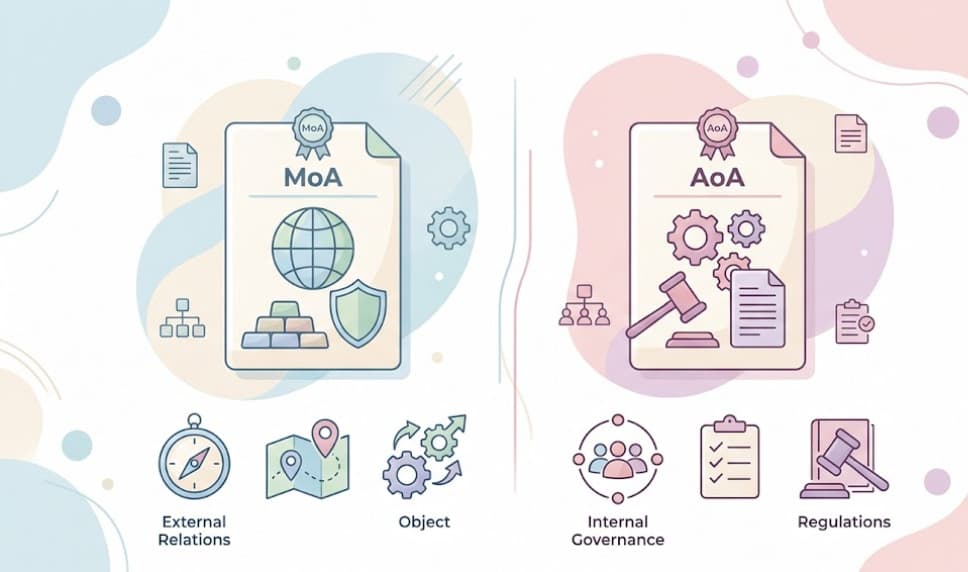
The Articles of Association set out the formal rules governing the company under the Companies Act, but the Shareholders' Agreement (SHA) — sometimes called the JV Agreement — is where the real terms of the partnership live. It's a private contract between the partners that sits alongside the company's constitutional documents, and where the two conflict, Indian courts generally give the SHA precedence since it more directly reflects what the parties actually intended.
Here's what a well-structured SHA needs to cover.
Capital Contribution and Valuation
Define exactly what each partner is contributing — cash, machinery, IP, technical know-how — and how each non-cash contribution is valued in Indian Rupees. Vague valuation language here is one of the most common sources of disputes down the line, particularly when one partner's contribution (like technology or brand) is harder to price than the other's cash investment.
Condition Precedents
List every regulatory approval that must be obtained — from the Reserve Bank of India, the Department for Promotion of Industry and Internal Trade, or sector regulators — before the agreement becomes effective. This protects both parties from being contractually bound to a deal that later turns out to need approval it can't get.
Board Composition and Management Structure
Spell out how many directors each partner can appoint, and make sure the foreign partner's board representation is proportionate to its economic stake — this isn't automatic and needs to be written into both the SHA and the Articles. In sectors where an Indian JV is mandatory for regulatory reasons, the Indian partner may be legally required to appoint the majority of directors, which materially changes how much day-to-day control the foreign partner can realistically hold onto.
Affirmative Voting Rights
Even where the foreign partner holds a minority stake, it's standard practice to negotiate affirmative voting rights — effectively veto powers — over a defined list of critical decisions: changes to the business plan, related-party transactions, additional fundraising, or amendments to the Articles. This is often the single most important protection a minority foreign partner can secure.
Intellectual Property Treatment
If the foreign partner is bringing proprietary technology, brand, or know-how into the JV, the general recommendation is to license that IP to the JV rather than assign it outright. Licensing lets the foreign partner retain ownership if the partnership eventually dissolves, rather than leaving valuable IP sitting inside a company it no longer controls.
Deadlock Provisions
Deadlocks — situations where the two sides simply can't agree on a critical decision — are common enough in JVs that the agreement needs a built-in resolution mechanism rather than relying on goodwill in the moment. "Buy-sell" or "Mexican standoff" clauses, where one party names a price and the other must either buy at that price or sell at it, are a standard and reasonably fair way to force resolution without dragging the relationship into prolonged litigation.
Exit Mechanics
This is the clause foreign companies most often under-invest in during negotiations, and the one they regret not having later. Cover right of first refusal on share transfers, tag-along and drag-along rights, put and call options, and — critically — what happens if the Indian partner wants to exit in a sector with a foreign ownership cap, where the foreign partner may be legally unable to simply buy out the remaining stake without finding a replacement Indian shareholder.
Dispute Resolution and Governing Law
Arbitration is the standard mechanism for resolving JV disputes, and foreign investors frequently prefer an international seat — Singapore or London are common choices — for a more predictable process than domestic litigation. It's worth noting that even with a strong SHA, minority shareholders retain the right to bring oppression and mismanagement claims under the Companies Act, which creates a parallel litigation track that a wholly owned subsidiary simply doesn't face.
Non-Compete Clauses: Manage Your Expectations
It's worth flagging directly: non-compete clauses are difficult to enforce under Indian law. They're generally only considered valid for the duration of the partnership itself and are rarely enforceable once a partner has exited. Foreign companies sometimes negotiate elaborate non-compete language expecting it to hold post-exit, only to find it carries little practical weight if tested in court. Confidentiality obligations and IP protection clauses tend to be more durable and worth prioritising instead.
Setting Up the JV Entity: Company Formation in India
Once the SHA terms are agreed, the JV needs an actual legal entity to operate through, and this is where company formation in India comes in. Most equity JVs are structured as a private limited company, since it offers limited liability to both partners and integrates cleanly with FDI approval routes.
If you're asking how to open a company in India for a JV specifically, the process for pvt ltd company registration in India generally involves:
Digital Signature Certificates (DSC) for directors nominated by both partners.
Director Identification Numbers (DIN) for each proposed director.
Name reservation through the Ministry of Corporate Affairs portal.
SPICe+ filing, covering incorporation, PAN, TAN, and related statutory registrations in a single application, with the shareholding pattern reflecting the agreed JV structure.
Certificate of Incorporation, followed by drafting the Articles of Association to align with the terms already agreed in the SHA — this alignment step is where many JVs discover gaps between what the SHA promised and what the Articles actually permit under the Companies Act.
The process for online registration of company formation in India has become considerably faster, but for a JV specifically, the incorporation itself is rarely the bottleneck. The real timeline driver is usually negotiating the SHA terms and securing any required regulatory approvals before the entity can be capitalised and made operational. India incorporation should follow the SHA negotiation, not run ahead of it — incorporating first and negotiating governance terms afterward is a common and avoidable mistake.
Common Mistakes Foreign Companies Make
Under-negotiating exit mechanics because the relationship feels strong at the outset, only to find there's no clean way out years later when priorities diverge.
Assigning IP to the JV instead of licensing it, losing ownership if the partnership eventually dissolves.
Treating the Articles of Association as a formality rather than making sure they're fully aligned with the SHA's governance and transfer provisions.
Overestimating the enforceability of non-compete clauses, particularly post-exit.
Skipping condition precedents, entering into a binding agreement before confirming the regulatory approvals the JV actually depends on.
Incorporating the entity before the SHA is finalised, creating a mismatch between what's legally in place and what the partners believe they've agreed to.
Final Thoughts
A joint venture in India can be one of the fastest ways for a foreign company to gain real market access, local expertise, and shared risk — but only if the agreement is built to survive disagreement, not just describe cooperation. The Shareholders' Agreement, not the incorporation certificate, is where the partnership actually gets defined, and it deserves the same level of scrutiny and negotiation as the commercial terms of the deal itself. Get the governance, IP treatment, and exit mechanics right before you incorporate, and the entity formation that follows becomes a formality rather than a scramble to fix gaps you didn't see coming.