.svg)
.svg)
.svg)
Gulf to India: Why So Many NRI Businesses in the UAE Are Now Opening an India Entity
UAE businesses are increasingly setting up Indian subsidiaries. Explore tax changes, CEPA, FDI rules, benefits, structures, and incorporation steps.

Accorp Compliance Team
Our team of compliance experts specializes in PCI DSS, SOC 2, and other security frameworks to help businesses achieve and maintain compliance.
Something has shifted in the conversations I have with UAE-based business owners over the last couple of years. It used to be that Indian entrepreneurs moved to Dubai and structured everything to stay there — the company, the ownership, sometimes even the customer base, all routed through UAE entities that looked back toward India only for occasional trading relationships. Increasingly, the traffic is running the other way. Established UAE businesses, many built by first- or second-generation Indian expats, are opening a formal India entity — not as an afterthought, but as a deliberate part of their next growth phase.
There's a specific reason this is happening now rather than five years ago, and it isn't just "India is growing." It has a lot to do with what changed in the UAE itself.
The UAE Isn't the Tax-Free Base It Used to Be
For two decades, one of the strongest arguments for keeping everything domiciled in the UAE was simple: zero corporate tax, zero personal tax, full stop. That calculus changed in June 2023, when the UAE introduced a 9% federal corporate tax on business profits above a modest threshold. It's still a low rate by global standards, and free zone entities retain certain exemptions under specific conditions — but the era of the UAE being an unambiguous zero-tax jurisdiction for every kind of business is over.
That single change has quietly reshaped a lot of structuring decisions. When the UAE offered pure tax neutrality, there was limited financial incentive to build real operating substance in India — better to route revenue through Dubai and treat India as a market to be served remotely. Once UAE profits started attracting a tax bill of their own, the calculation shifted: if profit is being taxed somewhere regardless, building genuine operating capacity in the market where the growth actually is starts to make more sense than optimising purely for jurisdiction.
CEPA Made the Corridor Genuinely Two-Directional
The India-UAE Comprehensive Economic Partnership Agreement, which came into force in 2022, gets mentioned constantly in the context of Indian exporters getting easier access to UAE and onward GCC markets. What gets discussed less is what it did for the reverse flow. Reduced tariffs and simplified customs procedures under CEPA made it commercially sensible for UAE-based trading and manufacturing businesses to establish a direct Indian presence, rather than working through third-party distributors and absorbing the margin loss that comes with an extra layer of intermediaries.
For a UAE trading company that's spent years importing Indian goods for GCC distribution, CEPA plus a formally incorporated Indian sourcing or manufacturing entity means tighter control over quality, prices, and lead times — advantages that were harder to justify chasing when the tariff and paperwork overhead made a direct entity more trouble than it was worth.
The Remittance Corridor Tells Its Own Story
The UAE remains India's largest single remittance corridor, with tens of billions of dollars flowing from Gulf-based Indians back home every year. Historically, that money has moved as personal remittances and property investment — NRE deposits, real estate purchases, family support. What's changing is the proportion of that capital now looking for a business home rather than a passive one. A business owner sitting on a decade of accumulated UAE profits, watching fixed deposit and property yields flatten, increasingly asks a different question: instead of parking capital, why not deploy it into an Indian operating company that can compound faster than a bank account ever will?
This is less about repatriating money defensively and more about recognising that capital sitting idle in the Gulf has an opportunity cost that active deployment into India increasingly outweighs.
What a UAE Business Actually Gains From an India Entity
The practical advantages tend to fall into a few categories that come up in almost every one of these conversations, regardless of the industry.
Market access is the obvious one — India's consumption growth, digital adoption, and expanding middle class make it one of the few markets globally still growing fast enough to matter to a business already comfortable operating internationally. But proximity matters just as much as market size: a five-to-seven-hour flight between the UAE and most major Indian cities means a UAE-based owner can genuinely run oversight on an Indian operation without the founder-fatigue that comes from managing a market on the other side of the world.
Talent cost is another quiet driver. Technology, back-office, design, and operations talent in India remains meaningfully more cost-competitive than equivalent hiring in the UAE, which makes an India entity attractive not just as a market to sell into but as a base to build from — captive centres, technology teams, and operational hubs increasingly sit in India even when the commercial headquarters stays in Dubai or Abu Dhabi.
And for businesses in manufacturing or assembly, India's expanding production-linked incentive schemes and improving industrial infrastructure have made local manufacturing a genuinely competitive alternative to importing finished goods — particularly for UAE trading businesses that have spent years reselling Indian-made products and are now asking why they shouldn't own the manufacturing step themselves.
Choosing the Right Vehicle for the Indian Entity
A UAE company doesn't have a single template for entering India — the right structure depends heavily on what the business intends to do. A wholly owned subsidiary, structured as a private limited company, is by far the most common choice, largely because it's the only structure that allows full operational flexibility: hiring staff, signing contracts, holding assets, and repatriating profits as dividends once the Indian entity has actually earned them.
Branch offices and liaison offices remain available but suit narrower purposes — a liaison office can't generate revenue at all and exists purely for market research and coordination, while a branch office carries specific RBI approval requirements and works best for UAE companies wanting to continue an existing line of business rather than build something distinct. For most UAE business owners genuinely building an India growth story rather than testing the water, pvt ltd company registration in India through a subsidiary structure is the more practical route, since it gives the Indian operation its own legal identity while keeping full ownership with the UAE parent under India's FDI automatic route, which covers the UAE in most sectors without requiring prior government approval.
The Documentation Reality of Company Formation in India From the UAE
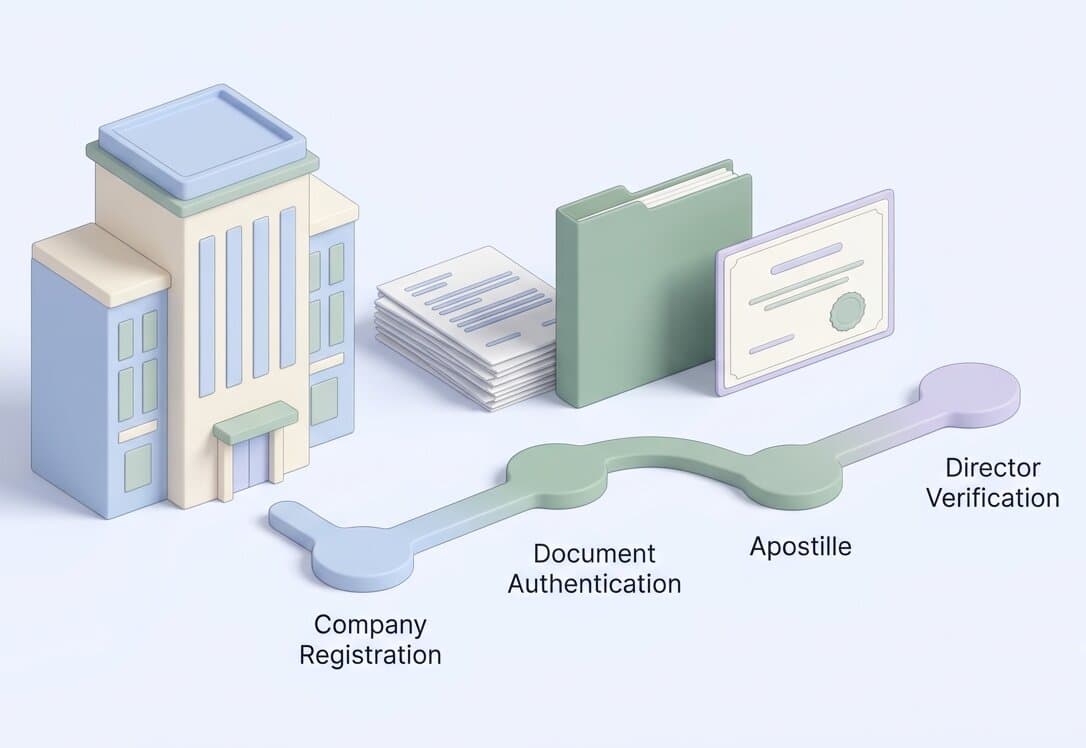
None of this incorporation work requires the UAE parent's directors or shareholders to be physically present in India. The core filing runs through the Ministry of Corporate Affairs' SPICe+ form, which bundles name reservation, incorporation, PAN, and TAN into a single submission — genuinely straightforward as a mechanical process. What takes real coordination is the documentation trail: the UAE parent company's incorporation certificate, board resolutions authorising the Indian investment, and the identity documents of proposed directors typically need notarisation and attestation through the UAE Ministry of Foreign Affairs and the Indian consulate before they're accepted for Indian incorporation and Indian incorporation filings.
Once the entity exists, capital coming in from the UAE parent needs to be reported to the RBI through the standard FDI filing process, and the Indian subsidiary needs its own compliance calendar running independently of whatever the UAE parent already handles — separate statutory audits, separate tax filings, separate board governance, even though the ownership sits entirely with the same family or founding group.
A Trend That Looks More Structural Than Cyclical
What makes this current wave of UAE-to-India entity formation different from earlier bursts of interest is that it isn't reacting to a single policy announcement or a short-term arbitrage opportunity. It's the compound effect of the UAE's tax position normalising, a trade agreement that actually reduced friction in both directions, a remittance corridor with capital looking for better returns than a savings account, and an Indian economy that keeps giving businesses reasons to want operating presence rather than remote market access.
For a UAE business owner asking how to register a company in India for the first time, or weighing online registration of company against continuing to operate purely through UAE-based trading relationships, the honest read of where things stand in 2026 is that the businesses moving early into direct India incorporation are positioning for a market that increasingly rewards being inside it rather than watching from across the Gulf.