.svg)
.svg)
.svg)
India Company Setup for Saudi Arabia & Qatar-Based Indian Expats
Saudi and Qatar-based NRIs can set up companies in India. Explore tax residency, resident director, document attestation, FEMA, FDI, and RBI rules.

Accorp Compliance Team
Our team of compliance experts specializes in PCI DSS, SOC 2, and other security frameworks to help businesses achieve and maintain compliance.
Every few months I get a version of the same call from Riyadh or Doha: an Indian professional who's spent a decade building a career in the Gulf, has capital sitting idle because it's earning nothing meaningful in a zero-tax jurisdiction, and wants to know what it actually takes to start a company back home. The instinct is usually right — India's growth story is hard to ignore from outside it — but the mechanics get tangled quickly, partly because Saudi Arabia and Qatar create a specific tax situation that expats in, say, the UK or Canada simply don't face.
That situation is worth unpacking properly before getting into the incorporation steps, because it changes what "being an NRI" actually means for you.
The Zero-Tax Trap Nobody Explains Properly
Saudi Arabia and Qatar don't levy personal income tax. For most of the years an Indian expat has lived and worked there, this has been treated as a straightforward advantage — no local tax on salary, full NRI status, minimal Indian tax exposure beyond what's earned inside India. That picture is no longer complete.
Indian tax law has a provision — previously Section 6(1A) of the old Income Tax Act, now carried forward as Section 6(7) under the Income-tax Act, 2025 that came into force on 1 April 2026 — built specifically for people in your position. If you're an Indian citizen earning more than ₹15 lakh from Indian sources in a year (rental income, fixed deposit interest, capital gains, dividends — anything sourced in India, not your Gulf salary) and you aren't liable to pay tax anywhere else because your country of residence simply doesn't tax individuals, India can deem you a resident for tax purposes. Not a full resident — you'd be classified as Resident but Not Ordinarily Resident, which protects your genuinely foreign-earned income — but resident enough that your India-sourced income gets taxed as if you'd never left.
This provision exists precisely because Saudi Arabia, Qatar, the UAE, Bahrain, and Kuwait don't tax salaries. It was written for exactly the profile of a person planning to set up an Indian company while based in one of these countries. It doesn't mean you shouldn't incorporate — it means your Indian income planning needs to account for it rather than assume the old "NRI equals untaxed" assumption still holds cleanly above that ₹15 lakh threshold.
What NRI Status From These Countries Actually Unlocks
None of this changes the fundamental fact that Indian citizens working in Saudi Arabia or Qatar qualify as NRIs under the day-count rules, and NRI status opens a genuinely favourable path into Indian company ownership. Foreign Direct Investment into an Indian private limited company is permitted up to 100% under the automatic route in most sectors — meaning no prior government approval is needed for an NRI from Riyadh or Doha to hold the entire shareholding of an Indian company. A handful of sectors (defence, telecom, certain media categories) sit outside the automatic route, but the overwhelming majority of services, trading, technology, and consulting businesses fall squarely within it.
This is the part that surprises people who assumed being outside India for years would complicate ownership. It doesn't. What actually creates friction is something more mundane: the Companies Act requires every private limited company to have at least one director who has stayed in India for a total of 182 days or more during the financial year. If you're based full-time in Jeddah or Doha and don't plan to spend that much time in India yourself, you'll need either a co-founder, family member, or a professionally appointed resident director to satisfy this requirement. It's a solvable problem, but it's one that needs a decision made before incorporation, not after.
Company Formation in India: What the Process Looks Like From the Gulf
For an NRI going through Pvt Ltd company registration in India while based abroad, the good news is that almost nothing in the process requires physical presence in the country. The Ministry of Corporate Affairs runs company formation through the SPICe+ form — a single integrated filing that handles name reservation, incorporation, PAN, TAN, and the initial statutory registrations together.
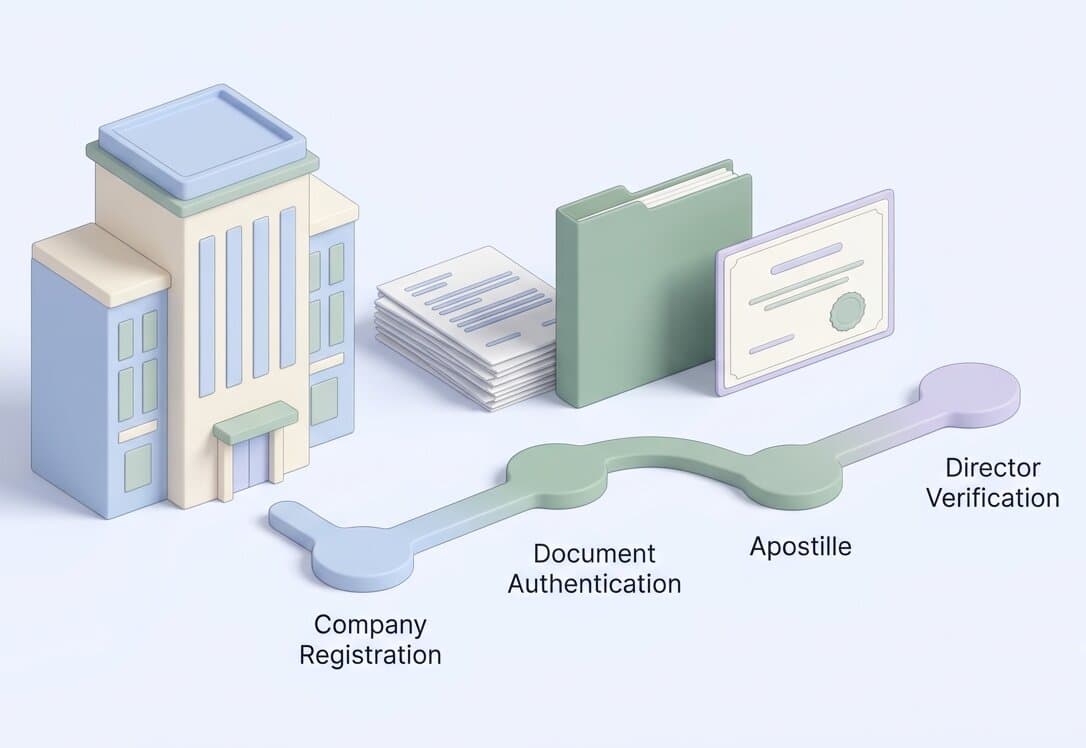
What changes for someone based in Saudi Arabia or Qatar is the documentation layer. Director identification documents — passport copies, proof of address, photographs — need notarisation and, depending on which route you take, either apostille or attestation through the Indian embassy or consulate in your country of residence. Saudi Arabia and Qatar are not Hague Convention signatories in the way apostille-friendly countries are, so documents typically need to go through embassy attestation rather than a simple apostille stamp — a step that takes longer and is worth starting early rather than leaving until the incorporation filing is otherwise ready.
Digital Signature Certificates, required for every proposed director to sign filings electronically, can be obtained without being physically present in India, though the video verification and Aadhaar-based processes that work smoothly for resident applicants sometimes need an alternate verification path for NRIs — this is where working with someone familiar with the Gulf-specific documentation flow saves real time.
Bringing Capital In: NRE, NRO, and the FEMA Layer
Once the company exists, funding it correctly matters as much as forming it correctly. Capital contributed toward share subscription typically needs to come in through banking channels recognised under FEMA — generally your NRE account, or direct inward remittance from your Gulf bank account, rather than an NRO account, which is meant for India-sourced income rather than fresh foreign capital. Getting this distinction wrong is a common and avoidable compliance headache: money routed through the wrong account type can complicate the FDI reporting your company needs to file with the RBI afterward.
Speaking of which — any equity issued to an NRI shareholder needs to be reported to the RBI through the FIRMS portal, typically via a Form FC-GPR filing, within the prescribed window after allotment. This isn't optional paperwork; it's the record that establishes your shareholding is properly recognised as compliant foreign investment rather than an undocumented inflow that surfaces as a problem years later.
Choosing the Right Structure and Location
For most Gulf-based Indian professionals, the private limited company remains the default structure, largely because it's the only vehicle that permits full foreign ownership without restriction and gives investors — should you ever bring in outside capital — a familiar, fundable entity type. A Limited Liability Partnership is occasionally considered for its lighter compliance burden, but LLPs face a more restricted FDI regime, generally requiring approval rather than automatic-route access, which makes them a less natural fit for a wholly NRI-owned venture.
Where you register also has practical consequences that have nothing to do with residency status. Delhi NCR, Bangalore, and Mumbai each carry different stamp duty structures, different access to talent pools, and different proximity to the regulatory ecosystem your business might eventually need — GST offices, sector regulators, banking relationships. For a Gulf-based founder who won't be physically present to navigate local bureaucracy in person, choosing a city with a mature virtual-office and compliance-support ecosystem tends to matter more than it would for a resident founder who can simply show up when needed.
The Sequencing That Actually Works
If there's one piece of advice worth taking from expats who've done this cleanly versus those who've had to unwind mistakes later, it's this: resolve your resident director arrangement and your document attestation pathway before you file anything, not during. Trying to fix either mid-filing — discovering you have no one who meets the 182-day residency requirement, or realising your notarised documents need re-doing through embassy attestation — is what turns a process that should take a few weeks into one that drags for months.
For someone in Riyadh or Doha working out how to open a company in India for the first time, online registration of company genuinely is possible end-to-end without a flight home. The pieces that need attention are the ones specific to your situation — the deemed residency threshold on Indian income, the embassy attestation requirement rather than a Hague apostille, and the resident director question — not the incorporation mechanics themselves, which work the same way for you as they do for any other NRI, anywhere else in the world.