.svg)
.svg)
.svg)
Spouse on a Dependent Visa? How H-4/EAD and Dependent Pass Holders Can Still Own an India Company
Can dependent visa holders own an Indian company? Learn H-4 and Dependent Pass rules, FEMA, resident director requirements, and incorporation from abroad.

Accorp Compliance Team
Our team of compliance experts specializes in PCI DSS, SOC 2, and other security frameworks to help businesses achieve and maintain compliance.
There's a myth floating around immigrant spouse communities that's costing people opportunities they don't actually need to give up: the belief that being on a dependent visa — H-4 in the US, Dependent Pass in Singapore, or similar spousal visas elsewhere — somehow blocks you from owning or directing a company back in India. It doesn't. Indian company law has no idea what an H-4 visa is, and it doesn't care. What matters to Indian regulators is your residency status under Indian law, not your immigration category in whatever country your spouse's work visa happens to be sponsoring.
That said, the question isn't entirely a non-issue either. There are real considerations — some on the Indian side, some on the host-country side — that a dependent visa holder genuinely needs to think through before assuming everything works exactly the way it would for someone with independent work authorization.
Indian Law Doesn't Ask About Your Visa Status Abroad
Start with what actually governs this from India's side. The Companies Act, 2013 and India's FDI framework determine who can own shares in and direct an Indian company based on residency status under the Foreign Exchange Management Act — specifically, whether you qualify as a Non-Resident Indian, an OCI cardholder, or a foreign national, and whether the sector you're entering permits foreign ownership under the automatic route. None of these classifications reference your visa category in the country you're living in. An Indian citizen who has moved abroad on a dependent visa and stayed outside India for more than 182 days in a financial year is an NRI under FEMA — full stop. Whether that stay abroad is enabled by an H-1B, an H-4, a Dependent Pass, or a tourist visa that got extended doesn't factor into the definition at all.
This matters because a lot of spouses on dependent status assume, reasonably but incorrectly, that if they can't independently work in their host country, they must be similarly restricted from any kind of business activity anywhere. Indian incorporation law simply isn't built around that logic. It asks who you are under FEMA, not what your visa stamp says.
Where the Real Complexity Lives: The Host Country, Not India
The genuine nuance in this situation sits on the other side of the equation — what your dependent visa permits you to do while physically present in that country, not what India permits you to do as an owner or director of an Indian company.
Take the H-4 visa specifically. A spouse on H-4 without employment authorization cannot work for a US employer, and cannot be compensated for services performed while physically present in the United States, without violating the terms of that visa. Simply owning shares in a foreign company — including an Indian private limited company — is generally understood as passive investment and directorship, not US employment, and doesn't require work authorization on its own. Where it gets genuinely murky is active involvement: logging into company systems daily, managing operations, drawing a regular salary from the Indian entity while physically sitting in the US. That pattern starts to look less like passive foreign ownership and more like performing work while in the country on a visa that doesn't permit it, even though the paycheck originates overseas.
The same logic plays out with Singapore's Dependent Pass. DP holders generally need a Letter of Consent to take up employment with a Singapore-based employer, but holding shares in, or serving as a director of, a foreign company — one that isn't operating or employing people within Singapore — sits in a different category. Again, the line that matters is between passive ownership and structured, day-to-day work performed from within the host country.
Neither of these situations makes company formation in India impossible. They shape how actively involved you can afford to be in day-to-day operations while physically located in that country, and whether drawing a regular salary versus retaining profits as a shareholder is the safer structural choice.
Structuring Ownership So It Actually Works
For a dependent-visa spouse who wants to move forward with private limited company registration in India, the cleanest structural approach usually separates ownership from active operational involvement, at least in the early stages. Holding shares, sitting on the board in a non-executive capacity, and receiving dividends as a shareholder is a fundamentally different activity — legally and practically — from acting as a full-time working director drawing a monthly salary while physically present on a visa that restricts employment.
This isn't about hiding activity or working around the rules; it's about understanding that Indian and host-country law are evaluating two different things. India cares whether you're a properly documented NRI shareholder or director who's completed the right FEMA filings. Your host country cares whether you're performing work within its borders without authorization. A structure where the India-based business genuinely runs day-to-day operations — through a resident director, local staff, or a co-founder physically present in India — while the dependent-visa spouse holds ownership and provides strategic input rather than operational labor, tends to sit comfortably on both sides of that line.
The Resident Director Requirement You'll Need Regardless
Here's where dependent-visa spouses run into a requirement that would apply to them whether or not the visa question existed at all. Every Indian private limited company needs at least one director who has stayed in India for a total of 182 days or more in the relevant period, under Section 149(3) of the Companies Act. If you're the spouse on a dependent visa living full-time abroad, you almost certainly won't meet this threshold yourself, and neither will your spouse if they're the one holding the primary work visa and also living abroad full-time.
This means the resident director requirement usually gets solved through a family member still based in India, a trusted co-founder, or a professional resident director service — the same solution, incidentally, that any NRI founder abroad needs regardless of their specific visa category. It's not a dependent-visa-specific obstacle; it's simply part of what India incorporation requires for any founder living outside the country full-time, and it's worth resolving before filing rather than scrambling to find someone once the incorporation paperwork is already in motion.
Getting Through Online Registration of Company From Abroad
The mechanical part of this — actually filing for incorporation — doesn't distinguish between a spouse on independent work authorisation and one on a dependent visa. Online registration of company through the Ministry of Corporate Affairs' SPICe+ form works the same way for both: name reservation, director identification numbers, incorporation, PAN, and TAN are handled through a single integrated filing, none of which requires physical presence in India.
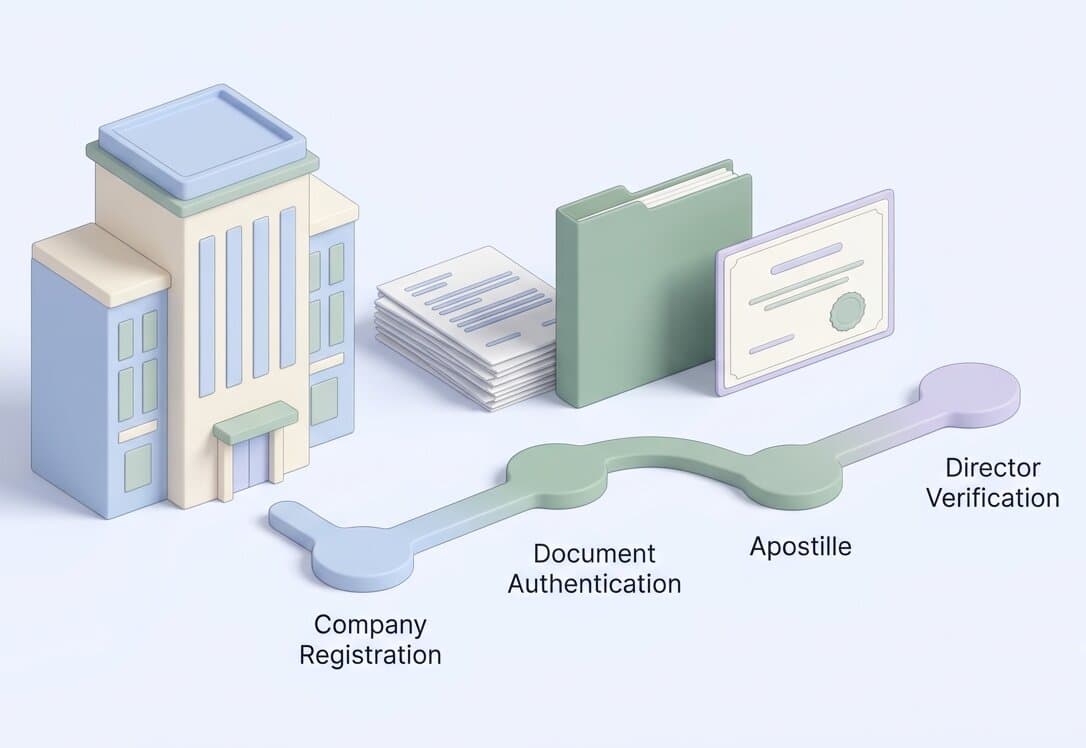
What does require attention is the document trail specific to your situation. Passport copies, proof of address in your host country, and director consent forms typically need notarization and either apostille or consular attestation, depending on whether your host country is party to the Hague Apostille Convention. A dependent-visa spouse filing from the US or Singapore generally goes through the apostille route, which is more straightforward than the embassy attestation required in non-Hague countries—one small logistical advantage worth knowing if you're comparing notes with friends navigating incorporation from elsewhere in the world.
The Bigger Picture Worth Remembering
The practical takeaway for a spouse sitting on an H-4, a Dependent Pass, or a similar visa category is that your host-country visa restricts what you can do for work inside that country — it says nothing about your ability to own, invest in, or hold a directorship in an Indian company under Indian law. The friction, where it exists, comes from how actively you're involved in day-to-day operations while physically present on a visa that limits local employment, not from any Indian-side restriction on dependent-visa holders specifically.
Structured correctly — ownership and strategic input from abroad, day-to-day execution handled by someone who satisfies India's resident director requirement — a dependent-visa spouse can build and hold a genuine stake in an Indian business without running into conflict on either side of the border. The visa category was never the real obstacle. Understanding which side of the ownership-versus-operations line you're standing on is.