.svg)
.svg)
.svg)
Form ODI Part II: Auditor Signature and Certification Requirements
Form ODI Part II certification explained, including auditor requirements for APR filing and certification processes for US and UK overseas subsidiaries.

Accorp Compliance Team
Our team of compliance experts specializes in PCI DSS, SOC 2, and other security frameworks to help businesses achieve and maintain compliance.
Every Indian entity or resident individual holding Overseas Direct Investment (ODI) is required to file an Annual Performance Report through Form ODI Part II. But the form itself is only half the story. What actually gives the filing its regulatory weight is the auditor's signature and certification attached to it. Without this step, RBI reporting requirements are considered incomplete, no matter how accurately the financial figures have been entered.
For businesses managing ODI compliance across multiple jurisdictions, understanding exactly who certifies the form, what they are certifying, and how that process differs by country is one of the most overlooked parts of APR filing India. This article breaks down the certification process in detail.
Why Certification Is Central to Form ODI Part II
Form ODI Part II is not a self-declared document. RBI relies on third-party verification to confirm that the figures reported for a Joint Venture (JV) or Wholly Owned Subsidiary (WOS) actually reflect the audited financial position of that overseas entity. This is where an overseas subsidiary audit comes in.
The certifying auditor is effectively vouching that:
The financial statements submitted are accurate and complete
The reported figures match the audited accounts of the foreign entity
The Indian party has complied with FEMA compliance conditions attached to the original investment approval
Without this verification layer, RBI would have no independent basis to trust the figures in an APR, which is why foreign subsidiary audit compliance is treated as a mandatory step rather than an optional formality.
Who Is Required to Certify the Form
Certification requirements depend on who is filing:
Indian companies and LLPs (Indian Parties): The APR must be certified by the entity's Statutory Auditor in India. The Statutory Auditor reviews the audited financial statements of the overseas JV or WOS and confirms that the figures reported in Form ODI Part II align with those statements.
Resident Individuals: Where an individual has made the ODI, self-certification generally applies instead of statutory auditor certification, since the compliance framework for individuals differs from that for corporate entities.
This distinction matters because it determines the entire certification workflow — a company cannot substitute self-certification for statutory auditor sign-off, and getting this wrong is one of the most common reasons filings are sent back for correction.
The Role of the Statutory Auditor in APR Filing
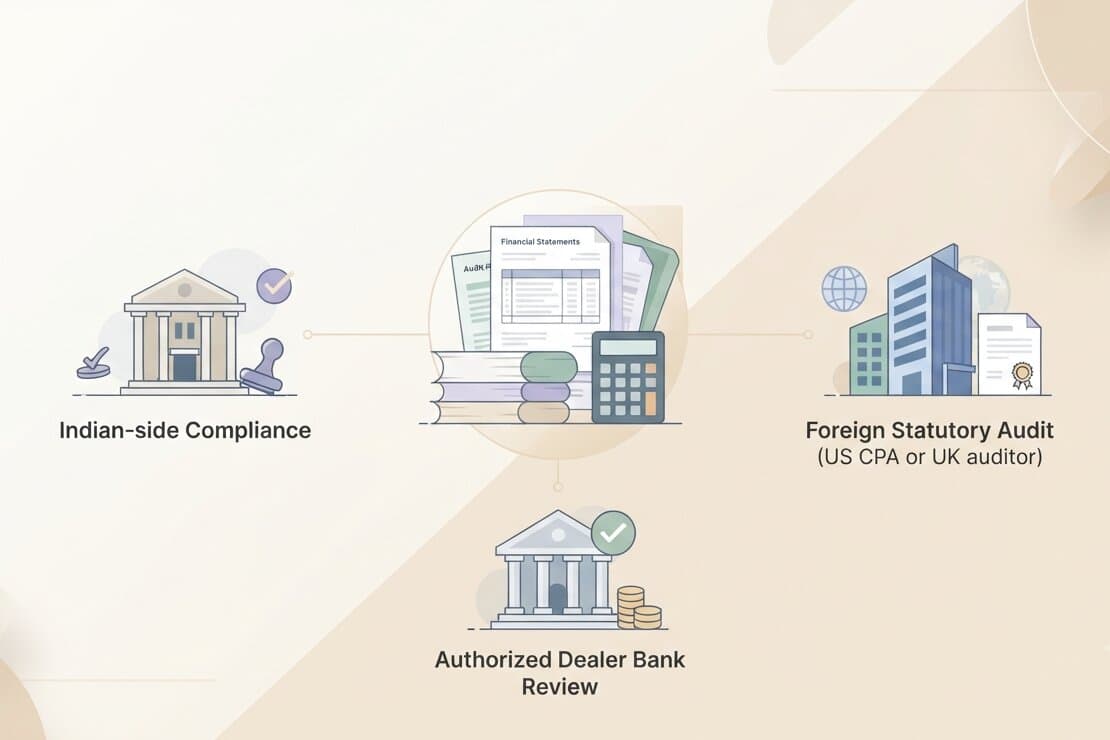
The Statutory Auditor in India is not auditing the foreign entity directly in most cases — that audit is usually performed by a local professional in the country where the subsidiary operates. Instead, the Indian Statutory Auditor's certification confirms that:
The audited (or otherwise verified) financial statements of the overseas entity have been reviewed
The figures have been correctly translated and represented in Form ODI Part II
The reporting is consistent with subsidiary compliance reporting norms expected under Indian regulations
This creates a two-layer verification process: one audit happening in the country where the subsidiary is based, and one certification happening in India that ties the two together for RBI purposes.
US CPA for APR Filing: What This Means for US Subsidiaries
When the overseas entity is a US LLC or US Inc, the underlying audit of that entity's financial statements is typically carried out by a US CPA. This audit produces GAAP-compliant financial statements, which are then used as the basis for what the Indian Statutory Auditor certifies in Form ODI Part II.
A US CPA for APR filing needs to work within a scope that satisfies both US accounting standards and the reporting expectations under India's overseas investment compliance framework. Since RBI does not directly interact with the US auditor, the accuracy and completeness of this underlying audit is what determines whether the India-side certification goes smoothly or triggers follow-up queries from the AD bank.
UK Auditor for APR Filing: What Changes for UK Entities
For subsidiaries structured as UK Ltd companies, the process follows a similar logic but with UK-specific standards. A UK auditor for APR filing prepares financial statements in line with UK GAAP or FRS 102, depending on the size and structure of the company. Some smaller UK entities may also qualify for audit exemption under Companies Act provisions, which can affect what documentation is available for the Indian Statutory Auditor to certify.
This is an important detail for businesses managing international business compliance across both US and UK subsidiaries — the underlying audit requirements are not identical, and treating them as interchangeable is a common source of delay.
What the Auditor's Certificate Must Confirm
Regardless of jurisdiction, the certificate accompanying Form ODI Part II generally needs to confirm:
That the financial statements of the overseas JV/WOS have been audited (or reviewed, where audit is not mandatory in the host country)
That the figures reported in the APR are consistent with those financial statements
That the Indian party has complied with the conditions of the original ODI approval, including repatriation of dues where applicable
Each of these points ties back to core ODI compliance obligations, and a certificate missing any one of them can result in the filing being flagged.
Common Certification Errors That Delay Filing
A few recurring issues show up across APR filing for foreign subsidiaries:
Certification submitted without the underlying overseas audit being finalized
Mismatch between figures in the foreign audit report and figures entered in Form ODI Part II
Missing signature or incomplete details of the Statutory Auditor
Confusion between audit exemption in the host country and RBI's own certification expectations
Most of these stem from poor coordination between the overseas auditor and the Indian Statutory Auditor rather than any single technical error — which is why timelines matter as much as accuracy.
Why This Matters for Annual Compliance
As part of annual compliance for foreign subsidiaries, certification is not a one-time checkbox — it repeats every financial year for as long as the overseas entity remains active. Businesses managing multiple JVs or WOS across the US, UK, or other jurisdictions need a consistent process for coordinating between local auditors and their Indian Statutory Auditor well before the filing deadline.
A structured APR audit process, where the overseas audit and the India-side certification are planned together rather than sequentially at the last minute, remains the most reliable way to keep foreign investment reporting accurate and free of avoidable back-and-forth with the AD bank.