.svg)
.svg)
.svg)
The APR Deadline Countdown: What to Do in October, November, and December
APR audit timeline for overseas subsidiaries: see what to complete in October, November, and December, from auditor engagement to AD Bank submission.

Accorp Compliance Team
Our team of compliance experts specializes in PCI DSS, SOC 2, and other security frameworks to help businesses achieve and maintain compliance.
Every year, the same pattern repeats. Companies with overseas subsidiaries treat December 31 as a single date on the calendar, rather than the finish line of a three-month process. By the time the urgency actually hits, there's often not enough runway left to do this properly.
Here's what each of the three months before the deadline actually requires — not a vague "start early" warning, but a real month-by-month breakdown of where you should be and what happens if you're not.
Why Three Months, Not One
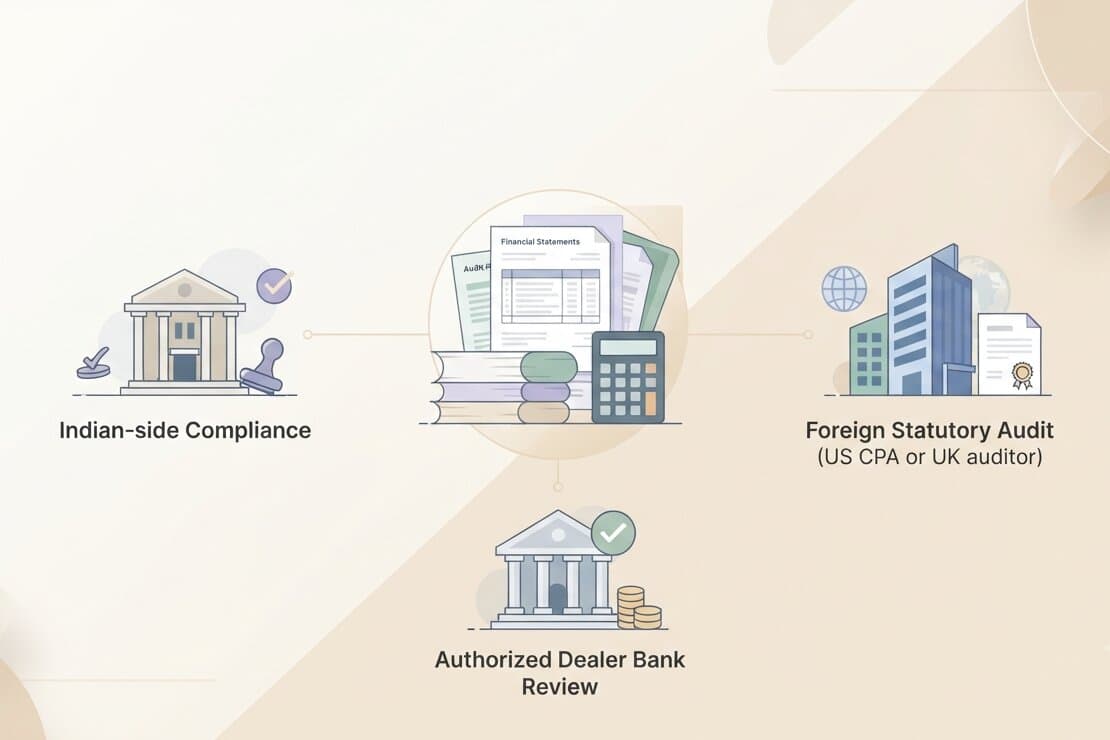
The APR itself — the form, the AD Bank submission — takes very little time once everything's ready. What actually eats the calendar is the audit of your foreign subsidiary's financials, which typically runs 60 to 90 days once a qualified auditor is engaged. Add reconciliation, Indian CA review, and AD Bank processing time on top of that, and the math becomes clear: starting in December for a December 31 deadline was never realistic.
Thinking in three phases — October, November, December — makes the workload manageable instead of overwhelming.
October: This Is When the Clock Actually Starts
If your company holds equity in a foreign JV or wholly-owned subsidiary, October is when the real work should begin, not when you start thinking about it.
Confirm your ODI structure first. Before anything else, verify your UIN, your prior year's APR filing history, and exactly what changed in your shareholding or investment structure this year. A shareholding percentage that drifted, a new step-down subsidiary that got added, an intercompany loan that wasn't documented properly — these are the details that create problems later if they're not sorted out now.
Engage the right auditor for the right jurisdiction. A US subsidiary needs a licensed US CPA. A UK entity needs someone qualified through ICAEW or ACCA. A Singapore entity needs ISCA certification. This isn't interchangeable — an audit report signed by the wrong type of professional gets rejected by your AD Bank, and finding that out in December leaves no time to fix it.
Start collecting financials from the subsidiary. Balance sheet, profit and loss statement, supporting documentation — the sooner your overseas entity starts pulling these together, the sooner the actual audit work can begin. This is also the point where companies with subsidiaries in multiple countries need to get organised: each jurisdiction needs its own audit, running on its own timeline, and October is when tracking all of them together actually matters.
If you're managing prior-year defaults, this is also the month to address them. A missed APR from an earlier year doesn't just disappear — the foreign subsidiary audit for that year still needs to happen before RBI accepts regularisation. Layering a backlog audit on top of the current year's engagement in October gives you room to handle both; trying to do it in December does not.
November: The Middle Stretch Where Most Delays Actually Happen
By November, your audit should be well underway — not started, underway. If your auditor hasn't yet requested documents from your subsidiary, or if requests have gone unanswered for more than a few days, this is where the 60–90 day window starts quietly eroding.
Respond to auditor queries immediately, not eventually. The single biggest reason audit engagements run long isn't the auditor's workload — it's a clarification request sitting in someone's inbox for a week because nobody flagged it as urgent. A CPA asking about an unusual transaction or a missing invoice needs an answer within days, not whenever it's convenient.
Begin the reconciliation conversation early, even before the audit finishes. Once draft figures start coming together, cross-check them against your original ODI investment records — the amount invested, your shareholding structure, any loans or guarantees. Catching a mismatch in November gives you time to sort it out. Catching the same mismatch in late December means submitting something incomplete or missing the deadline entirely.
If you have subsidiaries in more than one country, November is when coordination problems surface. Two audits running on two separate timelines, with two auditors who've never spoken to each other, tend to drift apart without someone actively tracking both against the same finish line. This is exactly the point where one engagement quietly finishes on schedule while the other falls behind, and nobody notices until it's too late to fix.
Get your Indian CA review scheduled now, not after the audit closes. The foreign audit confirms compliance with host-country standards; the Indian CA review confirms the package actually satisfies what RBI specifically expects. Booking this review in advance, rather than scrambling to find availability in December, saves a week you won't have later.
December: Execution, Not Preparation
If October and November went the way they should have, December is straightforward — submission, follow-up, and confirmation. If they didn't, December becomes a compressed version of everything that should have already happened, with far less room for error.
Assemble the complete dossier before submitting anything. Audited financial statements, the auditor's signed and stamped certification, your UIN matched exactly across every document, Form ODI Part II filled in correctly — a complete, well-organised submission moves through AD Bank review in days. A fragmented one comes back with follow-up questions, and there's no buffer left in December to absorb that delay.
Submit with enough runway to handle a rejection. AD Banks do send filings back — a mismatched figure, a missing signature, an unclear reconciliation note. If you submit on December 28 and something comes back, there's no time left to fix it before the hard deadline. Submitting in the first half of December, rather than the last week, is what actually protects you here.
Follow up until you have a stamped acknowledgement, not just a submission confirmation. A filing that's "sent" isn't the same as a filing that's "accepted." Chase your AD Bank until you have formal acknowledgement in hand — that's the document that actually closes out this year's obligation.
What Happens If You're Reading This in December
If it's already December and your audit hasn't started, the honest answer is that this year's timeline is tight but not automatically lost — it just means every step needs to move with real urgency, and there's no more room for slow responses or delayed engagement decisions. This is usually the point where companies with multi-jurisdiction structures, or anyone managing a backlog alongside a current filing, benefit most from having one team coordinating the entire engagement rather than chasing separate auditors and a bank independently.
The Real Lesson in All of This
APR compliance isn't a December task that occasionally starts early — it's a three-month process that happens to end in December. Companies that treat it that way, mapping October to engagement, November to execution, and December to submission, tend to file cleanly and move on. Companies that wait for December to feel urgent are the ones explaining to their AD Bank why a routine annual filing turned into a scramble.
If your foreign subsidiary company's financial year is approaching, or you're not sure which month you should actually be in right now, the safest assumption is this: if it's already November and the audit hasn't started, you're behind schedule — not on track.
Don't Navigate This Timeline Alone
Coordinating a foreign audit, an Indian CA review, and an AD Bank submission across three months is a lot to manage on top of running your business — and that's exactly the gap Accorp Partners closes. With in-house CPA and auditor teams across the US, UK, and Singapore, plus a team that handles the India-side FEMA filing under the same roof, there's no chasing separate vendors or losing weeks to email delays between firms that don't talk to each other.
Contact Accorp now → for an end-to-end APR audit solution — whichever month you're starting in.
Frequently Asked Questions
Q1. What if I have prior-year APR defaults along with this year's filing?
A missed APR from an earlier year doesn't disappear — that subsidiary's audit still needs to happen before RBI accepts regularisation. It's best handled alongside the current year's engagement, starting in October, not layered on top of it in December.
Q2. My audit is underway — do I still need to worry about reconciliation separately?
Yes. Reconciliation checks the audited figures against your original ODI records — investment amount, shareholding, loans or guarantees. It should start as draft figures come in, not after the audit fully closes, so mismatches get caught with time to fix them.
Q3. It's already December and the audit hasn't started — what now?
Still possible, but every step — auditor engagement, CA review, submission — needs to move with real urgency and no delayed responses. This is usually when companies bring in one team to run the whole process instead of chasing separate vendors.