.svg)
.svg)
.svg)
US CPA vs UK ICAEW vs Singapore ISCA: What Your Auditor's Credential Actually Means
Understand audit credentials and accounting standards for US, UK and Singapore subsidiaries under RBI APR, ODI and FEMA compliance requirements.

Accorp Compliance Team
Our team of compliance experts specializes in PCI DSS, SOC 2, and other security frameworks to help businesses achieve and maintain compliance.
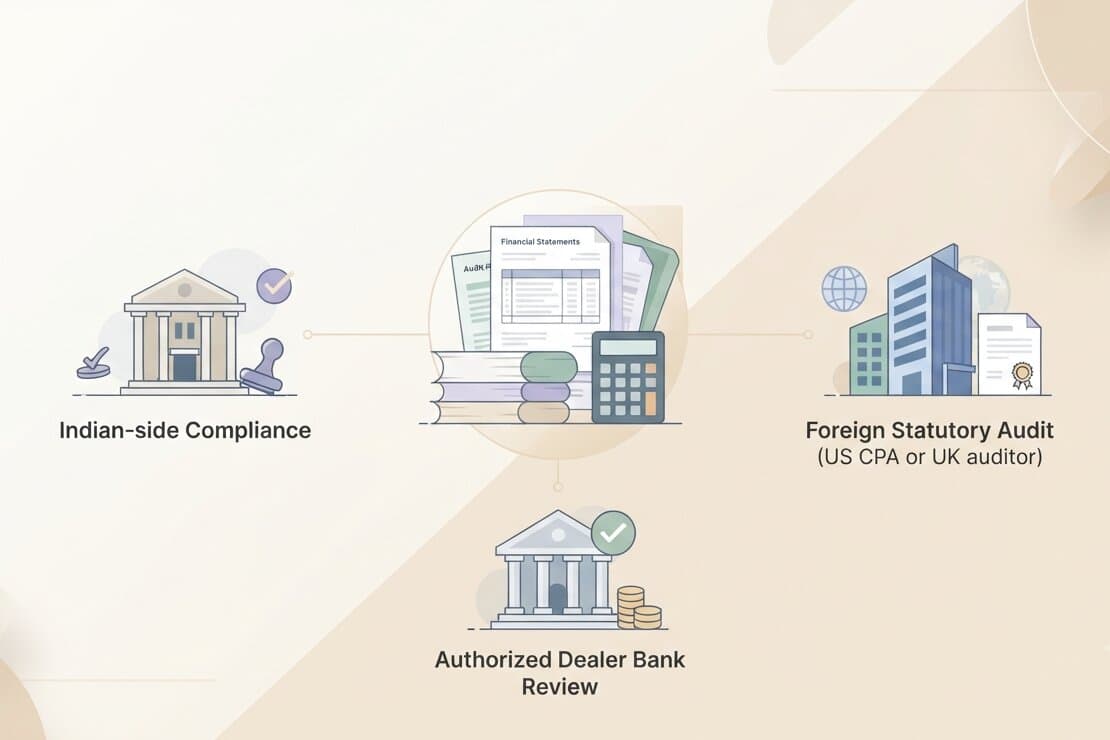
An Indian company setting up its first overseas subsidiary usually assumes that "getting the accounts audited" is a fairly universal exercise — find someone qualified, have them sign off, move on. It isn't. The audit of a foreign subsidiary of an Indian company is governed by whichever country that subsidiary sits in, and the professional signing that report has to hold a license recognised in that jurisdiction, not a general accounting qualification that sounds equivalent.
This distinction sits at the centre of most APR audit delays and rejections. RBI's reporting requirements under FEMA don't ask whether your subsidiary's numbers are accurate in some abstract sense — they ask whether a specific, licensed professional in that country has certified them under that country's own accounting and auditing framework. Get the credential wrong, and the accuracy of the numbers stops mattering.
Why the Credential Matters More Than Most Companies Expect
For ODI compliance purposes, the Annual Performance Report isn't just a form — it's a representation to RBI, through your AD Bank, that your overseas investment is being reported honestly and that the underlying financials have been independently verified. RBI's framework doesn't accept "independently verified" as a loose concept. It specifies who counts as independent, and that specification changes by country.
This is why an AD Bank will reject a perfectly accurate audit report if it's signed by the wrong type of professional. The bank isn't second-guessing the numbers. It's checking whether the signature carries the legal weight RBI's Master Direction on ODI requires for that jurisdiction. A finance team that treats this as a formality — engaging whichever accountant was available, or the cheapest one — usually discovers the gap only after the AD Bank sends the filing back, with weeks already gone.
The US Route: What a CPA Actually Certifies
For a US subsidiary — an LLC, a C-Corp, or otherwise — the auditor has to be a Certified Public Accountant licensed by a US state board of accountancy. This isn't a title anyone can adopt after a few years of bookkeeping experience; it requires passing the Uniform CPA Examination, meeting state-specific education requirements, and maintaining an active license.
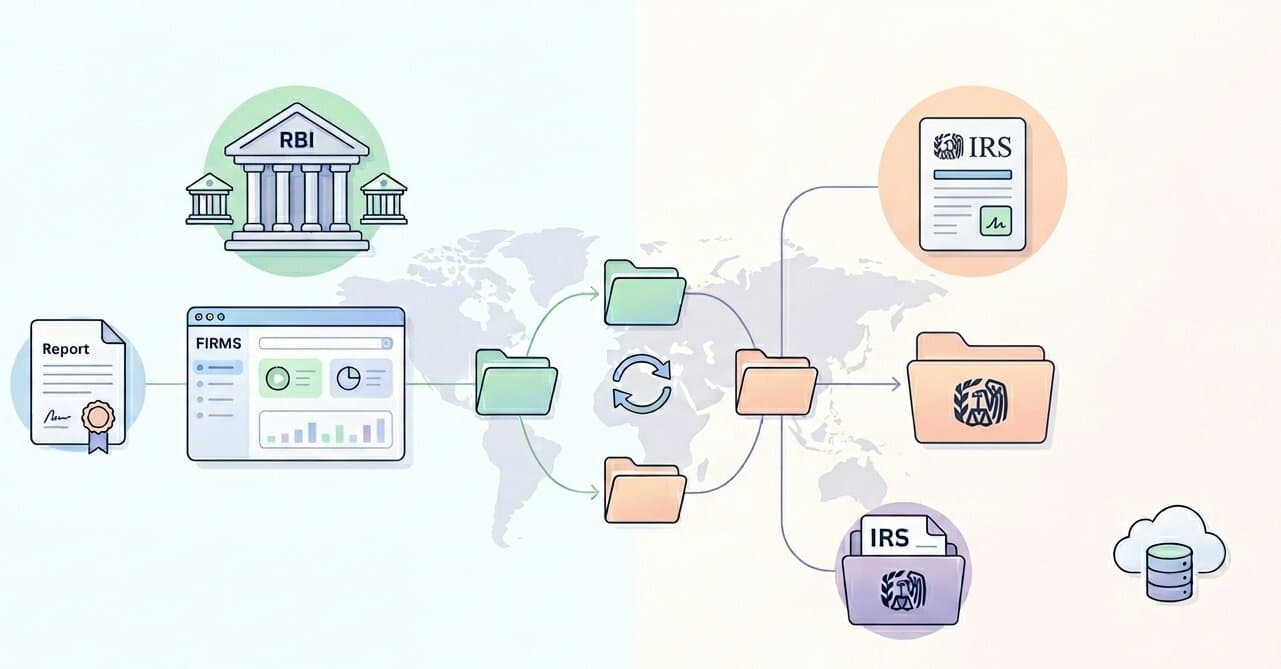
What often surprises Indian finance teams is that a full statutory audit isn't always what's needed. Many single-member LLCs and smaller entities are better served by a CPA Review Report under SSARS (Statements on Standards for Accounting and Review Services), which is a lighter-touch engagement than a full audit but still requires the CPA's formal opinion. Choosing the wrong service level here — either overpaying for a full audit nobody asked for, or submitting draft management accounts thinking they'll pass — is one of the more common ways US-subsidiary APR filings go sideways. The other recurring issue is reconciliation: US GAAP-based financials need to tie back cleanly to whatever your subsidiary separately files with the IRS, particularly Form 5471, since AD Banks and RBI increasingly cross-check consistency across an entity's reporting trail.
The UK Route: ICAEW, ACCA, and Why the Two Aren't the Same Thing
A UK entity's audit has to be signed by someone registered with a Recognised Supervisory Body — typically a member of the Institute of Chartered Accountants in England and Wales (ICAEW), or the Association of Chartered Certified Accountants (ACCA). Both are legitimate, both are internationally respected, but they aren't interchangeable in every situation. ICAEW members are more commonly the statutory auditors of record for UK-registered companies, while ACCA-qualified accountants frequently handle the accounting and compliance work surrounding the audit rather than the audit sign-off itself, depending on the individual's registered auditor status.
The other UK-specific detail Indian companies tend to miss is the accounting standard. A UK subsidiary's financials should be prepared under UK GAAP — specifically FRS 102 for most private companies, or the simplified FRS 105 for entities qualifying as micro-companies. Financials prepared loosely under "international standards" without mapping cleanly to FRS 102 create exactly the kind of ambiguity that triggers an AD Bank query, even when the underlying figures are correct. For UK subsidiaries specifically, this FRS classification also determines how much audit exemption the entity might legitimately claim under UK company law — which then has to be reconciled against what RBI still expects to see for FEMA compliance purposes, since a domestic audit exemption in the UK doesn't automatically satisfy India's reporting requirement.
The Singapore Route: ISCA Membership and ACRA Oversight
Singapore adds a layer that neither the US nor UK route has in quite the same form: the professional has to be a member of the Institute of Singapore Chartered Accountants (ISCA) and specifically approved by the Accounting and Corporate Regulatory Authority (ACRA) as a public accountant authorised to conduct statutory audits. Not every ISCA member holds this public accountant status — plenty of ISCA-qualified professionals work in roles that never require ACRA approval, which means the credential check here needs to go one level deeper than simply confirming ISCA membership.
Singapore entities also report under SFRS(I) — Singapore Financial Reporting Standards (International), which are closely aligned with IFRS but carry local adaptations. A Singapore Pte Ltd that qualifies as a "small company" under ACRA's criteria may be exempt from statutory audit domestically, similar to the UK's exemption regime. Again, that domestic exemption doesn't remove the RBI requirement — Indian parent companies still need a qualified compilation or review report for APR purposes, even when Singapore law itself wouldn't have demanded a full audit.
Where This Goes Wrong in Practice
The most common failure pattern isn't companies ignoring these distinctions outright — it's companies assuming international portability where none exists. A US CPA cannot sign off a UK subsidiary's accounts, no matter how experienced or well-regarded they are, because their license doesn't extend that authority. The same applies in every direction between these three jurisdictions. Each license operates strictly within its country of issue.
The second failure pattern shows up with companies running subsidiaries in more than one of these three countries simultaneously. Three subsidiaries mean three separate audit engagements, each governed by a different licensing body, a different accounting standard, and often a different local audit season — US CPA firms, for instance, run their heaviest workload around the US tax filing season, which can collide badly with a December 31 RBI deadline if the engagement starts too late. Treating these as one coordinated effort rather than three disconnected vendor relationships is what actually keeps a multi-country APR audit on schedule.
Matching the Credential to the Jurisdiction, Not the Other Way Around
The practical takeaway for any Indian company managing a foreign subsidiary is straightforward, even if the execution rarely is: identify the subsidiary's jurisdiction first, then work backwards to the specific license that jurisdiction's regulators — and RBI, by extension — will actually accept. A CPA, an ICAEW or ACCA member, and an ISCA-registered public accountant are all rigorous, credible professionals within their own systems. None of them substitutes for one another. For a company trying to keep its APR audit, its broader FEMA compliance, and its ODI reporting on schedule, getting this one detail right at the start of the engagement is usually what separates a filing that clears on the first pass from one that doesn't.