.svg)
.svg)
.svg)
APR Audit for Foreign Subsidiaries: The Myths vs. The Truth About the CPA and the Process
APR audit myths explained: clarify foreign CPA requirements, audit timelines, Indian CA roles, financial year mismatches, and common compliance mistakes.

Accorp Compliance Team
Our team of compliance experts specializes in PCI DSS, SOC 2, and other security frameworks to help businesses achieve and maintain compliance.
A finance head at a mid-sized IT company once told me his team assumed any accountant abroad could sign off on their US subsidiary's financials for APR. Their AD Bank rejected the report because it wasn't signed by a licensed CPA. That one wrong assumption cost them six weeks — right before the deadline.
Most APR problems don't come from companies ignoring the requirement. They come from believing something about the audit that simply isn't true. Here's the real picture, myth by myth.
Myth: The APR Is Just a Form You Fill Out
Truth: The form is the easy part. What actually makes it valid is the audit behind it — a real review of your foreign subsidiary's financial statements by a qualified professional in the country where that subsidiary is based. The filing takes an afternoon once the audit is done. The audit is what eats up the calendar, usually two to three months.
Myth: Any Accountant Abroad Can Sign Off the Audit
Truth: The requirement is specific to the country and specific to a license.
A US subsidiary needs a state-licensed CPA — not a bookkeeper, not a general accountant
A UK entity needs an ICAEW or ACCA member registered with a Recognised Supervisory Body
A Singapore entity needs an ISCA member approved by ACRA
If the signature doesn't come from someone with the right license, your AD Bank sends the whole submission back, no matter how accurate the numbers are.
Myth: My Indian CA Can Handle the Whole Thing
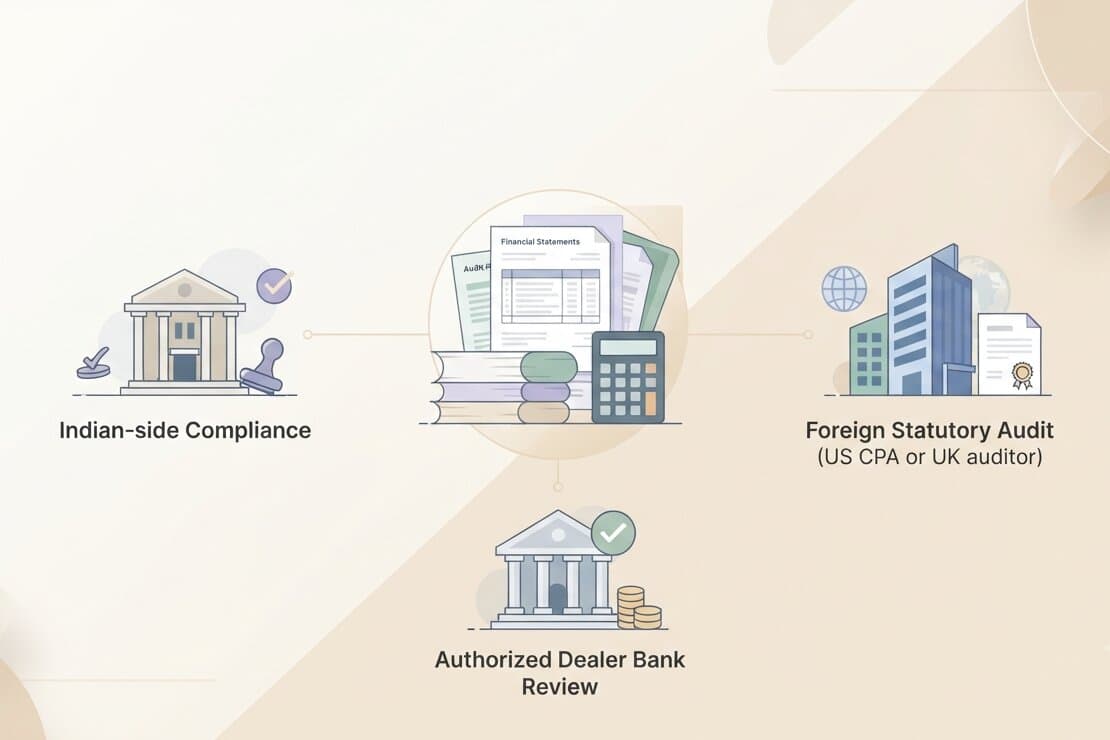
Truth: No — not the audit itself. Where the Indian parent holds equity in a foreign entity, the audit of that entity's financials has to be performed by a qualified professional licensed in that host country — a CPA for a US entity, an ICAEW/ACCA member for a UK entity, an ISCA member for a Singapore entity. An Indian CA doesn't hold a license to audit a foreign company under that country's own accounting and auditing standards, and RBI's Master Direction is specific about needing sign-off from the host-country's own statutory auditor or equivalent professional. Your Indian CA plays a role afterward — reviewing the audited package and confirming it satisfies RBI's expectations — but they cannot be the one certifying the foreign subsidiary's financials in the first place.
Myth: The Audit Takes a Week or Two
Truth: A genuine audit or review engagement for APR takes 60 to 90 days. The CPA reviews your statements, checks transactions against real documents, follows up with questions, and only then issues a formal opinion your bank will accept. Starting this in November, hoping for a quick turnaround before December 31, means you're already working against a timeline that was never realistic.
Myth: Any CPA Is Basically the Same as Any Other
Truth: CPAs specialize, just like any other profession. A CPA who's never handled an RBI-facing engagement often won't know that your APR financials need to reconcile with your Form 5471 filing, or that a CPA Review Report under SSARS is usually what an LLC actually needs — not a full statutory audit. Choosing someone based purely on cost, without checking their experience with Indian ODI or FEMA reporting, is how companies end up with numbers that are technically correct but still get flagged for formatting or reconciliation issues.
Myth: A Mismatched Financial Year Means I Can Skip This Year
Truth: A mismatch is common, not a loophole. If your subsidiary runs January to December instead of India's April to March, RBI lets you submit unaudited figures first, with the audited version following within six months of your subsidiary's year-end, or by the next December 31, whichever comes first. It shifts your timeline. It doesn't remove the requirement.
Myth: One CPA Can Handle All My Foreign Subsidiaries
Truth: A CPA's license only works in their own country. A US CPA can't sign a Singapore audit report, and a UK auditor can't certify US financials. Three subsidiaries in three countries means three separate engagements, each running on its own clock — not one person covering everything.
Myth: Sending Draft Financials Is Good Enough to File On Time
Truth: Submitting management accounts before the CPA's formal opinion is ready gets your APR rejected outright, and in serious cases can flag the entity for FEMA compounding. This is a shortcut companies try under deadline pressure, and it rarely works out.
Myth: A Dormant or Small Subsidiary Doesn't Need a Real Audit
Truth: Being small or inactive doesn't remove the requirement — it just changes what kind of report is acceptable. Even a dormant US LLC still needs a CPA-issued compilation or review report. It doesn't get to skip the process.
Myth: The CPA Is Usually What Slows Things Down
Truth: Rarely. The biggest reason a 60-day engagement stretches into 90-plus days is a question that sits unanswered for a week — a missing invoice, a query about an unusual transaction. Engage a CPA and then go quiet, and don't be surprised if you're scrambling in late December.
Myth: Once the Audit Is Done, You're Ready to File
Truth: Not quite yet. The audited numbers still need to be reconciled against your original investment records — how much was invested, your shareholding, any loans or guarantees. Small mismatches here are one of the most common reasons AD Banks send filings back with questions. After that, an Indian CA reviews the full package to confirm it meets RBI's specific expectations, separately from whether it already meets the host country's standards. Only then does it go to your AD Bank.
A Realistic Timeline, Worked Backwards From December 31
Give yourself 2–3 weeks for submission and AD Bank review. Before that, reconciliation and CA review take about a week once the audit closes. Before that, the audit itself takes 60 to 90 days. Working backwards, your realistic start date lands somewhere in early-to-mid September — any later, and every step after gets squeezed.
The Real Takeaway
Almost every expensive mistake here — a rejected dossier, a missed deadline, a scramble in December — comes back to one thing: treating the foreign audit like a formality instead of a real engagement with its own rules, its own timeline, and its own ways of going wrong. Know who's actually qualified to sign, plan around a realistic timeline, and stay responsive once the engagement starts. That's what turns this from a yearly fire drill into something routine.
Frequently Asked Questions
Q1. Can any accountant abroad sign off my foreign subsidiary's audit?
No. The signature has to come from someone specifically licensed in that country — a state-licensed CPA for the US, an ICAEW/ACCA member for the UK, an ISCA member for Singapore. A signature from anyone else gets the whole submission sent back, no matter how accurate the numbers are.
Q2. Can my Indian CA handle the entire audit instead of hiring a foreign one?
No. RBI requires the foreign subsidiary's financials to be audited by a qualified professional licensed in that host country. Your Indian CA reviews the audited package afterward to confirm it meets RBI's expectations, but can't certify the foreign entity's financials themselves.
Q3. My subsidiary's financial year doesn't match India's — do I still need to file this year?
Yes. A mismatched year shifts your timeline, not the requirement — you can submit unaudited figures first, with the audited version following within six months of your subsidiary's year-end or by December 31, whichever comes first.