.svg)
.svg)
.svg)
APR Audit for Indian-Owned Singapore Pte Ltd: What's Required
Understand APR audit requirements for Indian-owned Singapore Pte Ltds, including audit exemptions, group tests, SFRS financials, and RBI compliance.

Accorp Compliance Team
Our team of compliance experts specializes in PCI DSS, SOC 2, and other security frameworks to help businesses achieve and maintain compliance.
Singapore is one of the more common jurisdictions for Indian businesses expanding overseas, thanks to its straightforward incorporation process and favourable business environment. But when an Indian company holds a Pte Ltd in Singapore as a JV or WOS, the compliance obligations don't stop at the Singapore side — the entity also needs to be accounted for annually in the Indian parent's Annual Performance Report. This creates a specific set of audit and reporting requirements that differ from what applies to US or UK subsidiaries.
This article explains what an APR audit actually requires for an Indian-owned Singapore Pte Ltd, and where Singapore's own compliance framework intersects with RBI's expectations.
Why Singapore Subsidiaries Follow a Different Audit Path
Unlike the US, where an audit is typically expected regardless of company size, Singapore operates an audit exemption framework for small companies. This means a Singapore Pte Ltd may not be legally required to undergo a statutory audit at all, depending on its size — a detail that directly affects what an Indian parent can rely on for its overseas subsidiary audit.
Understanding this distinction early avoids a common assumption that every overseas entity follows the same audit obligations. For Singapore specifically, the starting question isn't just "who audits the entity" but "is an audit even required in the first place?"
Singapore's Small Company Audit Exemption
Under Section 205C of Singapore's Companies Act, a private company qualifies as a "small company" — and is therefore exempt from mandatory audit — if it meets at least two of the following three criteria for the immediately preceding two consecutive financial years:
Total annual revenue not exceeding S$10 million
Total assets not exceeding S$10 million
Number of employees not exceeding 50
A newly incorporated Singapore subsidiary is assessed against these criteria in its first financial year alone, since it won't yet have two years of history to look back on.
Why the Group Test Matters for Indian-Owned Subsidiaries
This is where Singapore's framework becomes particularly relevant to ODI compliance. When a Singapore Pte Ltd is part of a group — which includes being a subsidiary of an Indian parent company — the exemption isn't assessed on a standalone basis alone. The entire group must also qualify as a "small group" on a consolidated basis, meeting the same two-of-three thresholds together.
This means an Indian-owned Singapore subsidiary that looks small on its own financial statements may still be required to undergo an audit if the Indian parent's consolidated figures push the group above the exemption thresholds. This is a detail that's frequently missed and is worth clarifying early, since it directly determines whether formal audited financials will even exist to support the APR filing.
What Happens When the Subsidiary Is Audit-Exempt
If the Singapore entity genuinely qualifies for audit exemption, it is still required to prepare financial statements in accordance with Singapore Financial Reporting Standards (SFRS), file an Annual Return with ACRA, and maintain proper accounting records. What it does not need is a formal audit opinion from a licensed auditor.
For APR filing for foreign subsidiaries in this situation, the Statutory Auditor in India typically certifies based on these unaudited but SFRS-compliant financial statements, along with a note confirming that audit is not mandatory under Singapore law for the entity in question. This is explicitly recognised as a valid basis for certification, provided it's documented clearly rather than left ambiguous.
What Happens When an Audit Is Required
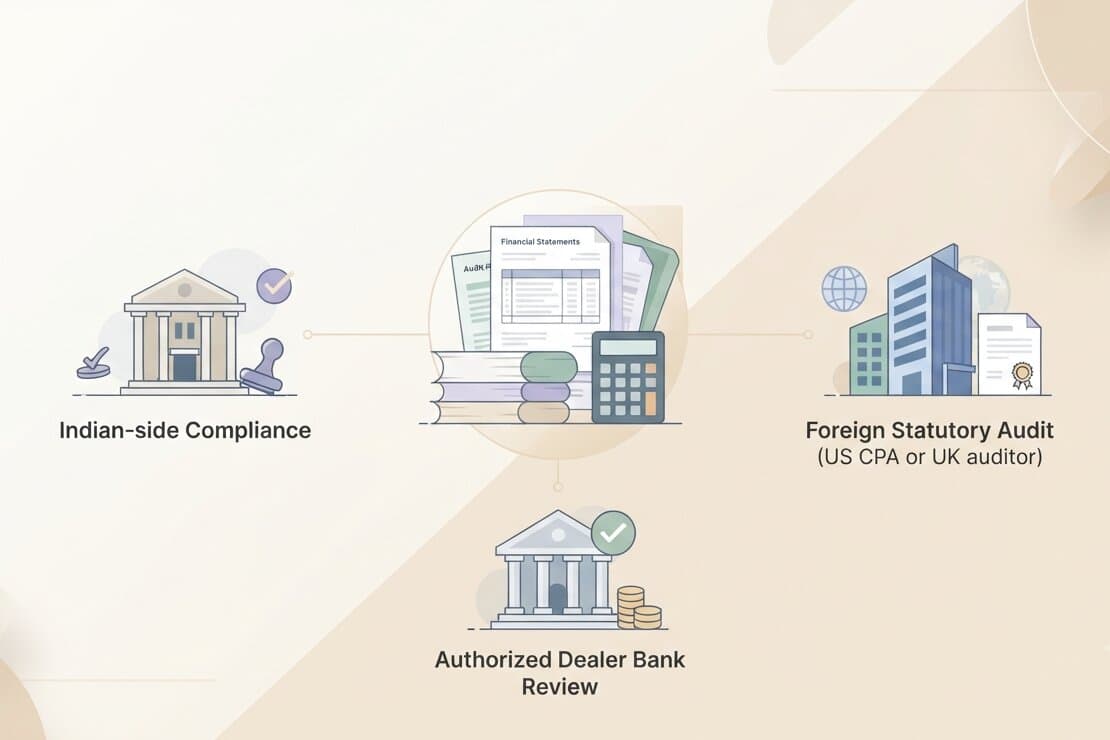
Where the Singapore subsidiary does not qualify for exemption — either on a standalone basis or because of the group test — it needs to engage a Public Accountant registered with ACRA to conduct a formal audit. This audit reviews the company's financial statements against SFRS and results in an audit report that accompanies the accounts, similar in purpose to what a US CPA for APR filing or a UK auditor for APR filing would produce in their respective jurisdictions.
This audited output then becomes the basis for the Indian Statutory Auditor's review and certification of Form ODI Part II, following the same overall structure used for foreign subsidiary audit compliance in other countries.
Documentation Needed Regardless of Audit Status
Whether or not the Singapore entity is formally audited, certain documentation is needed to support the APR:
Financial statements prepared under SFRS for the relevant financial year
Confirmation of the entity's audit-exempt status, if applicable, along with the basis for that determination
Details of any investment movement during the year, including fresh capital injected or repatriated
Records of dividends, fees, or other amounts due to the Indian parent, and confirmation of repatriation within prescribed timelines
This documentation feeds directly into subsidiary compliance reporting on the Indian side, regardless of whether a full audit was legally required in Singapore.
Coordinating Singapore's Timeline With RBI's Deadline
Singapore companies file their Annual Return with ACRA within seven months of their financial year end, which does not always align neatly with India's December 31 APR deadline. Businesses managing overseas investment compliance need to map out when Singapore's financial statements will realistically be finalised — audited or not — and ensure that timeline leaves enough room for reconciliation and Statutory Auditor certification before India's own deadline.
This becomes particularly important for companies managing multiple entities across jurisdictions, where a US or UK subsidiary may follow a very different audit and reporting calendar than a Singapore Pte Ltd.
Common Points of Confusion for Indian Parents
A few issues come up repeatedly when Indian companies manage APR filing India for their Singapore subsidiaries:
Assuming audit exemption automatically applies without checking the group test against the Indian parent's consolidated figures
Treating unaudited financial statements as insufficient for certification, when they may be entirely valid if the exemption genuinely applies
Missing the distinction between ACRA's Annual Return filing and the separate requirement for RBI reporting under the APR
Failing to track investment movement and repatriation details specifically, since these aren't always a standard feature of Singapore's own compliance filings
Building a Reliable Process for Singapore Entities
As with other jurisdictions, managing Singapore subsidiary compliance as part of a broader international business compliance framework works better than treating it as a one-off task each year. This means confirming exemption status early, engaging a Public Accountant promptly if an audit is required, and maintaining clear documentation of investment movement and repatriation throughout the year — not just at filing time.
Conclusion
An APR audit for an Indian-owned Singapore Pte Ltd doesn't always mean a full statutory audit — Singapore's small company exemption, assessed alongside the group test against the Indian parent, often determines whether audited or unaudited SFRS-compliant financials form the basis of certification. Understanding this distinction, and preparing the right documentation regardless of audit status, is what keeps annual compliance for foreign subsidiaries in Singapore aligned with RBI's expectations and free of last-minute uncertainty during the APR audit process.