.svg)
.svg)
.svg)
APR Deadline Dec 31: Why Starting in October Is Already Too Late
Starting APR filing in October can create avoidable delays. See why early audit planning, reconciliation, certification, and AD bank coordination matter.

Accorp Compliance Team
Our team of compliance experts specializes in PCI DSS, SOC 2, and other security frameworks to help businesses achieve and maintain compliance.
Every year, a large number of businesses approach their APR filing in the final quarter, treating October as the natural starting point before the December 31 deadline. On paper, three months looks like enough time. In practice, by the time an overseas audit is arranged, financial statements are finalized, and the Statutory Auditor completes certification, October leaves almost no room for anything to go wrong — and something almost always does.
This article explains why the real working window for APR filing India closes much earlier than most businesses assume, and what actually needs to happen before October for a smooth filing.
The Deadline Is a Single Date, But the Process Isn't
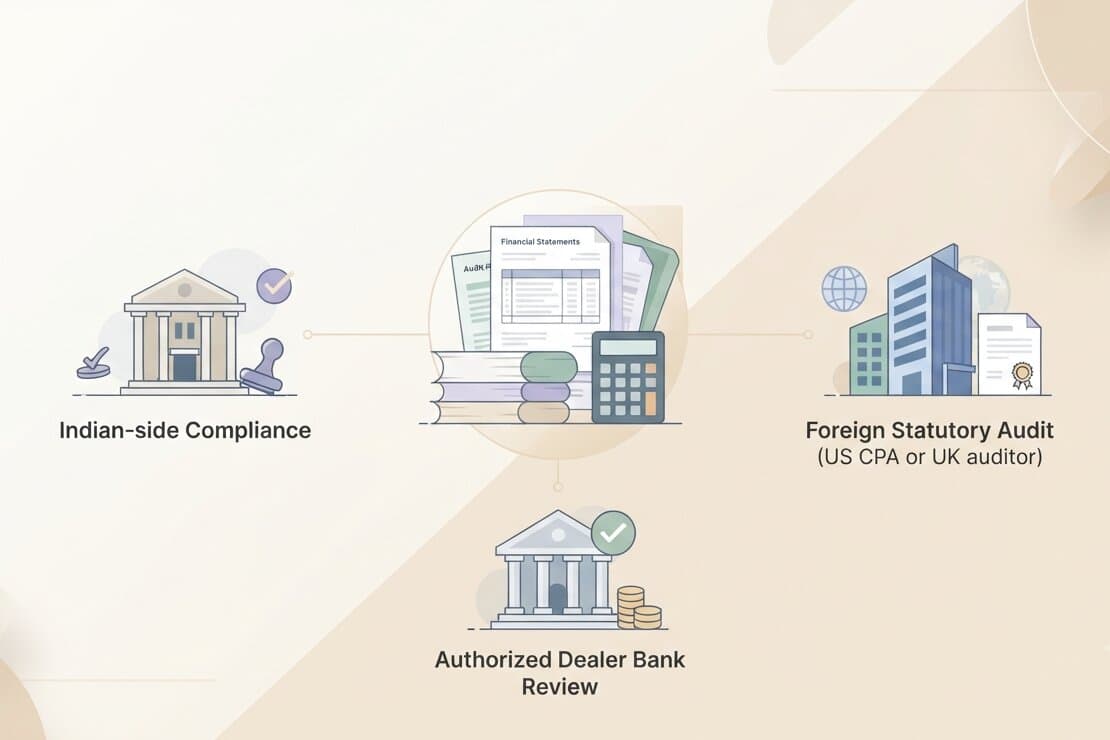
RBI's December 31 deadline applies to the completed filing, not to any of the steps that lead up to it. Before a business reaches that final submission, it needs to complete an overseas subsidiary audit, reconcile the audited figures against Form ODI Part II requirements, secure Statutory Auditor certification, and route everything through the AD bank. Each of these steps depends on the one before it being finished — which means starting in October means starting every one of these stages back-to-back, with no buffer for delay at any point.
Overseas Audits Don't Run on India's Calendar
A common misconception is that a US CPA for APR filing or a UK auditor for APR filing can be engaged quickly once the need becomes urgent. In reality, audit firms in the US and UK operate on their own regional workloads and seasonal demand, and availability tightens considerably in the final quarter of the calendar year. An engagement started in October is competing for auditor time against the firm's own year-end priorities, which often pushes completion dates later than expected.
This is one of the most overlooked risks in foreign subsidiary audit compliance — the assumption that overseas auditors can move as quickly as the Indian side needs them to, regardless of when they're approached.
Reconciliation Takes Longer Than It Appears On Paper
Even once audited financial statements are available, they still need to be reconciled against what RBI expects to see under ODI compliance requirements — net worth, investment movement, repatriated dues, and consistency with the prior year's filing. This reconciliation step is rarely quick, particularly for businesses managing more than one overseas entity, since each jurisdiction's financial statements need to be mapped individually into the required format.
Starting this stage in October, after the audit is already complete, compresses a process that ideally needs several weeks into a much tighter window — one that leaves little room to resolve discrepancies if the reconciled figures don't align cleanly with prior filings.
The Statutory Auditor Needs Real Review Time, Not a Quick Sign-Off
Once the reconciled figures are ready, the Statutory Auditor in India still needs to review the audited overseas financials and certify that everything aligns with the conditions of the original ODI approval, satisfying FEMA compliance requirements tied to the investment. This certification is not a formality that can be completed same-day, particularly where a business holds multiple JVs or WOS across different countries and each one needs to be reviewed on its own merits.
When this step is pushed into November or December because earlier stages ran late, the Statutory Auditor is left reviewing complex cross-border figures under time pressure — exactly the conditions under which errors are most likely to be missed.
AD Bank Submission Isn't Instant Either
Even after certification is complete, the finalised Form ODI Part II still has to be submitted through the company's AD Category-I bank, which verifies the documentation against its own records before the filing is considered complete. If the bank identifies any discrepancy at this stage, there needs to be time left to correct and resubmit before December 31 — something an October start rarely accounts for, since it assumes every earlier stage will go exactly as planned.
What an October Start Actually Assumes
Starting the process in October only works if every subsequent step happens without delay: the overseas auditor is immediately available, the audit is completed without complications, reconciliation surfaces no discrepancies, the Statutory Auditor has full availability to review multiple filings quickly, and the AD bank raises no queries. In a process involving multiple professionals across different countries and regulatory systems, this level of alignment is the exception rather than the rule.
This is why businesses that begin in October often find themselves managing the final weeks of December under significant pressure, even when nothing has technically gone wrong — the process simply had no built-in room for anything to take longer than expected.
When the Process Should Realistically Begin
For most businesses managing overseas investment compliance, engaging the overseas auditor in the second or third quarter of the financial year — well before October — leaves adequate time for the audit itself, reconciliation, Statutory Auditor certification, and a comfortable submission window before the deadline. This timeline naturally adjusts depending on how many entities are involved and how complex each jurisdiction's requirements are, but the underlying principle stays the same: the overseas audit needs to be substantially complete before the final quarter begins, not started within it.
Treating APR as a Recurring Cycle, Not a Year-End Task
Because this filing repeats every year for as long as an overseas entity remains active, businesses that continue starting in October tend to repeat the same time pressure annually. Approaching APR filing for foreign subsidiaries as a structured, recurring cycle — with the overseas audit initiated early and each subsequent stage scheduled with realistic lead time — is what keeps annual compliance for foreign subsidiaries predictable rather than a recurring scramble each December.
Conclusion
October feels early relative to a December 31 deadline, but it is late relative to everything that has to happen before that deadline is met. Overseas audits need time to be scheduled and completed, reconciliation against RBI's reporting requirements takes longer than expected, and Statutory Auditor certification deserves proper review rather than a rushed sign-off. Businesses that map out their APR audit timeline several months ahead of October — rather than treating it as the starting line — consistently avoid the compressed, high-pressure filing cycle that so many companies experience every year.