.svg)
.svg)
.svg)
Statutory Auditor vs US CPA: Roles in Overseas Subsidiary Audit
Understand the roles of a US CPA and Indian Statutory Auditor in APR filing India, and how coordinated audits support overseas subsidiary compliance.

Accorp Compliance Team
Our team of compliance experts specializes in PCI DSS, SOC 2, and other security frameworks to help businesses achieve and maintain compliance.
When an Indian company sets up a Joint Venture (JV) or Wholly Owned Subsidiary (WOS) in the United States, two different auditing professionals end up involved in the compliance process: the Statutory Auditor in India and the US CPA handling the subsidiary's accounts abroad. Businesses often assume these two roles overlap or that one can substitute for the other. In practice, they serve distinct functions, and confusing the two is one of the more common reasons APR filing India runs into delays.
This article explains what each professional actually does, where their responsibilities separate, and how the two roles work together to complete an overseas subsidiary audit.
Two Different Jurisdictions, Two Different Mandates
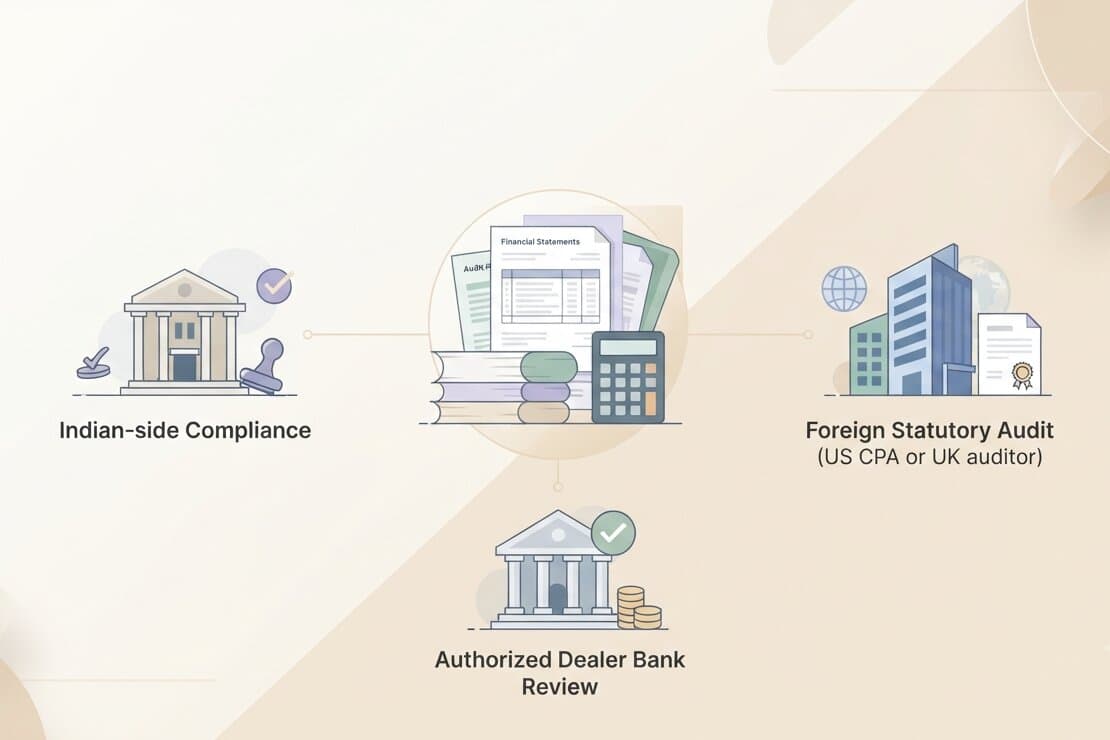
The Statutory Auditor is appointed under Indian company law to audit the Indian parent entity. Their responsibility is tied to Indian regulatory obligations, including FEMA compliance and RBI reporting requirements connected to the parent's overseas investments.
The US CPA, on the other hand, operates entirely within the US regulatory and accounting framework. Their job is to audit or review the financial statements of the US LLC or Inc itself, in line with US GAAP, without any direct obligation toward Indian reporting requirements.
Neither professional is positioned to fully perform the other's function. The Statutory Auditor is not licensed to audit a US entity's books under US standards, and a US CPA has no role in Indian regulatory filings. This separation is the starting point for understanding subsidiary compliance reporting.
What the US CPA Is Responsible For
A US CPA for APR filing is primarily engaged to audit or review the financial statements of the overseas subsidiary. Their scope of work typically includes:
Verifying the accuracy of the subsidiary's income, expenses, assets, and liabilities
Preparing financial statements in accordance with US GAAP
Issuing an audit opinion or review report that can be relied upon for cross-border compliance
Responding to specific data requests needed to support the Indian side of the filing
This output — the audited financial statements — becomes the foundation on which the rest of the APR filing for foreign subsidiaries is built. Without it, there is nothing concrete for the Indian side to certify against.
What the Statutory Auditor Is Responsible For
The Statutory Auditor's role begins where the US CPA's work ends. Once the audited financials of the overseas entity are available, the Statutory Auditor in India:
Reviews the audited statements received from the US CPA
Confirms that the figures reported in Form ODI Part II accurately reflect those statements
Certifies compliance with the terms of the original ODI approval, as required under ODI compliance norms
Signs off on the APR before it is submitted through the Authorised Dealer (AD) bank
The Statutory Auditor is not re-auditing the US entity. Their certification is based on trust in the underlying audit performed by the US CPA, combined with their own review of how that data has been translated into the Indian reporting format.
Where the Two Roles Intersect
Although their mandates are separate, the two roles are not independent of each other. The quality and completeness of the US CPA's audit directly affects how smoothly the Statutory Auditor can complete certification. If the US CPA's report is delayed, incomplete, or uses a format that doesn't map cleanly to what RBI expects, the Statutory Auditor is left trying to reconcile a mismatch — which slows down the entire annual compliance process for foreign subsidiaries.
For this reason, businesses managing overseas investment compliance across the US benefit from coordinating both professionals early in the reporting cycle rather than treating the two audits as sequential, disconnected tasks.
Common Misunderstandings Between the Two Roles
A few misconceptions come up repeatedly in international business compliance work:
Assuming the Statutory Auditor can certify without a US audit. Certification is meant to reflect verified figures, not internally prepared estimates. Skipping the US CPA step undermines the entire purpose of the certification.
Assuming the US CPA's report alone satisfies RBI. A US GAAP audit report is not, by itself, a substitute for Form ODI Part II certification. It is an input to that process, not the final filing.
Treating both professionals as interchangeable. Some businesses attempt to have one party sign off on work outside their jurisdiction to save time. This creates compliance risk rather than reducing it, since neither professional has authority outside their own regulatory system.
Underestimating coordination time. Because the two audits happen in different countries, under different standards, and often on different timelines, businesses that leave coordination until close to the filing deadline frequently run into avoidable back-and-forth.
Why This Distinction Matters for Foreign Subsidiary Compliance
Understanding the boundary between these two roles is central to foreign subsidiary audit compliance. It clarifies who to approach for what, prevents duplicated or misdirected work, and sets realistic expectations about how long the overall process takes.
For companies with subsidiaries beyond the US — including UK entities where a UK auditor for APR filing plays a similar but jurisdiction-specific role — the same principle applies: the local auditor certifies the subsidiary's financials under local standards, while the Statutory Auditor in India certifies the RBI-facing filing based on that work.
Building a Coordinated Audit Process
A well-managed APR audit treats the US CPA and the Statutory Auditor as two stages of one connected process rather than two separate obligations. Practical coordination includes:
Sharing RBI's reporting timelines with the US CPA well before the US audit begins
Confirming the format and level of detail the Statutory Auditor will need from the audited financials
Building in review time between receipt of the US audit report and the Statutory Auditor's certification
Applying the same coordinated approach across every jurisdiction where the business holds overseas investments
Conclusion
The Statutory Auditor and the US CPA are not competing or overlapping roles — they are two distinct parts of the same compliance chain that supports foreign investment reporting. The US CPA validates the subsidiary's financial position under US standards; the Statutory Auditor validates that this position has been accurately and compliantly reported to RBI. Businesses that plan around this distinction, rather than around the assumption that one auditor can cover both ends, are far better positioned to complete their overseas subsidiary audit and APR filing without last-minute complications.