.svg)
.svg)
.svg)
Missed an APR? Why You May Not Be Able to Make Your Next Overseas Investment
APR audit requirements for foreign subsidiaries, missed APR filings, LSF, AD bank issues, and FEMA compliance under India's overseas investment rules.

Accorp Compliance Team
Our team of compliance experts specializes in PCI DSS, SOC 2, and other security frameworks to help businesses achieve and maintain compliance.
A mid-sized auto-component maker in Coimbatore (a composite of situations we see often, not one named client) gets board approval to set up a second entity in the UAE. The finance head briefs the bank, the wire instruction goes in, and two days later the forex desk calls back with an awkward question: why does the ODI record for the UK subsidiary show an Annual Performance Report pending since 2023?
Nobody in the room knew. The UK company had been profitable, its accounts were filed at Companies House, and the founders assumed that was that. The wire did not move for six weeks.
This is the pattern behind most APR trouble. The form itself is short. What hurts is the gap between when it was missed and when someone notices.
What the APR Actually Is, and Why It Never Switches Off
The Annual Performance Report is the yearly update an Indian investor files, through its authorised dealer (AD) bank, on every foreign entity it holds under the Overseas Investment Rules and Regulations, 2022. It reports on how the foreign entity performed and what the Indian side holds in it. The due date is 31 December each year.
Two points surprise people. First, the obligation lasts as long as the investment exists, so a dormant company with no revenue still needs an APR. Second, where several Indian investors share a foreign entity, the one with the highest stake files. If stakes are equal, they must agree on a designated filer. Leaving that conversation undone is a common way for everyone to assume someone else did it.
How a Missed APR Blocks the Next Overseas Investment
Overseas investment is not a one-time approval. It is a continuing relationship with the regulator, and the APR is how that relationship stays in good standing.
When an APR is overdue, the ODI record attached to your unique identification number (UIN) carries a flag. In practice, AD banks are reluctant to process further remittances or fresh financial commitments to that entity until the default is regularised. Some banks go further and hold outward payments for the same investor generally, including routine dividend or royalty flows. Bank practice varies, and you should not assume the more lenient reading will apply to you.
There is a second, quieter cost. Any lender, PE investor or acquirer looking at your group will ask for evidence that foreign-entity filings are current. An unresolved APR default shows up in that diligence as a FEMA compliance red flag, and it tends to trigger follow-up questions about everything else.
Signs You May Already Have a Default
You rarely get a notice. More often, the first clue is indirect: a bank asking for "pending documents" on an unrelated payment, a Form FC that will not upload cleanly, or a new finance hire who cannot find last year's APR acknowledgement. If your team cannot produce an acknowledgement for each foreign entity for each year since incorporation, treat that as a default until proven otherwise. Checking takes an afternoon. Discovering it mid-transaction takes weeks.
The Wider Set of RBI Reporting Requirements
The APR is one of several filings, and defaults rarely travel alone. The full set an Indian company with a foreign subsidiary company should be tracking looks like this:
Form FC, filed with the AD bank around the time of the initial investment, and again for later financial commitments.
Share certificates or equivalent proof of investment, which must reach the AD bank within six months of allotment.
The APR, every year by 31 December.
The FLA return (Foreign Liabilities and Assets), filed annually by 15 July with the RBI.
Disinvestment or closure reporting, when you eventually exit.
If you have missed an APR, check the FLA return for the same year. In our experience the two lapse together, because both depend on someone owning the foreign-entity calendar.
What Regularising Costs: Late Submission Fee Versus Compounding
The RBI offers a route for reporting delays called the Late Submission Fee (LSF). For an APR, the fee is a flat ₹7,500 per delayed return. It is available for delays of up to three years from the original due date.
Beyond three years, or where the issue goes past a simple reporting delay, the matter moves to compounding. That means a formal application to the RBI, a compounding order, and a penalty calculated on the facts. Under Section 13 of FEMA, the statutory ceiling for a quantifiable contravention is up to three times the amount involved, though compounding outcomes for pure reporting lapses are typically far lower than that ceiling.
Here is the arithmetic most people miss. A subsidiary with three missed years costs ₹22,500 in LSF. That is trivial. The real cost is that each of those three years needs a set of financial statements prepared to the standard the RBI expects, and that brings us to the audit question.
Audit of a Foreign Subsidiary of an Indian Company: When It Is Compulsory
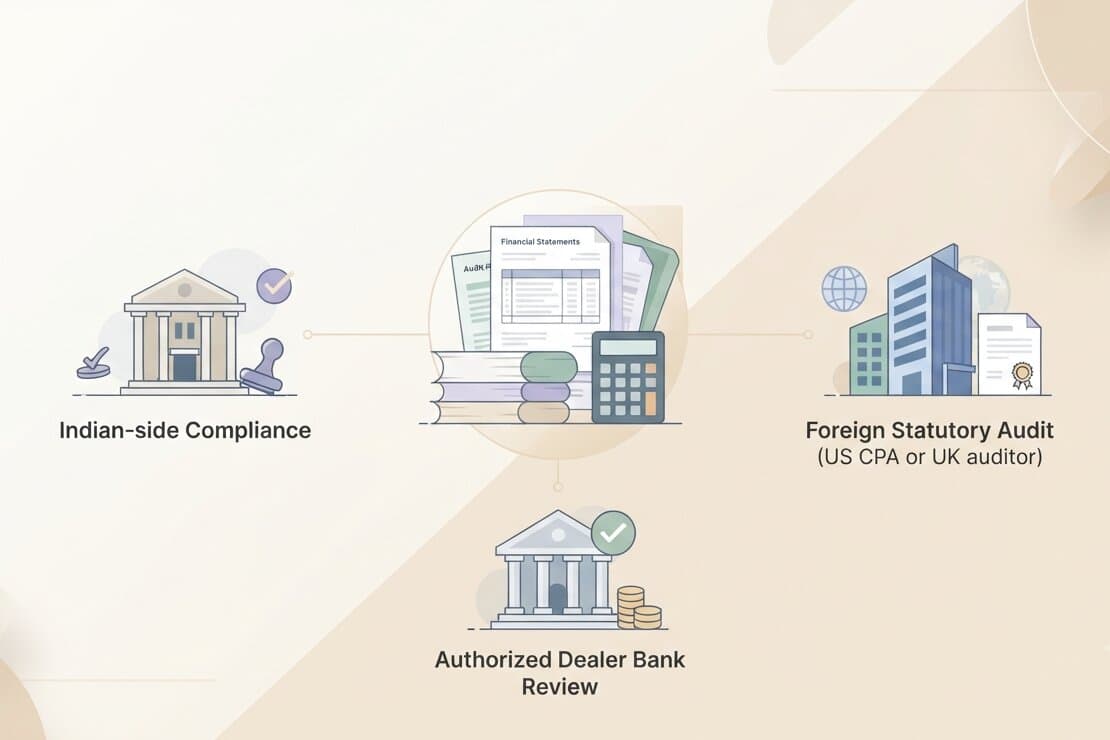
The general rule is straightforward. Where the Indian investor has control of the foreign entity, or where the laws of the host country require an audit, the APR must be based on audited financial statements of the foreign entity. Where neither is true, the APR can be filed on unaudited financials certified by the statutory auditor of the Indian company.
Most operating subsidiaries fall on the audited side, because Indian parents usually hold control. The audit of a foreign subsidiary of an Indian company is therefore not optional housekeeping. It is what makes the APR acceptable to the AD bank at all.
A common misstep is filing the APR using management accounts because the local tax filing did not need an audit. The two requirements are independent. Local law deciding you do not need an audit does not remove the RBI's requirement.
The UK Question: Why You May Need a UK Auditor for APR Filing
The UK is where this trips up the most Indian groups. Small UK companies can claim an audit exemption when filing accounts at Companies House, and many do, quite legitimately, to save cost. Their statutory accounts are unaudited and perfectly valid under UK law.
But if the Indian parent controls that company, the APR still needs audited numbers. That means engaging a UK auditor for APR filing: a properly qualified, registered audit professional who can issue a report under UK standards, on financial statements prepared under the UK framework the entity uses. An Indian chartered accountant signing off does not solve this, since the point of the requirement is that the audit happens in the jurisdiction where the entity operates.
Check three things before appointing anyone. Does the audit report state which standards it follows? Does the year-end match the entity's actual accounting reference date? And will the AD bank accept the format, since some banks want a short confirmation of the auditor's registration alongside the report? Asking the bank first saves a second round of work.
The same logic applies in the US and Singapore, where local audit exemptions for small private companies exist but do not cancel the APR requirement when the Indian parent has control.
A Practical Route Back to Compliance
If you already have a gap, this is the order that works:
Pull your ODI record. Confirm the UIN, every foreign entity linked to it, and which years show as filed. Do this before anything else, since surprises tend to appear here.
List every missed year per entity. Include entities you consider dormant.
Get financials for each missed year. Where control exists, that means an audit of each year, not just the latest one. Finance teams are often surprised that the audit of the foreign subsidiary has to be done retrospectively.
File the delayed APRs through the AD bank and pay the LSF for each.
If any default is beyond three years, prepare a compounding application rather than waiting for the AD bank to raise it.
Only then sequence the new investment. Trying to run both in parallel usually means the new Form FC sits idle.
Making Sure It Does Not Happen Again
The Coimbatore company fixed this with three changes, and none needed new software. A named person in finance now owns the foreign-entity register. The APR process begins in September, because a full audit can take six to eight weeks once documents are chased. And the board receives a one-line status on ODI filings each quarter.
Individuals who hold an overseas company directly, including through a foreign LLC, have the same obligation and should build the same habit.
The Short Version
A missed APR looks like a ₹7,500 problem. It behaves like a business problem, because it decides whether your next remittance goes through. With the next 31 December about three months away, the cheapest time to close the gap is before a payment is waiting on it.