.svg)
.svg)
.svg)
Step-by-Step: From Overseas Audit to RBI APR Submission
Explore the 8-step APR filing India process, from overseas audits and financial reconciliation to Statutory Auditor certification and AD bank submission.

Accorp Compliance Team
Our team of compliance experts specializes in PCI DSS, SOC 2, and other security frameworks to help businesses achieve and maintain compliance.
Filing the Annual Performance Report is often described as a single compliance task, but in practice it is a chain of dependent steps spread across two countries. The overseas audit has to be completed first, the results have to be translated into a specific reporting format, and only then can the filing move through the Statutory Auditor and the Authorised Dealer (AD) bank to RBI. Skipping or rushing any step in this chain is what usually causes delays.
This article walks through the process from start to finish, so businesses managing APR filing for foreign subsidiaries know exactly what happens at each stage and who is responsible for it.
Step 1: Identify Every Overseas Entity Requiring an APR
Before any audit work begins, the Indian party needs a clear list of every JV or WOS that requires a filing for the year. This includes entities that were active for only part of the year, since partial-year operations often still fall under ODI compliance obligations. Missing an entity at this stage creates gaps that surface much later, usually close to the deadline.
Step 2: Confirm the Applicable Accounting Standard
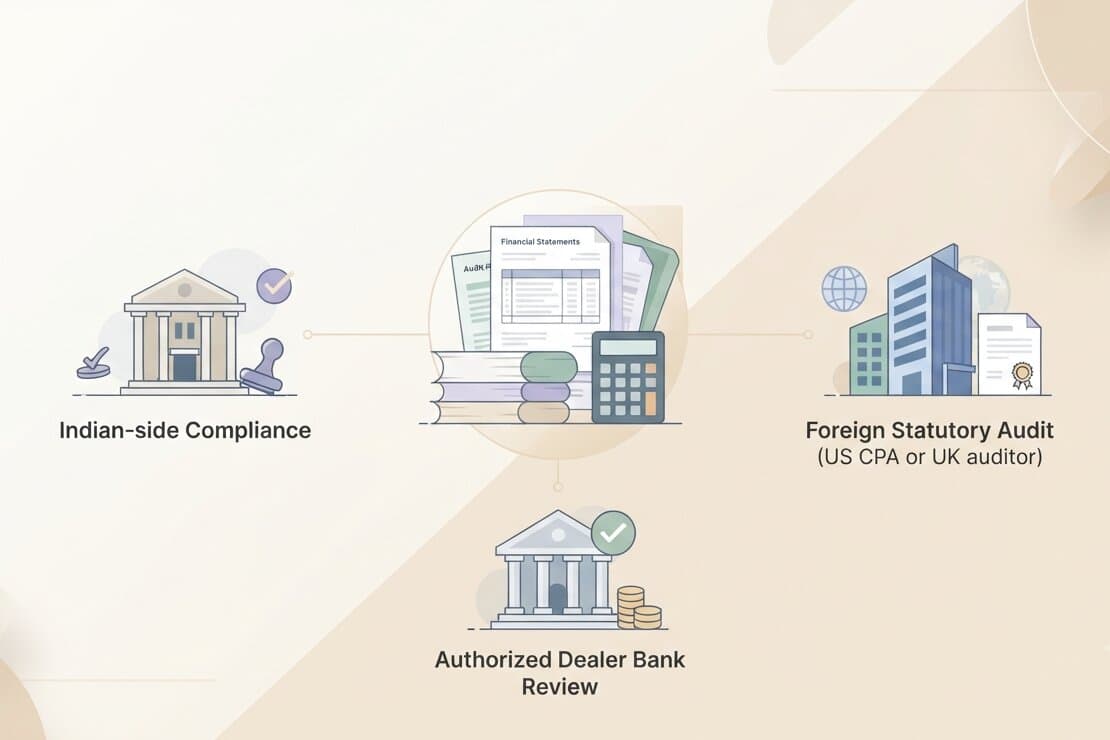
Each jurisdiction has its own reporting framework, and this needs to be confirmed before the audit starts, not after. A US entity is generally audited under US GAAP by a US CPA for APR filing, while a UK entity follows UK GAAP or FRS 102 under a UK auditor for APR filing. Getting this wrong at the outset means the financial statements may need to be reworked later to align with what the Statutory Auditor in India ultimately needs.
Step 3: Engage the Local Auditor for the Overseas Subsidiary Audit
With the standard confirmed, the next step is engaging a qualified local professional to conduct the overseas subsidiary audit. This is where the subsidiary's financial statements — income, expenses, assets, liabilities, and equity — are formally verified. The output of this step is the audited (or reviewed, where audit is not mandatory in the host country) financial statement package that everything downstream depends on.
At this stage, it helps to share the RBI filing timeline with the local auditor in advance, since local audit cycles are not always aligned with India's December 31 reporting requirement.
Step 4: Reconcile the Financials Against Form ODI Part II Requirements
Once the overseas audit is complete, the audited figures need to be mapped into the structure required by Form ODI Part II. This step is often underestimated. Financial statements prepared under US GAAP or UK GAAP are not automatically formatted the way RBI expects, and figures such as net worth, profit repatriation, and investment value need to be reconciled carefully.
This reconciliation stage is central to subsidiary compliance reporting, because errors introduced here — rather than in the original audit — are a leading cause of queries from the AD bank later in the process.
Step 5: Statutory Auditor Review in India
With the reconciled figures ready, the Statutory Auditor in India reviews the audited overseas financials and confirms that the data reported in Form ODI Part II accurately reflects them. This is also the point where the Statutory Auditor certifies compliance with the conditions attached to the original ODI approval, satisfying FEMA compliance requirements tied to the investment.
This step should not be treated as a formality completed in a day. Reviewing overseas financial statements against Indian reporting requirements takes time, particularly when a business holds multiple entities across different jurisdictions.
Step 6: Prepare and Finalize Form ODI Part II
Once certification is confirmed, the actual APR — Form ODI Part II — is completed with the finalized financial details, investment particulars, and any other disclosures required for the reporting year. Every section needs to be checked against the underlying audited data prepared in the earlier steps, since inconsistencies at this point can affect the credibility of the entire filing.
Step 7: Submission Through the AD Bank
The completed and certified APR is submitted to RBI through the company's designated AD Category-I bank, not directly to RBI. The bank verifies the documentation against its own records before forwarding it. This is the point where overseas investment compliance is formally reported to the regulator, and any mismatch between the bank's existing records and the current filing can result in the submission being returned for correction.
Step 8: Retain Documentation for Future Reference
Once submitted, the audited financial statements, the Statutory Auditor's certification, and the filed APR should be retained as part of the business's compliance records. These documents are often referenced again in subsequent years, particularly when a subsidiary undergoes changes such as additional investment, partial disinvestment, or closure, all of which affect future foreign investment reporting.
Why Sequencing Matters More Than Speed
A recurring pattern in delayed APR filing India cases is not a lack of effort, but a breakdown in sequencing — for example, attempting Statutory Auditor certification before the overseas audit is finalized, or starting the reconciliation step without confirming the correct accounting standard first. Each step in this process depends on the one before it being complete and accurate, which means working out of order rarely saves time and usually costs more of it later.
Businesses managing several overseas entities as part of broader international business compliance benefit from mapping out this sequence for each jurisdiction separately, since a US subsidiary and a UK subsidiary may be at different stages of their local audit cycle at the same point in the year.
Building a Reliable APR Audit Process Year After Year
Because this process repeats annually for as long as an overseas entity remains active, treating it as a one-time project rather than a recurring workflow tends to create the same problems every year. A structured APR audit approach — where the overseas audit, reconciliation, Statutory Auditor review, and AD bank submission are planned as connected stages rather than isolated tasks — is what keeps annual compliance for foreign subsidiaries consistent, regardless of how many jurisdictions are involved.
Conclusion
Getting from an overseas audit to a completed RBI submission involves more coordination than the final form itself suggests. Each stage — audit, reconciliation, certification, and submission — depends on the accuracy and timing of the one before it. Businesses that map out this sequence clearly, and engage the right local and Indian professionals early, are far better positioned to complete their APR filing without the last-minute corrections that so often arise from steps being rushed or taken out of order.