.svg)
.svg)
.svg)
Timeline for APR: Audit, Signatures, AD Bank Submission
Plan APR filing India with a realistic timeline covering overseas audits, reconciliation, Statutory Auditor certification and AD bank submission.

Accorp Compliance Team
Our team of compliance experts specializes in PCI DSS, SOC 2, and other security frameworks to help businesses achieve and maintain compliance.
The Annual Performance Report has a single fixed deadline — December 31 — but the work behind it does not happen in a single month. Between the overseas audit, the Statutory Auditor's certification, and final submission through the AD bank, each stage takes its own share of time, and these stages cannot be compressed indefinitely. Businesses that treat APR filing India as a year-end task, rather than a process spread across several months, are the ones most likely to run into last-minute complications.
This article breaks down a realistic timeline for the APR process, from the start of the overseas audit through to AD bank submission, and explains why each phase needs the time it does.
Why a Single Deadline Hides a Multi-Stage Process
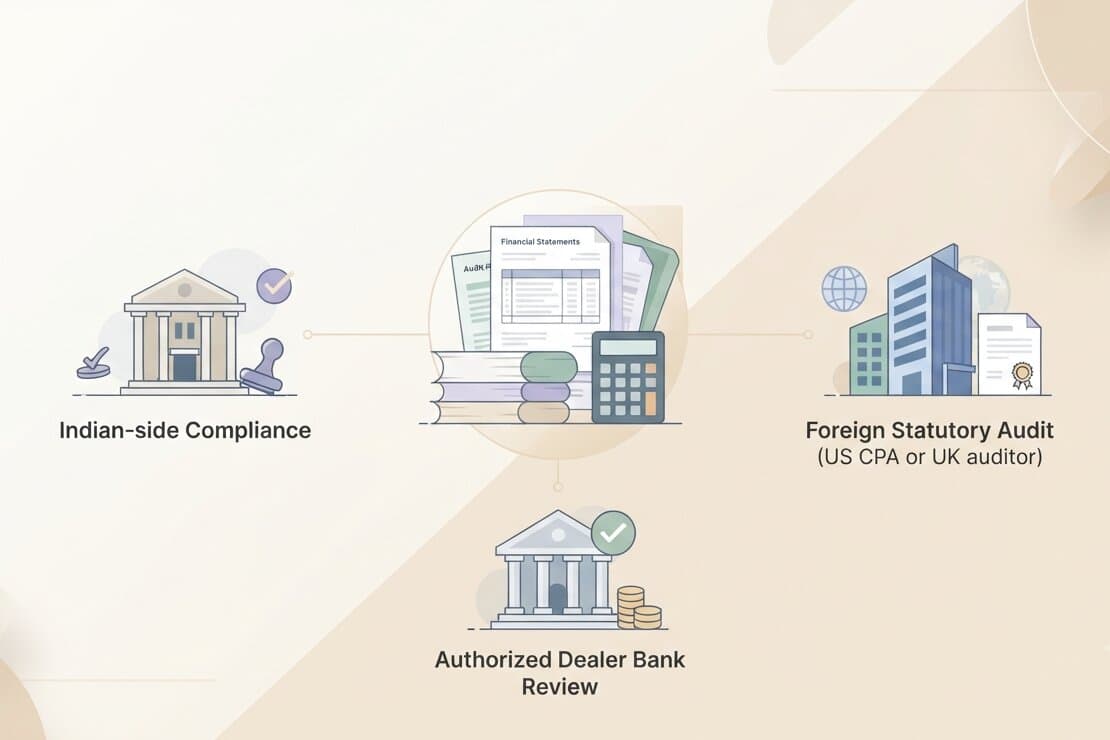
RBI's December 31 deadline applies to the final filing, not to any individual stage within it. Before that date, a business needs to complete an overseas subsidiary audit, reconcile those figures against Indian reporting requirements, obtain Statutory Auditor certification, and route the completed form through its AD Category-I bank. Each of these stages depends on the one before it, which means the effective working deadline for the overseas audit is much earlier than December 31 itself.
Understanding this layered structure is the starting point for planning APR filing for foreign subsidiaries realistically rather than reactively.
Early in the Financial Year: Confirming Scope and Standards
The timeline effectively begins as soon as the previous year's APR is filed. At this stage, businesses should confirm which JVs or WOS will require a filing for the current year and identify the applicable accounting standard for each. A US entity will typically be audited under US GAAP by a US CPA for APR filing, while a UK entity follows UK GAAP or FRS 102 under a UK auditor for APR filing.
Confirming this early avoids a common issue later in the year, where financial statements are prepared under the wrong assumptions and need to be revisited before they can be used for ODI compliance purposes.
Mid-Year: Engaging the Overseas Auditor
Ideally, the overseas subsidiary audit should be engaged well before the second half of the financial year closes. Local audit firms — particularly in the US and UK — often work to their own regional filing seasons, and availability tends to tighten as the calendar year progresses. Starting this engagement mid-year gives enough buffer for the audit to be completed without being rushed against India's own deadline.
This stage produces the audited financial statements that everything else in the APR process depends on, making it the foundation of foreign subsidiary audit compliance for the year.
Third Quarter: Completing the Overseas Audit
By the time the financial year moves into its final quarter, the overseas audit should ideally be complete or very close to completion. This is the point where audited figures — income, expenses, net worth, and investment details — become available for reconciliation against Form ODI Part II requirements.
Delays at this stage have a compounding effect. Every week lost here reduces the time available for reconciliation and certification later, which is why this phase is often the real determinant of whether a business files comfortably or under pressure.
Reconciliation: Translating Overseas Figures into RBI Format
Once the audited financials are in hand, they need to be reconciled against the specific reporting requirements under Form ODI Part II. This includes aligning figures such as net worth, repatriated dues, and investment value with what RBI expects to see, since financial statements prepared under a foreign accounting standard are not automatically formatted the same way.
This step is central to subsidiary compliance reporting and typically takes longer than businesses initially expect, particularly when a company holds multiple overseas entities with staggered audit completion dates.
Statutory Auditor Certification: The Critical Middle Stage
With reconciled figures ready, the Statutory Auditor in India reviews the audited overseas financials and certifies that the reported data is accurate and compliant with the terms of the original ODI approval. This step satisfies FEMA compliance requirements tied to the investment and is a mandatory precondition for submission.
This stage should be scheduled with real lead time, not treated as a quick sign-off. A Statutory Auditor reviewing financials from multiple jurisdictions needs sufficient time to verify each one properly, especially where a business is managing international business compliance across more than one country.
Final Weeks: AD Bank Submission
Once certification is complete, the finalized Form ODI Part II is submitted through the company's designated AD Category-I bank. The bank verifies the documentation against its own records before the filing is considered complete. This stage should not be left for the final days of December, since any discrepancy the bank identifies needs time to be corrected and resubmitted before the deadline passes.
Submitting with a comfortable margin before December 31 — rather than exactly at the deadline — protects against this kind of last-minute correction cycle affecting overseas investment compliance for the year.
What Happens When the Timeline Is Compressed
When any of these stages are compressed, the effects tend to cascade rather than stay contained. A delayed overseas audit shortens the time available for reconciliation. A rushed reconciliation increases the chance of figures not matching between the foreign audit report and Form ODI Part II. A hurried certification increases the risk of the Statutory Auditor missing something that later surfaces as an AD bank query.
None of these outcomes stem from a single point of failure — they are the result of treating a multi-month process as a single year-end task.
Planning APR as a Recurring Annual Cycle
Because this timeline repeats every year for as long as an overseas entity remains active, the most reliable approach is to treat it as a recurring cycle rather than a one-off project. A structured APR audit process — where overseas audit engagement, reconciliation, certification, and submission are each scheduled with realistic lead time — is what keeps annual compliance for foreign subsidiaries manageable year after year, regardless of how many jurisdictions are involved.
Conclusion
The December 31 deadline is only the visible endpoint of a process that begins many months earlier. Overseas audits need time to be scheduled and completed, reconciliation takes longer than it appears on paper, and Statutory Auditor certification is not something to be finalized in the last few days. Businesses that map out this timeline in advance, rather than working backward from the deadline under pressure, are consistently better positioned to complete their foreign investment reporting accurately and on time.