.svg)
.svg)
.svg)
Why Does My AD Bank Keep Rejecting My APR Audit? The Real Reasons, Explained
APR audit rejections explained: see common AD Bank issues with auditor credentials, accounting standards, management accounts, ODI records, UINs, and deadlines.

Accorp Compliance Team
Our team of compliance experts specializes in PCI DSS, SOC 2, and other security frameworks to help businesses achieve and maintain compliance.
A CFO once forwarded me his AD Bank's rejection email with one line above it: "This is the second time. What are we missing?" The audit had already been done. The financials looked fine to his team. The bank still sent it back.
This happens more often than most companies expect, and rarely for the reason people assume. It's rarely about the numbers being wrong. It's almost always about the audit not meeting a specific, technical expectation that RBI has built into the APR process — expectations most finance teams only discover after their first rejection.
The Wrong Person Signed the Report
This is, by a wide margin, the most common reason an AD Bank sends an APR audit back. RBI's requirements are jurisdiction-specific down to the license type, and banks check this closely.
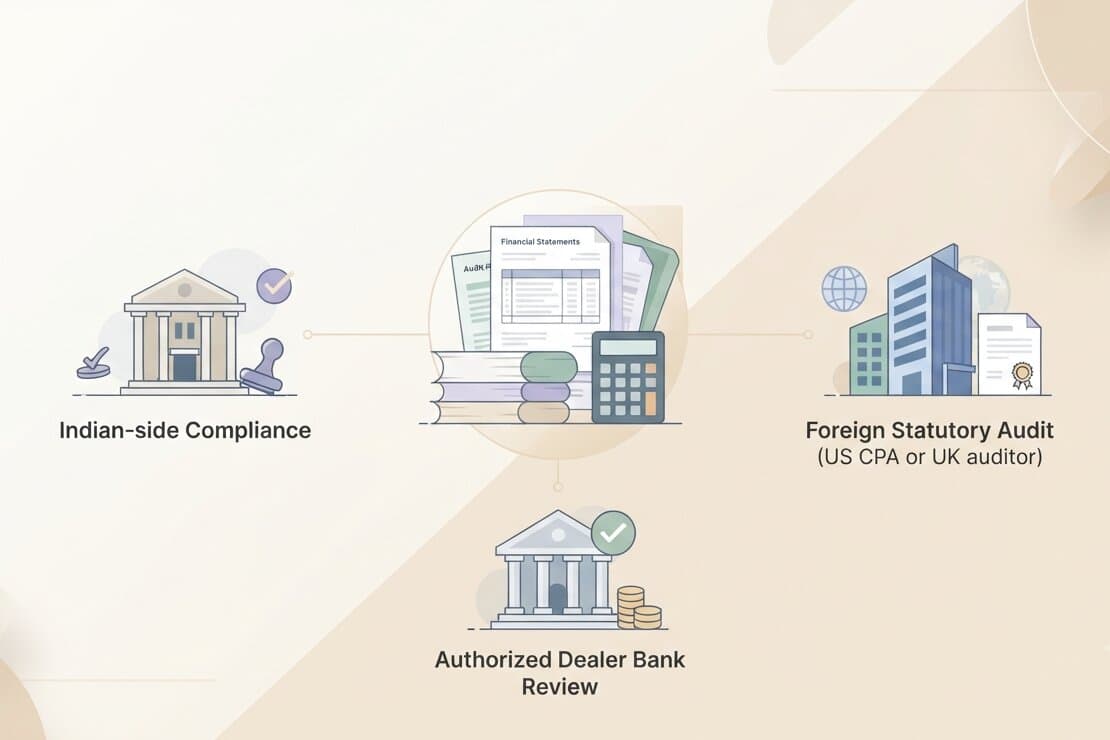
A US subsidiary's financials need a state-licensed CPA's signature. A UK entity needs sign-off from an ICAEW or ACCA member registered with a Recognised Supervisory Body. A Singapore entity needs an ISCA member approved by ACRA. If the signing professional doesn't hold the exact credential RBI expects for that country, the audit gets rejected regardless of how accurate the underlying financials are.
This trips up companies most often when they've engaged a general accountant or a bookkeeper abroad — someone competent at managing books, but not licensed to issue the kind of audit opinion RBI's Master Direction on ODI specifically requires.
The Auditor Wasn't Actually Qualified to Sign for That Jurisdiction
A related but distinct problem: sometimes the right type of professional signs, but not one licensed in the correct country. A US CPA cannot certify a UK subsidiary's accounts. A UK-registered auditor cannot sign off on a Singapore Pte Ltd. Each license only carries authority within its own jurisdiction, and an AD Bank reviewing your submission will check that the auditor's credentials actually match the country the subsidiary operates in.
Companies running subsidiaries in more than one country are especially exposed here — it's an easy mix-up when three separate engagements are being coordinated at once, and the wrong report gets paired with the wrong entity during a rushed December submission.
The Financials Weren't Prepared Under the Host Country's Own Standards
Audited financials for APR purposes need to follow the accounting standards of the country where the subsidiary is based — not Indian standards, and not a generic international format. A US entity's financials should follow US GAAP. A UK entity follows UK GAAP (FRS 102 or FRS 105). A Singapore entity follows SFRS(I).
An AD Bank reviewing financials prepared under the wrong framework — or under a framework that doesn't map cleanly to what RBI expects to see — will send the audit back for correction. This is a subtler rejection reason than the signature issue, but it happens regularly with auditors who aren't specifically experienced in preparing statements for RBI-facing filings, even if they're otherwise competent in their home jurisdiction.
Management Accounts Were Submitted Instead of a Real Audit Opinion
This is one of the costlier mistakes companies make under deadline pressure. Submitting draft or management accounts — figures the company itself prepared, without the auditor's formal review or audit opinion attached — gets rejected outright. In more serious cases, RBI treats this as a red flag serious enough to trigger scrutiny under FEMA compounding provisions.
The distinction matters: management accounts show what the company believes its numbers are. An audit opinion shows that an independent, licensed professional tested those numbers and is willing to formally attest to them. Only the second one satisfies RBI's requirement.
The Numbers Don't Reconcile With Your Original ODI Records
Even a properly signed, correctly framed audit can get bounced if the figures don't line up against what RBI already has on file — your original investment amount, your shareholding percentage, any loans or guarantees extended to the subsidiary. A shareholding percentage that's drifted since the last filing, or an intercompany loan that was never properly documented on the Indian side, creates exactly the kind of mismatch that triggers an AD Bank query.
This reconciliation step is easy to underestimate because the audit itself can be flawless while the surrounding paperwork tells a slightly different story. Banks are specifically trained to catch this kind of inconsistency, because it's one of the more common ways ODI reporting quietly drifts out of alignment over several years.
The UIN Doesn't Match Across Documents
Every ODI investment carries a Unique Identification Number allotted by RBI at the initial approval stage. If that 13-digit alphanumeric UIN doesn't match exactly across the APR form, the audited financials, and RBI's own records — even a single transposed digit — the submission gets flagged. This sounds minor, but it's a genuinely common rejection reason, especially in companies where the person filing this year wasn't involved in the original ODI approval and is working from incomplete historical records.
The Financial Year Mismatch Wasn't Handled Correctly
A foreign subsidiary running a different financial year than India's April-to-March cycle isn't automatically a problem — RBI has a defined process for it. But companies that don't follow that process correctly run into trouble. If unaudited figures were submitted as an interim measure, the audited version still needs to follow within six months of the subsidiary's year-end, or by the following December 31, whichever comes first. Missing that follow-through, or submitting the audited version in a format that doesn't clearly link back to the earlier interim submission, is a frequent source of confusion at the AD Bank's end.
What a Rejection Actually Costs You
The real damage from a rejection isn't the rejection itself — it's the time lost fixing it against a fixed deadline. If your AD Bank rejects a submission on December 20, there's very little runway left to re-engage an auditor, get a corrected report issued, and resubmit before December 31. This is exactly why the most experienced approach isn't reacting to a rejection quickly — it's structuring the audit engagement from the start in a way that avoids these specific triggers altogether.
Getting the Audit of Your Foreign Subsidiary Right the First Time
Every reason on this list traces back to the same root issue: treating the foreign subsidiary audit as a generic accounting exercise rather than a specific, RBI-facing compliance requirement with its own rules about who signs, what standards apply, and how the numbers need to be reconciled. Companies that engage the right licensed professional for the right jurisdiction, insist on a full audit opinion rather than draft figures, and reconcile carefully against their original ODI records before submission are the ones whose APR clears on the first pass — not the second, and not the third.
Where Accorp Fits Into This
Every rejection reason above — the wrong signature, the wrong jurisdiction, the wrong accounting framework, a reconciliation gap — comes from the same root cause: pulling together an audit engagement piecemeal, often under deadline pressure, without one team managing the whole picture. Accorp Partners runs this differently, with in-house CPA, ICAEW, and ISCA-qualified professionals across the US, UK, and Singapore, plus the India-side FEMA filing handled under the same roof. The reconciliation between the foreign audit and your ODI records, the UIN matching, the Indian CA review — all of it happens inside one coordinated engagement, which is exactly the part that tends to break down when companies are managing separate vendors on their own. If your APR has been rejected before, or you'd rather not find out the hard way this year, that's the gap Accorp is built to close.
Frequently Asked Questions
Q1. My audit is done, and the financials are accurate — why did the AD Bank still reject it?
It's usually not the numbers. The most common cause is the signature — the auditor wasn't licensed for that specific jurisdiction (a state-licensed CPA for the US, ICAEW/ACCA for the UK, ISCA for Singapore), or held the right license but in the wrong country.
Q2. Can I submit management accounts if the audit opinion isn't ready in time?
No — this gets rejected outright, and in serious cases can trigger scrutiny under FEMA compounding. An AD Bank needs a formal audit opinion, not figures the company prepared itself, however accurate they look.
Q3. What actually happens if my APR gets rejected close to December 31?
The real cost is time, not the rejection itself. A rejection on, say, December 20 leaves very little runway to re-engage an auditor, get a corrected report, and resubmit — which is why structuring the engagement correctly upfront matters more than reacting quickly afterwards.