Your Foreign Subsidiary Raised Funding and Your Stake Fell: Do You Still File the APR?
Your stake in a foreign subsidiary fell after a funding round. Do you still need APR filing? Learn what ODI dilution means and what to report to your bank.

Accorp Compliance Team
Our team of compliance experts specializes in PCI DSS, SOC 2, and other security frameworks to help businesses achieve and maintain compliance.
Yes, in most cases you still file the Annual Performance Report. A fall in your percentage does not end your investment, and the APR follows the investment, not the majority.
Picture the scene. The round closes, the new investors join the cap table, and your Indian company drops from 100% to 41% of its US entity. Then your bank emails asking for the APR. It is easy to think the subsidiary is no longer really yours, so the report must no longer apply. This guide shows why that thinking usually fails, how each stage of dilution changes your position, and what to do in the 30 days after closing. It also explains how APR filing for foreign subsidiaries keeps running through a funding year.
Five Myths About APR After Stake Dilution
Myth | What is actually true |
"We own less than half, so it is no longer our subsidiary and no APR is due." | Subsidiary status and ODI status are different tests. For an unlisted foreign company, your equity is generally still an overseas direct investment, and the UIN attached to it continues. |
"Under 10% means it is not an ODI." | The 10% test applies to listed foreign companies. A typical startup subsidiary is unlisted, so size alone does not switch the obligation off. |
"We will mention the round in the next APR." | Report the change to your authorised dealer (AD) bank first. The APR confirms the new position later. |
"Dilution and disinvestment are the same thing." | Dilution is new shares issued to others. Disinvestment is you selling your own shares, with its own pricing and proceeds conditions. |
"We no longer control it, so nobody will ask about audit." | The bank may expect lighter documentation for entities you no longer control, but the numbers must still tie to the foreign entity's accounts. Confirm what applies to you. |
Thresholds and conditions under India's overseas investment rules have been revised before. Check the current directions and your bank's reading of them before you rely on any row above.
Your Stake, Your Status: A Stage-by-Stage View
Control matters under the rules, but it answers different questions from whether you file. It affects how the foreign entity is classified, what the bank expects to see, and which limits apply to further investment. Control is read broadly: board appointment rights, voting arrangements and the power to steer management all count, so you can hold under half the shares and still have control. If the entity later sits below another foreign company, read our note on step-down subsidiaries.
Here is how a typical journey looks for an Indian company that starts with 100% of a US subsidiary.
Stage | Your stake | Control | ODI and UIN | What you do |
Before the round | 100% | Whole board | Continues | File the APR as usual |
Seed round | 70% | Board majority | Continues, still a subsidiary | Report the change, then file the APR |
Series A | 38% | One of five board seats | Continues, no longer a subsidiary in the ordinary sense | Report the change, APR shows 38% |
Exit | 0% | None | Ends once closed out with the bank | Report as disinvestment and handle the proceeds |
The filing did not stop at any point because the percentage fell. At exit, the money is a separate topic: see our guide to the repatriation of overseas proceeds and profits.
The Audit and the Numbers Behind the APR
The APR is only as reliable as the financial statements behind it, so foreign subsidiary audit compliance deserves early attention in a funding year. Three points tend to cause trouble.
First, the audit requirement can depend on your holding and control position, so ask your bank what applies after the round. Second, new investors often want audited US GAAP accounts on their own schedule, which may not match the December APR deadline. Third, if the foreign entity's year-end is not 31 March, plan the calendar early using our guide on APR audits when the financial years differ.
For a walk-through of how the certification works in practice, see the APR audit process under FEMA and ODI. Even low-activity entities get questions here, as explained in our note on dormant subsidiaries and APR certification.
One set of numbers should agree everywhere: your APR, the foreign entity's share register, and your own books. If your APR shows 38% and the register shows 36% after an option pool top-up, expect questions.
Who Does What: Indian CA and US CPA
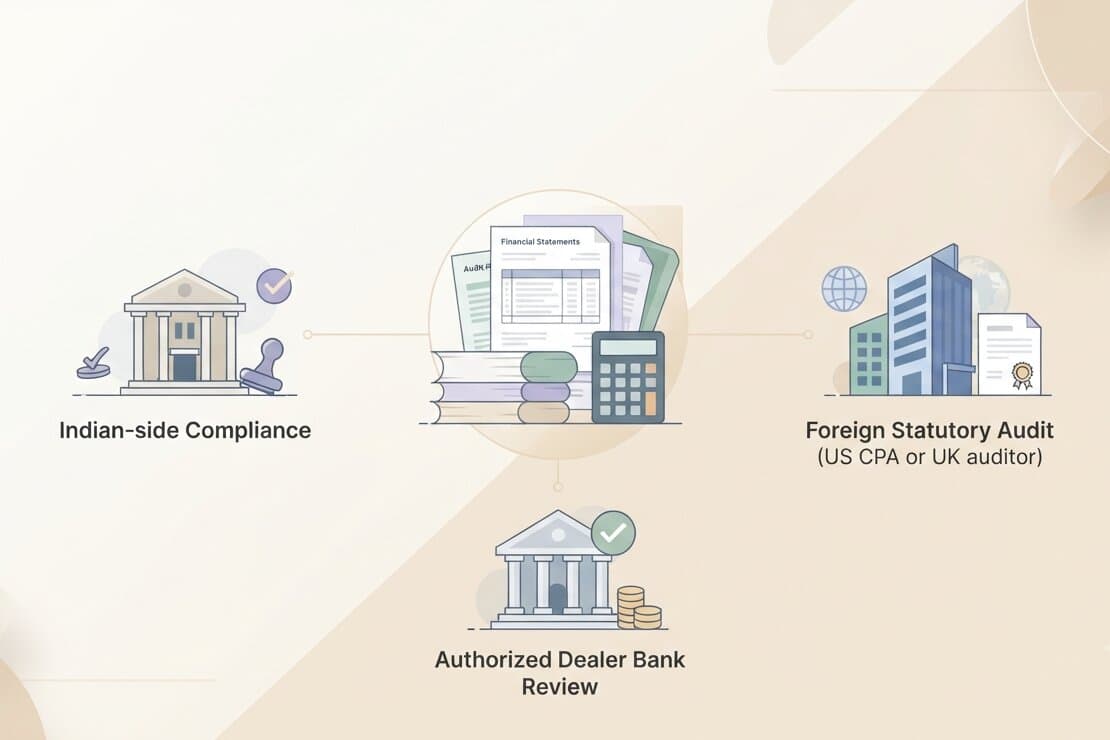
APR filing sits between two countries. Your Indian advisor knows FEMA and the AD bank process. The foreign entity's records and audit sit in the US. A US CPA for APR filing support closes that gap.
Task | Indian CA / FEMA advisor | US CPA |
Report the dilution to the AD bank | Leads and files | Supplies cap table and share documents |
Foreign entity financial statements | Confirms what the bank needs | Prepares US GAAP accounts |
Audit coordination | Checks timing against the APR deadline | Coordinates the audit |
Reconcile holding to the register | Checks it against the APR | Confirms option pool and new issuances |
US tax filings | Checks consistency with Indian reports | Prepares and files |
What Else Changes When Your Stake Falls
The APR is one consequence among several. Moving from subsidiary to associate or financial investment changes how the Indian company consolidates, so tell your auditor when the shift happened. Associated-enterprise status turns on shareholding and control tests, so review each transaction with the foreign entity for transfer pricing instead of assuming. Pro-rata rights, follow-on investments and guarantees are measured against the overseas investment limits, and loss of control may change which route is open. Your US-side position also changes, so keep your US tax filings consistent with what you report in India.
The two annual filings are also easy to mix up. Read APR vs the FLA return so you file the right one.
Your First 30 Days After the Round Closes
Days 1 to 3: fix the facts. Get the updated cap table and signed share documents. Record the closing date, the shares issued, your old and new holding, and any board or voting changes.
Days 4 to 10: tell the bank. Write to your AD bank with the change and ask which form and timeline it expects, as practice varies.
Days 10 to 20: keep the paper. File the term sheet, subscription agreements, share certificates and any waiver of pre-emption or pro-rata rights.
Days 20 to 30: line up the numbers. Ask the foreign entity's accountants for year-end statements early, confirm the register matches your holding, and brief your auditor and transfer pricing advisor.
Then calendar 31 December. That is the general APR due date. Confirm it against the current directions.
If you miss a step, regularise as early as you can. A gap around a funding round looks worse in due diligence than gaps elsewhere because the event is so visible.
Bottom Line
A lower stake is good news for the business and no excuse for skipping the filings. In nearly every case, the APR continues until the investment itself ends. The work in a funding year is to report the change cleanly and keep the numbers consistent across your bank filing, the foreign entity's books and its share register.
Raised a round and unsure where your APR stands? Talk to Accorp Partners about APR filing India support and FEMA compliance. If you are still deciding how to hold the structure, start with Indian parent vs US parent.